
March 16, 2024 - PBS News Weekend full episode
3/16/2024 | 26m 44sVideo has Closed Captions
March 16, 2024 - PBS News Weekend full episode
Saturday on PBS News Weekend, we examine the safety and reliability of helicopters after a string of fatal crashes. Then, the myth of plastic recycling and how the plastics industry knew for decades that it wasn’t a viable solution. Plus, the human implications of a shark conservation success story off the coast of Cape Cod.
Problems playing video? | Closed Captioning Feedback
Problems playing video? | Closed Captioning Feedback
Major corporate funding for the PBS News Hour is provided by BDO, BNSF, Consumer Cellular, American Cruise Lines, and Raymond James. Funding for the PBS NewsHour Weekend is provided by...
Support provided by:

March 16, 2024 - PBS News Weekend full episode
3/16/2024 | 26m 44sVideo has Closed Captions
Saturday on PBS News Weekend, we examine the safety and reliability of helicopters after a string of fatal crashes. Then, the myth of plastic recycling and how the plastics industry knew for decades that it wasn’t a viable solution. Plus, the human implications of a shark conservation success story off the coast of Cape Cod.
Problems playing video? | Closed Captioning Feedback
How to Watch PBS News Hour
PBS News Hour is available to stream on pbs.org and the free PBS App, available on iPhone, Apple TV, Android TV, Android smartphones, Amazon Fire TV, Amazon Fire Tablet, Roku, Samsung Smart TV, and Vizio.
Providing Support for PBS.org
Learn Moreabout PBS online sponsorshipJOHN YANG: Tonight on PBS News Weekend, after a string of fatal helicopter crashes, we examine their safety and reliability, then the myth of plastic recycling, how the plastics industry knew for decades, it was not a viable solution.
And off the coast of Cape Cod, a conservation success story with human implications, a surge in sharks creeping closer to the shore.
MAN: Cape Cod exploded as an area that draws people to enjoy this environment.
And so now, the predator is coming back to feed on its prey, but it's overlapping with human activities and certainly humans are not used to that, but they're coming to grips with it.
(BREAK) JOHN YANG: Good evening, I'm John Yang.
Tonight nearly a million and a half.
Gazans are sheltering of the southern city of Rafah, the last remaining haven on the Gaza Strip, as Israel moves towards sending ground forces into the city.
Across northern Gaza There were more airdrops of aid from the United States Jordan and Germany.
The UN says a quarter of the population of Gaza is starving.
And some say the aid isn't enough.
ZAHR SAQR, Khan Younis Resident (through translator): The situation is so bad that no one can imagine it.
And the ship even if it helps will be a drop in the ocean.
Because the entire region is in need.
They throw us air drops of aid and we run like dogs behind the air drops.
JOHN YANG: In Central Gaza, Israeli bombs were also delivered by plane.
Gaza hospital officials say about 20 people were killed overnight in Israeli strike in a refugee camp.
They said nearly half of them were children.
Talks aimed at a deal for the release of Israeli hostages in exchange for Palestinian prisoners are expected to resume tomorrow in Doha, Qatar.
Hamas has proposed an eventual permanent ceasefire, something that Israeli Prime Minister Benjamin Netanyahu says he is out of the question.
Police are surrounded a home in Trenton, New Jersey at this hour where a 26-year-old shooting suspect has barricaded himself.
Trenton Police say the residents of the home have been evacuated.
The suspect is armed with an AR-15 style long gun and is believed to have killed at least three people in Falls Township, Pennsylvania, a suburb of Philadelphia.
There was a Shelter In Place order but it's been lifted.
Police said the suspect knew his victims and that the shooting was the result of a domestic situation.
There's been another incident involving a Boeing jetliner, an older United Airlines 737 landed safely in Oregon on Friday minus a large external panel along the planes belly.
There were no indications of trouble during the flight and the missing panel was only discovered during a post flight inspection.
Both United and the FAA are investigating.
In Russia, protests on the second day of voting and the country's three-day presidential election, protesters tried to set fire to voting booths and poured green dye into ballot boxes.
At least a half dozen cases of vandalism have been reported at polling stations and supporters of the late opposition leader Alexei Navalny tried to undermine President Vladimir Putin is hold on power.
Putin is facing no serious challenges and is almost certain to win another six-year term.
Meanwhile, in Belgorod, Russian officials say Ukrainian shelled the border city killing two people.
And more Americans are tying the knot.
The CDC says marriages are back to pre-pandemic levels.
During the COVID-19 isolation marriages dropped to the lowest level since 1963.
But despite this uptick marriages in the United States remain in a decades long decline.
Still to come on PBS News Weekend, the problems with plastic recycling and how plastic makers knew it wouldn't work and tracking the surge in sharks off the Cape Cod coast.
(BREAK) JOHN YANG: Late last month, the head of a Nigerian bank, his wife, son, and three others were killed when the helicopter taking them to Las Vegas, crashed in California's Mojave Desert.
Also late last month, the Army National Guard temporarily halted all its helicopter operations after fatal crashes in Utah and Mississippi, and that followed the Army's temporary grounding late last year of its Osprey aircraft which can function as a helicopter.
These incidents and recent high profile accidents like the one that killed basketball star Kobe Bryant and his daughter in 2020 and 2019 tour helicopter crash in Hawaii that killed seven raise questions in people's minds about the safety of helicopters.
John Goglia is a former member of the National Transportation Safety Board and former chair of the National Coalition for Aviation Education.
John, we may be seeing a lot more helicopters as air taxis are being developed as soon as next year.
Quite simply, our helicopter safe?
JOHN GOGLIA, Former Member, National Transportation Safety Board: Helicopters in the vehicle itself is very safe.
What we're seeing today is a lot of issues with we have pilot issues, and maybe not monitoring their operations well enough.
You know, you mentioned two accidents in Nigeria and fella who died.
And Kobe Bryant.
Both of those were helicopter pilots that disregarded weather cues in order to accomplish the mission.
And that self-imposed pressure that they have on themselves to get the mission done.
Oftentimes, it's the driver behind the event that leads to a crash.
JOHN YANG: In those military ground as we talked about what they call stand downs.
Those were to -- make sure that the crews the pilots understood the operating guidelines, or were they worried about the craft themselves?
JOHN GOGLIA: Most of the time, the craft is pretty reliable.
And there's been a few instances where there was a mechanical problem.
But the real issue is the pilots.
Usually that single pilot operations, especially in the military, let's get it done.
Got a mission to do, I'm going to get it done.
Well, when you're not in a war zone, you have a lot more flexibility.
But sometimes it's difficult for people to separate those two events.
JOHN YANG: Pilot error is more difficult or helicopters trickier, more difficult to fly than fixed wing aircraft?
JOHN GOGLIA: Helicopters require a lot of concentration.
In an airplane, oftentimes, with the automation that's in there that you don't have to focus as much helicopters, you have to maintain your focus from beginning to end.
And so sometimes people will lose their focus and when the consequences are severe.
JOHN YANG: And is there a narrower margin of error with a helicopter than a fixed wing aircraft?
JOHN GOGLIA: Yes, but if you're talking about the pilot, is its concentration that is has to be maintained, you know, and the helicopter industry themselves has taken a page out of the commercial aviation playbook with their safety themes, and really driving down analyzing virtually every mishap that happens, and looking at the cause, and identifying that the pilots are flying today.
So, getting caught up in bad weather.
That's a major contributor to helicopter accidents, fatigue on the part of the pilots, which leads to that lack of concentration, that's a major factor in accidents.
JOHN YANG: Can that problem be addressed with regulations or guidelines about training about recertification?
JOHN GOGLIA: Helicopter industry has a very robust set of regulations, you know, if the pilots not going to follow the guidelines for whether, you know, sooner or later that's going to lead to a bad outcome.
That's not a regulation issue.
That's -- that individual pilot issue.
So I don't know that at this point in time we need additional regulations.
But we need to have a very robust training program which the industry themselves is pushing for, and audit to make sure that the pilots don't lose sight of the fact that they need to maintain their skills and their attention to accomplishing the job not just getting the mission done.
JOHN YANG: Is the pipeline for helicopter pilots with those skills that concentration, that ability to safely fly a helicopter?
Is that big enough?
Or is that is there a supply problem?
JOHN GOGLIA: Is there is a bit of a supply problem, because most of them come out of the military and the military is having problems building their own pilots so that they're not letting them out so much so to speak, that providing additional bonuses to keep them in the military because training takes a lot of resources, a lot of money to train a pilot.
There are commercial trainers, but they're only a fraction compared to what the military supplies.
JOHN YANG: Most people's experience with helicopters these days really is probably sightseeing tours like over Hawaii, the Grand Canyon, a tourist out there about to get on a helicopter.
We're thinking about taking one of these tours, what would you say to them?
JOHN GOGLIA: Well, I've taken them myself.
So I don't think they're particularly dangerous.
But there are certain pilots that like to give the people that are on that helicopter, the thrill of the adventure and I have been on some of those helicopters to an unannounced that I've had throwing rides.
And again, it's up to the individual because he's alone.
He doesn't have the company's representative over his shoulder.
He doesn't have the FAA looking at him until it's something bad happens.
So yes, you need to be concerned, and sometimes, you need to have a conversation if you're chattering a helicopter, that what you expect from that pilot.
So if, you know, if you have it beforehand, say if the weather gets bad, I don't mind if we don't go, you know, so make sure they understand that this is a mission critical.
I don't have to accomplish this, this task getting me from point A to B, that it's okay that we don't go.
JOHN YANG: John Golia, former member of the NTSB.
Thank you very much.
JOHN GOGLIA: Thank you for having me.
JOHN YANG: On average, the world produces 430 million metric tons of plastic every year.
The United States alone produces 10s of millions of tons of plastic waste annually.
Yet on average, in the United States, only about five to 6 percent of plastic is recycled.
Ali Rogin digs into a new report covering the plastic industries, tactics to push recycling and avoid regulation.
ALI ROGIN: A new report by the Center for Climate Integrity and environmentalist group says newly uncovered statements from oil and plastics executives underscore the industry's decades long secret skepticism about the viability and efficacy of recycling.
The authors of the report reviewed old investigations and new documents, including previously unknown assertions from industry executives.
In 1994, one Exxon chemical executive put the industry support for plastics recycling in blunt terms, saying, quote, we are committed to the activities, but not committed to the results.
Another representative from DuPont noted in 1992, that recycling goals were set, knowing full well quote, they were unlikely to meet them.
Michael Copley is a correspondent covering climate issues for NPR.
Michael, thank you so much for joining us.
Some of these quotes that are in this report are very blunt, they might be shocking to some but you've been covering these issues for a long time.
Were you surprised by anything that's in this new report?
MICHAEL COPLEY, NPR Correspondent: Yeah, I think what's in the report echoes a lot of what we've been seeing from previous investigations, and that is that the plastics industry pushed recycling as a solution, even though industry officials have known for a long time that it wasn't going to be viable at scale, or that they had serious doubts about its ability to be viable at scale.
What we've seen is that they really looked at recycling as a way to kind of fend off regulation, and to keep selling more plastic.
And so we've known about that.
I think it's always striking when you see a report like this that honors, new statements, new quotes, and to see the way in which they really seem to view recycling as sort of, you know, a public relations tool, as opposed to an environmental tool that they sort of presented publicly.
ALI ROGIN: Many of the most eyebrow raising quotes from this report are 10, 20, even 30 years old, if they're so old, why should we be paying attention than today?
MICHAEL COPLEY: So right now what the industry is saying is the focus on these comments doesn't accurately reflect where the industry is today.
And so what's asking for is sort of the public to trust it, that it's working on this new technology that is going to solve the problem of plastic waste now.
And I think that the historical record sort of undercuts public trust in the industry and raises questions about those assertions now.
I think the other reason why this matters is it could potentially be legally problematic for the industry.
And by that I mean, the oil and gas industry right now is facing dozens of lawsuits from states and localities, based in part on statements it made about climate change and fossil fuel going back decades.
We know that the state of California has opened an investigation into the role of oil and gas companies in the petrochemical industry, in kind of the creation of the plastic waste crisis that we're facing.
And the group that put out the report and Center for Climate Integrity was upfront, saying that it was compiling this to serve as kind of the fact basis or the basis of evidence for potential legal action.
ALI ROGIN: I want to read a response we got from a plastics trade group called America's Plastic Makers.
Their President accused this report and the authors of it of citing quote outdated decades old technologies, and says it's mischaracterizing the current state of the industry as you were just talking about.
This group also says that plastic makers are looking to have all plastic packaging be, quote, reused, recycled and recovered by 2040.
So you just mentioned this, but where does plastics recycling technology stand right now how advanced is that technology?
MICHAEL COPLEY: So the industry has present Advanced recycling chemical recycling as a real solution.
There is deep skepticism of it.
And not just from sort of environmental sealed, who you'll talk to but, you know -- ALI ROGIN: Right.
And I should note, Michael, that advanced recycling is actually a term of art that is used among the plastics industry to describe the current state of this recycling.
MICHAEL COPLEY: Yeah, that's right.
And so as opposed to sort of traditional mechanical recycling, what they're doing now is turning plastics, sort of back into liquids and gases to sort of reuse.
The skepticism comes from questions about anything about the economics of recycling changed.
If in the past, it was cheaper to make new plastic, why is that not still the case, especially when you see low oil and gas prices, and the other piece of it is plastic degrades over time.
And so what scientists say is there are just limits to how many times you can reuse plastics.
So there is deep skepticism.
ALI ROGIN: What does your reporting say about this claim that all plastics will be recyclable by the year 2040?
MICHAEL COPLEY: Obviously, the industry has put out this promise, I think that its critics will say we have been hearing these promises or promises like it for decades now.
And that there is nothing in the record to think that now is any different.
ALI ROGIN: Is there a solution here that climate activists and environmental experts agree on that that actually includes recycling?
Or is there a consensus among that side of the issue that stakeholders need to be looking at solutions, beyond recycling, that recycling is not the be all end all to avert the climate crisis that experts will point to and say we're in.
MICHAEL COPLEY: There's a recognition that plastic is so engrained in modern life, and it plays important roles in medical devices and other things, that it's almost impossible to envision a world where we move completely beyond plastic.
I think what people are talking about is reducing plastic production to a level that is more manageable with kind of recycling systems, getting rid of types of plastic that are especially hard to recycle, you can't recycle, being more transparent about what chemicals go into this stuff that again, make recycling hard, but it really does come down to when you talk to not just activists, but also businesses, increasingly, that regulation is going to play a big role.
And so that, you know, there was a hearing in the Senate and the head of SC Johnson, A big consumer goods company, said something to the effect of we need government regulation.
Businesses can't do this on their own.
And I think, you know, again, that gets back in large part to the economics of this if companies don't have to deal with these costs.
It's hard to imagine that they will in sort of a sustained way, create systems to deal with this if they don't have to.
ALI ROGIN: Michael Copley, correspondent covering climate issues for NPR, thank you so much for breaking this down for us.
MICHAEL COPLEY: Thanks Ali.
JOHN YANG: Environmental efforts to protect sharks in recent years has resulted in a huge increase in the great white shark population off the New England coast.
It's a conservation success story, with potentially unnerving implications for beach goers.
David Wright of Rhode Island PBS Weekly went out with one conservation group, which is tracking the rise of the world's biggest known predatory fish.
DAVID WRIGHT (voice-over): Just when you thought it was safe to go back in the water.
MAN: It's not that little.
DAVID WRIGHT (voice-over): Comes up pointed reminder that you might want to think twice at least in Cape Cod.
DAVID WRIGHT: I guess the headline is, there are lots of sharks here more than we thought.
MEGHAN WINTON, Atlantic White Shark Conservancy: Yes.
DAVID WRIGHT (voice-over): Meghan Winton of the Atlantic white shark Conservancy is one of the authors of a new study documenting a surge in the population of great white sharks here in recent years.
DAVID WRIGHT: And what's your best testimony?
MEGHAN WINTON: So the best estimate is over that four-year period that 800 individual white sharks visited the waters off of Cape Cod.
DAVID WRIGHT (voice-over): She and her colleagues have spent years patrolling these waters tracking every shark they encounter.
They recently let us tag along.
MEGHAN WINTON: We did just get one.
Okay, so it says white shark spotted 100 yards off southern most part of Nasik ORV.
DAVID WRIGHT (voice-over): Overhead they have a spotter plane the pilot Wayne keeps a sharp eye.
On the boat, they have underwater cameras and microphones and a ready supply of these things.
MEGHAN WINTON: It's just kind of like an easy pass for sharks.
The simplest way to explain it.
DAVID WRIGHT: You're charged call.
MEGHAN WINTON: We should start.
DAVID WRIGHT (voice-over): A radio beacon with batteries that last 10 years.
Every time a tag shark swims past one of these yellow buoys it sends out a ping you conservancy relies on citizen sightings to from a growing number of eco tour boats.
DAVID WRIGHT: You got to see some?
MAN: Yeah.
WOMAN: Yeah, I saw one.
Supper shallow here.
I saw 14 feet it wasn't tagged.
DAVID WRIGHT (voice-over): People on that boat tell us they us they saw a 14 footer here moments ago.
Every sighting from people or pings gets relayed to an app you can download, sharktivity.
They've identified more than 600 individual sharks here over the past 10 years.
DAVID WRIGHT: As I bet your app is fairly popular among beachgoers.
MEGHAN WINTON: I mean, I'd like to think so it is.
It's been downloaded over 100,000 times at this point.
And it's a great platform for us to report sightings.
Oh, we're out on the water for eco tour boats to report sightings and for anybody.
DAVID WRIGHT (voice-over): It may come as a surprise to know that nearly 50 years ago, when Steven Spielberg scared the pants off just about everybody with his iconic movie about sharks in this part of the Atlantic.
The population of great whites here was in danger of dying out.
MAN: You're going to need a bigger coach.
DAVID WRIGHT: Greg Skomal was still in grade school when Jaws came out.
The movie caught his imagination in the best possible way.
GREG SKOMAL, Director, Massachusetts Shark Research Program: I was motivated by the scientist in the film, as were a lot of colleagues of mine at the time to become sharp biologists, you know, so as a young kid watching that, I was thinking, wow, this is a really cool job.
DAVID WRIGHT (voice-over): Skomal has personally tagged more than 300 sharks, fulfilling his dream at a time when Cape Cod is finally beginning to see the dividends of decades of marine conservation efforts.
Over the last 50 years, the Marine Mammal Protection Act gradually helped bring back the seals and the sharks who prey on them.
GREG SKOMAL: We think about it in the time that both sharks and seals were gone, you know, Cape Cod has exploded as an area that draws people to enjoy this environment.
And so now, the predators coming back to feed on its prey, but it's overlapping with human activities.
And certainly humans are not used to that.
And so you know, but they're coming to grips with it.
DAVID WRIGHT (voice-over): The team deploys a drone for a bird's eye view of the water.
What they tend to find is that the sharks spend about half their time and water that's less than 15 feet deep.
MEGHAN WINTON: We've got the seals which love the beautiful beaches of Cape Cod, so do people and the sharks are coming in close to shore to hunt for seal.
So there is an overlap of these three species.
MAN: It has a tag.
DAVID WRIGHT (voice-over): finally, late in the day, a bonafide sighting.
Greg Skomal climbs out onto the pulpit, like a friendly Captain Ahab, armed, not with a harpoon, but a GoPro camera.
A 14 footer, a teenager, not yet fully grown.
Great white sharks are four feet long when they're born, they can grow up to 20 feet long their lifespan more than 70 years.
GREG SKOMAL: So that shark right there is one that we tagged a few weeks ago, you know, right in this exact same area.
So clearly, he's been sticking around.
And I think the only reason they stick around is if they're successfully feeding, because no point in staying in an area where you're not having any success.
DAVID WRIGHT (voice-over): Most of the regulars have nicknames, not this one yet.
DAVID WRIGHT: Who gets to name it?
MEGHAN WINTON: We've got a donor in the queue, who gets to name that shark, and that program helps us fund the cost of research trips.
DAVID WRIGHT: So you contribute a little to the work that you guys are doing.
MEGHAN WINTON: Yes.
Yes.
DAVID WRIGHT: And you got to name a shark.
MEGHAN WINTON: Exactly.
It's a pretty cool thing.
DAVID WRIGHT: How much is sharks name go for these days?
MEGHAN WINTON: $2,500.
DAVID WRIGHT (voice-over): That nickname will pay for another day out on the water like this one.
For PBS News Weekend, I'm David Wright in Chatham, Massachusetts.
JOHN YANG: And finally, tonight, how do you apparent a rescued newborn fox?
Well, if you're at the Richmond Virginia Wildlife Center, you wear a Fox mask.
Because the goal is to reintroduce the kid into its natural habitat, she needs to keep a healthy fear of people.
So the masks keep it from becoming too attached to its human caretakers.
They also try not to speak while they're with her and have given her a stuffed animal to try to make her feel like she's with her real mother.
This newborn Fox arrived at the Wildlife Center a few weeks back after a Richmond man mistook it for a kitten and turned her over to a local humane shelter.
The Richmond Wildlife Center was founded in 2010 to provide veterinary care for all animals in the area and operates solely on donations.
Right now on the PBS NewsHour YouTube channel, the challenges of getting aid into Gaza as the humanitarian crisis there worsens.
All that and more is on the official PBS NewsHour YouTube channel.
And that is PBS News Weekend for this Saturday.
On Sunday, concerns about the recent decline in support for LGBTQ rights, reversing years of increasing support.
I'm John Yang.
For all of my colleagues, thanks for joining us.
See you tomorrow.

Aviation expert weighs in on the safety of helicopters
Video has Closed Captions
Are helicopters safe? Aviation expert weighs in on factors behind notable crashes (6m 4s)
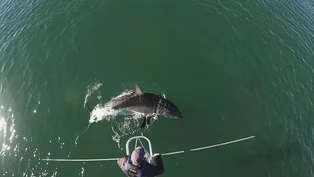
Conservationists track surge in sharks off Cape Cod’s coast
Video has Closed Captions
Conservationists track surge in great white sharks off the coast of Cape Cod (5m 56s)
Plastic industry pushed myth of recycling, new report finds
Video has Closed Captions
The plastic industry knowingly pushed recycling myth for decades, new report finds (6m 32s)
Providing Support for PBS.org
Learn Moreabout PBS online sponsorship
- News and Public Affairs

FRONTLINE is investigative journalism that questions, explains and changes our world.

- News and Public Affairs

Amanpour and Company features conversations with leaders and decision makers.












Support for PBS provided by:
Major corporate funding for the PBS News Hour is provided by BDO, BNSF, Consumer Cellular, American Cruise Lines, and Raymond James. Funding for the PBS NewsHour Weekend is provided by...