
January 1, 2024 - PBS NewsHour full episode
1/1/2024 | 57m 46sVideo has Closed Captions
January 1, 2024 - PBS NewsHour full episode
Monday on the NewsHour, Israel's Supreme Court strikes down a controversial overhaul of the nation's judiciary, a blow to the prime minister already facing scrutiny amid the war. An investigation finds auditors overlook child migrants being put to work in unsafe and illegal conditions. Plus, the consolidation of healthcare services into corporate hospital systems drives some doctors to unionize.
Problems playing video? | Closed Captioning Feedback
Problems playing video? | Closed Captioning Feedback
Major corporate funding for the PBS News Hour is provided by BDO, BNSF, Consumer Cellular, American Cruise Lines, and Raymond James. Funding for the PBS NewsHour Weekend is provided by...
Support provided by:

January 1, 2024 - PBS NewsHour full episode
1/1/2024 | 57m 46sVideo has Closed Captions
Monday on the NewsHour, Israel's Supreme Court strikes down a controversial overhaul of the nation's judiciary, a blow to the prime minister already facing scrutiny amid the war. An investigation finds auditors overlook child migrants being put to work in unsafe and illegal conditions. Plus, the consolidation of healthcare services into corporate hospital systems drives some doctors to unionize.
Problems playing video? | Closed Captioning Feedback
How to Watch PBS News Hour
PBS News Hour is available to stream on pbs.org and the free PBS App, available on iPhone, Apple TV, Android TV, Android smartphones, Amazon Fire TV, Amazon Fire Tablet, Roku, Samsung Smart TV, and Vizio.
Providing Support for PBS.org
Learn Moreabout PBS online sponsorshipGEOFF BENNETT: Good evening, and happy new year.
I'm Geoff Bennett.
Amna Nawaz is away.
On the "NewsHour" tonight: Israel's Supreme Court strikes down a controversial overhaul of the nation's judiciary, a blow to Prime Minister Netanyahu, already facing scrutiny amid the war.
An investigation finds auditors consistently overlook child migrants being put to work in unsafe and often illegal conditions.
And the consolidation of health care services into corporate hospital systems is driving some doctors to unionize.
DR. MATT HOFFMAN, Allina Health: The main problem is, we have so much paperwork, so much administrative work that really isn't about delivering care to patients.
The victims of that are really the patients we see.
(BREAK) GEOFF BENNETT: Welcome to the "NewsHour."
Israel has opened 2024 with what could be a major shift in the war in Gaza.
The military announced today it's withdrawing several thousand troops, the first such move since the war started.
Meantime, Israel airstrikes again hit Central Gaza.
The Associated Press reported a missile strike killed at least 17 people.
To the south, Palestinian children in Rafah said they're praying for peace in the new year.
LAYAN HARARA, Displaced Palestinian (through translator): I wish to not die in 2024.
Our childhood is gone.
There is no bathroom, no food and no water, only tents.
There is no safe space.
There is nothing.
Our wish is to go back to our homes and end this.
GEOFF BENNETT: Amid the fighting in Gaza, there was news on the political front in Israel.
In an 8-7 decision, the country's Supreme Court rejected a key part of Prime Minister Benjamin Netanyahu's judicial overhaul.
The plan sparked deep divisions, but they have largely been put aside since Hamas attacked on October 7.
We turn now to NPR international correspondent Daniel Estrin, who is in Tel Aviv, for more on all of this.
So, Daniel, tell us, on what grounds did Israel's Supreme Court strike down that law that limited its power and oversight?
And what exactly are the implications?
DANIEL ESTRIN, NPR: The Israeli Supreme Court said that it was an overreach, that the Supreme Court in Israel's democracy is part of the separation of powers and that the Supreme Court quite simply has the power of oversight over the government, that the law that Israel passed several months ago was trying to strip the Supreme Court of one of its key powers, the power of oversight in certain decisions.
And this is opening -- it could potentially open a Pandora's box in Israel at this very sensitive time, as the government is waging a war.
The government is facing very low approval ratings, according to polls.
Netanyahu's government has lost between a third and a fourth of its support during this war and because of the war.
And now a government which is trying to hold on to power needs to face a public that largely sees it as lacking that legitimacy and while it's waging a war at this catastrophic time for Israel.
And so now, with this divisive issue coming back up in the Israeli public, this issue of the separation of powers, an issue that brought out hundreds of thousands of Israelis to protest in the months leading up to the war, it's a big question whether the government will continue to keep this polarizing issue of changing the makeup of Israel's separation of powers, will continue to keep that on the back burner while it while it wages the war.
Will it take up this issue again now that the Supreme Court has struck it down?
GEOFF BENNETT: I want to ask you about this other significant development today, Israel's military announcing the drawdown of troops for the first time since the war started.
Israel had called up more than 220,000 reservists at the start of this conflict, pulling them from the work force and putting them into battle.
Help us understand the timing.
Why now?
Why this the scaling back now of troops in Gaza?
DANIEL ESTRIN: An Israeli defense official told me that Israel believes that it has attained some operational gains in the war so far, speaking about the number of Hamas militants killed, weapons confiscated, tunnels destroyed in Gaza.
He describes largely Gaza's northern area as under Israel's operational control, most of it.
There still is some fighting there, and the fighting is based chiefly now in Khan Yunis, which is Gaza's second largest city in the southern area of the Gaza Strip.
And so with these gains that Israel sees in the war, it is allowing itself to draw back some of its troops.
This also comes, of course, as the U.S. has called on Israel to take this significant step to transition this war from the high-intensity bombardment that we have seen with enormous death tolls on Gaza's side, nearly reaching 22,000 people, according to Gaza's Health Ministry, and to transition it to a more lower-intensity conflict, lower intensity in terms of more concentrated, more pinpointed -- pinpointed raids at high-value targets and less of this wide-scale offensive.
And so that is the backdrop.
But the way that the army is portraying it, it says that Israeli reservist soldiers need to go back to their families.
They need to go back to their jobs.
The economy has been lagging as people have been called up to war.
And so they need to be given this breather.
GEOFF BENNETT: Daniel, when you talk to Israelis in the course of your daily reporting, what do they tell you about Netanyahu's leadership, the war with Hamas, and the catastrophic humanitarian situation in Gaza right now?
DANIEL ESTRIN: This is a moment in the war where you do sense a growing sense of skepticism and debate among the Israeli public about what kind of victory Israel can achieve against Hamas.
For many on the center-left, they see that Israel is not reaching a deal with Hamas.
They would like to see the combat put on pause, at least, and to try to reach a deal with Hamas for the release of the remaining hostages, more than 100 still remaining in Gaza.
For those on the right, many say that Israel is not hitting Gaza hard enough, and that a complete victory would be a complete occupation of the Gaza Strip, and seeing to it even that Palestinians are transferred out of Gaza to neighboring countries.
But Israeli soldiers are being killed and wounded every day, very, very high numbers for an Israeli operation.
And you get a sense that people are feeling that that victory, that decisive victory that Israel promised may not be achievable.
GEOFF BENNETT: NPR international correspondent Daniel Estrin.
Daniel, thank you for sharing your reporting and insights with us.
DANIEL ESTRIN: You're welcome.
GEOFF BENNETT: In the day's other headlines: Russian forces pounded Ukraine today with a record 90 drones during the early hours of the new year.
The barrage struck Lviv in the West and Odesa in the south, and it followed a weekend of intensive new Russian aerial assaults.
In Moscow, President Vladimir Putin blamed it on Ukraine's attack on a Russian border city on Saturday that reportedly killed 25 people.
VLADIMIR PUTIN, Russian President (through translator): What is the point of what they are doing?
They want firstly to intimidate us and then create some kind of uncertainty inside our country.
For our part, we will increase our strikes.
Undoubtedly, this is a crime against the civilian population and will not go unpunished.
GEOFF BENNETT: Russian officials said Ukrainian forces also shelled parts of Russian-occupied Donetsk today, killing at least four people and wounding 13 others.
Central Japan's strongest earthquake in more than 40 years rocked the region today, killing at least four people.
It was centered on the Noto Peninsula along the Sea of Japan and it triggered tsunami warnings, but they were later downgraded.
Still, nearly 100,000 people were ordered to evacuate.
The quake also struck scores of homes and businesses and sparked fires.
A court in Bangladesh has convicted Nobel Peace Prize winner Muhammad Yunus of violating labor laws at his nonprofit telecom company.
He appeared in court today and was sentenced to six months in jail, but granted bail for now.
Protesters outside the court claimed he is being prosecuted for political reasons.
Yunus gained recognition for pioneering microloans to alleviate poverty.
And this first day of 2024 has brought parades and football here at home and other time-honored festivities the world over.
In Taiwan, dazzling fireworks lit up the Taipei Tower at midnight.
In the Netherlands, hardy souls charged into the new year with an ice cold plunge in the North Sea.
And at London's New Year's Day parade, thousands lined up to see fleets of carriages, iconic British cars and a bobby balloon go by.
Still to come on the "NewsHour": Tamara Keith and Amy Walter break down the latest political headlines; the Department of Transportation scrutinizes frequent flier programs; we look at the major discoveries in space exploration over the past year; and the art of removing graffiti in Rhode Island.
While the presidential candidates have been making their case to early state voters for months now, 2024 is officially here, and the first votes are just weeks away.
Our Politics Monday team is here with a look at the busy year ahead.
That's Amy Walter of The Cook Political Report With Amy Walter and Tamara Keith of NPR.
Well, happy new year.
AMY WALTER, The Cook Political Report: Happy new year.
TAMARA KEITH, National Public Radio: Happy new year.
GEOFF BENNETT: It's great to see you both.
So, look, I'm told by a source familiar that, as early as tomorrow, Donald Trump's legal team could file challenges to the pair of rulings both in Maine and Colorado that knocked him off those state's primary ballots.
Tam, in the days that -- in the days that have passed since then, how has his campaign sought to capitalize on those rulings?
TAMARA KEITH: Here is another instance of something that happened that caused people who opposed Donald Trump to come to his defense.
These are the sorts of events that he thrives on and benefits from.
And so you had anti-Trump Republicans being interviewed and saying, well, I don't think he should be running.
I don't think he should win.
But in this case, he shouldn't be pushed off the ballot.
And this is a situation where you even have liberals, people on the left, who feel that this could be dangerous territory, that this could create a situation where anyone could be removed from the ballot, anyone could say something is insurrection if -- even without there being a conviction yet.
Interestingly, the Maine secretary of state was interviewed by my colleague Scott Detrow and she said that they welcomed the Supreme Court weighing in, in fact, because this is incredibly murky territory.
GEOFF BENNETT: And the secretary of state has received death threats since that ruling.
TAMARA KEITH: Yes.
GEOFF BENNETT: Meantime, you have got Nikki Haley and Ron DeSantis both saying that, if they are elected, they would pardon Donald Trump if he's convicted on any one of the 91 felony counts he faces.
Here's what Nikki Haley said late last week.
NIKKI HALEY (R), Presidential Candidate: If he is found guilty, a leader needs to think about what's in the best interests of the country.
What's in the best interests of the country is not to have an 80-year-old man sitting in jail that continues to divide our country.
What's in the best interests of the country would be to pardon him so that we can move on as a country and no longer talk about him.
GEOFF BENNETT: So this is the persistent question.
How can either Haley or DeSantis distinguish themselves when they continue to court Donald Trump's base of supporters?
AMY WALTER: Well, and question many of the legal challenges against him.
GEOFF BENNETT: Right.
AMY WALTER: I think it's important, though, to go back, even before this campaign started, to where a lot of this began, which was right after the 2020 election, where, after January 6, Republicans had an opportunity to impeach the president, obviously did not.
Going into 2022, the January 6 commission was supposed to be a bipartisan commission.
The Senate, Republicans there said, we don't want to do that, to support that.
On the House side, obviously, Speaker McCarthy pulled Republicans that he had picked to be on that committee.
So, really, from the very beginning -- I guess this campaign basically started at the end of 2021 -- Republicans in power have been basically saying to the voters, we think that this is OK.
It's not OK to criticize him, and it's certainly not OK to see that some of these very critical issues, whether it is January 6, Mar-a-Lago, the documents there, are worthy of questioning whether he is, forget about even guilty, whether he should be a candidate, a serious candidate for office.
So, that's the position that those presidential candidates find themselves in all these months later.
The ground was already tilled by the previous Republican leadership.
And that's -- I guess maybe mixing a metaphor, but that's what they're going to have to deal in that environment.
GEOFF BENNETT: Yes.
And, then, Tam, meantime, Nikki Haley is ascendant in New Hampshire.
She, of course, faced criticism from DeSantis and Christie after her comments about the cause of the Civil War.
The two of them certainly see vulnerability.
Is there time for her to sort of manage the momentum ahead of the primary in New Hampshire?
TAMARA KEITH: The exciting thing is, is that the primary in New Hampshire is just three weeks away.
We have the Iowa caucuses just two weeks away.
Actual, real-life voting is going to happen.
We aren't going to have to talk about polls.
I mean, we probably still will.
But we're going to be able to talk about actual voting and real momentum and not just perceived momentum.
And so this is a key crunch time, and it's actually almost, like, very normal in this very abnormal year to have a candidate who is ascendant suddenly have a controversy that everyone's talking about.
What isn't clear is what that controversy will mean with voters.
She is someone who has been trying to get those suburban voters, those independent voters, the sort of non-Trump Republicans.
And so does fumbling on this and having to answer it a few times and saying somebody was basically trying to ask her a trick question about something that should be pretty easy to answer, just talk about the Civil -- just talk about slavery.
Does that hurt her with the very voters that she needs as part of her coalition?
Is Chris Christie able to make the case that he's trying to make?
Or is the governor of New Hampshire able to make the case that he's able to -- trying to make, which is, don't look at that, and, Chris Christie, you should go away, which is the argument that's being made over the weekend.
GEOFF BENNETT: Yes.
Yes.
AMY WALTER: Right.
GEOFF BENNETT: Well, meantime, looking ahead to the general, we were talking before the broadcast about how both of you increasingly encounter people in your reporting and in your research who have the sense of disbelief that this will be a Biden-Trump matchup.
AMY WALTER: That's right.
We have these discussions every week about, well, how is this issue going to impact voters?
What do you think voters -- how are they going to react to this?
And so many voters -- This isn't just folks who are not maybe paying close attention -- this includes people who are paying close attention to the election -- are still in disbelief that the two candidates will beat Donald Trump and Joe Biden, that, at some point, something's going to happen and we will have two different - - so -- two different nominees.
And so when we talk about all of this stuff, for so many voters, they really aren't pricing it in yet, because it is not something that they really at this point believe is going to be true.
And I don't know when that's going to kick in.
Will we have to wait until the actual conventions?
Will it be earlier than that?
I don't know.
But even at the conventions, I have had people come say to me, maybe one of the candidates will drop out at the convention.
TAMARA KEITH: Yes.
And I have had people literally say, who are you going to be covering in 2024?
Are -- really, Joe Biden's running for president?
Yes.
Yes, he is running for reelection.
I repeatedly have spoken to people who are in disbelief that he really is going to follow through with it.
Let me tell you, there is a campaign infrastructure in place.
He is really running for president.
GEOFF BENNETT: Right.
We should be clear.
AMY WALTER: Yes, he is really running.
GEOFF BENNETT: Yes.
TAMARA KEITH: And Donald Trump is really running for president and building a ground game in Iowa and trying to finish this off early, so that, if trials were to start later in the spring, he could be distracted by those trials, because he'd already basically de facto be the nominee.
GEOFF BENNETT: Well, here we are, the first day of 2024.
What is the biggest political story you're watching, outside of the election, looking forward?
AMY WALTER: Yes.
I'm really fascinated by the group of voters that Donald Trump did better with in 2020 than he did in 2016, Latino voters.
We remember, in 2012, after Republicans lost those previous elections, 2008 and 2012, they did this autopsy, saying, this party's not going to survive if we don't do better reaching out and winning over Latino voters.
They then nominated Donald Trump, who talked about Muslim bans and building the wall.
And yet, in 2020, he did quite well with Latino voters, much better than many Republican candidates have, and with African American voters.
There are a lot of Republicans who believe that a coalition is being built right now.
Donald Trump's at the head of it, but it may not always need Donald Trump to be there.
A more multiracial, populist coalition, sort of a working-class multiracial coalition that will be the new Republican Party.
And we get 2024 to be our second test case.
GEOFF BENNETT: Tam?
TAMARA KEITH: I'm looking way, way, way down-ballot, things like mayor's races for county commissioners or even election administrators.
In the last couple of years, down-ballot races have gotten a lot of national attention.
In some ways, many of those races have been nationalized.
And what I'm watching to see is whether, in a year when there is a presidential race that gets all this attention, whether those races will continue to be nationalized, whether the mayor of Kenosha, Wisconsin, will get big money from outside of the state.
GEOFF BENNETT: Tamara Keith and Amy Walter, thanks for being here.
AMY WALTER: Thank you.
TAMARA KEITH: You're welcome.
GEOFF BENNETT: Migrant children in the U.S. are working in some of the most dangerous jobs in the country.
What's more, private auditors assigned to root out unlawful labor practices often overlook child labor.
Laura Barron-Lopez has more.
LAURA BARRON-LOPEZ: A recent New York Times investigation found auditors failed to identify child migrants working at production warehouses used by some of America's most recognizable brands, including Skittles, McDonald's and Gerber.
In addition, the most common job for migrant children coming to the U.S. is also one of the most hazardous, roofing and construction, despite federal law prohibiting anyone under 18 from doing so.
Hannah Dreier of The New York Times joins me now.
Hannah, thanks so much for being here.
You reviewed private audits conducted at 20 production facilities for well-known brands.
What did those audits reveal about the use of illegal child labor?
HANNAH DREIER, The New York Times: So, at all of these production facilities, there were children working usually the night shift with fake I.D.s doing jobs that are totally off-limits for minors.
These are industrial jobs, working assembly lines, working with caustic chemicals at slaughterhouses.
And despite the fact that there were private auditors sent explicitly to try to find out if these plants were using child labor, these kids were missed every single time.
LAURA BARRON-LOPEZ: How did the companies respond to your investigation that these children were missed repeatedly?
HANNAH DREIER: You know, I have been covering migrant child labor for the past almost two years now, and we have uncovered children working these kinds of jobs in all 50 states.
And every time I have gone to the companies and said, McDonald's, why were children making the pork in your sandwiches, or, Gerber, why were children working overnight on your baby food products, they say, well, that can't possibly have happened because we have auditors in place who are supposed to be catching this stuff.
And what we found is, really, the system is set up in a way that it's not going to find children.
Children work at night, and the auditors come in the morning.
Children work with fake I.D.s.
The auditors are checking paperwork, not actually speaking with children.
A 16-year-old was killed over the summer making chicken that goes in Chick-fil-A sandwiches.
But he was working with an I.D.
that said that he was in his 30s.
So that's never going to get caught by the system.
LAURA BARRON-LOPEZ: The private auditing industry makes billions to root out bad labor practices.
So you hinted at why these children sometimes fall through the cracks, children that are cleaning in cleaning crews for slaughterhouses or they're working in meat-packing plants across the country.
Are there disincentives for auditors to actually say that there are child laborers?
HANNAH DREIER: That's exactly right.
I talked to dozens of these auditors, and they say that they essentially have this conflict of interest.
The audits are paid for by the factories.
And so auditors say, when they come in and they find a lot of violations, they get in trouble with the factories and sometimes even with their own private auditing firms.
I spoke to one auditor who was finding a lot of problems at factories.
And his bosses sent him an e-mail, and they said, people will forget what you said.
They will forget what you did, but they're not going to forget how you made them feel.
And they're essentially saying, we want you to provide better customer service.
And this auditor is trying to find actual problems and getting this pushback from inside his own organization.
LAURA BARRON-LOPEZ: Your reporting has also documented a surge in the number of migrant children coming to the U.S.
Since 2021, nearly 400,000 migrant children have arrived alone in the United States.
What countries are these children coming from?
And what's caused this increase?
HANNAH DREIER: We have seen record numbers of children coming every single year since 2021.
And, like you say, they're coming from Central America, for the most part, and they're coming really escaping poverty.
These are places that were hit very hard by the pandemic.
Food prices have soared.
The jobs haven't come back.
And what we're seeing again and again is, parents are sending children, sometimes as young as 10, 11 years old, and they're expecting these kids to not only support themselves in the U.S., but also send money back.
And so we have a situation now where there are nearly half-a-million kids in this country, and they're under huge pressure to make money.
And they're ending up in these jobs that are sort of the only jobs they can get.
LAURA BARRON-LOPEZ: Many of these migrant children are working in roofing.
And you spoke to more than 100 child roofers.
What kind of tasks are they assigned?
And can you give us a picture of the type of serious injuries that they might have when they're working in these jobs?
HANNAH DREIER: I went up on sites with some of these children, and the conditions are terrifying.
They're at sometimes 30, 40 feet.
They're working without harnesses or training.
And sometimes they're falling.
Roofing is one of the three most dangerous jobs in this country.
It's something a child should never be doing.
But these kids are working 12-hour days.
And in a lot of cases, they're getting hurt.
I spoke to the family of a 15-year-old who died in Alabama after he fell 40 feet.
He was replacing the roof on a warehouse.
A 16-year-old just this summer was killed in Florida when he fell from the roof of a house.
Even when children aren't dying, I mean, they're getting terribly injured.
And that goes for all of this work.
They're getting their legs ripped off and slaughterhouses, their arms ripped open.
And, sometimes, they're just working overnight, every night, and going to school, and they're sleep-deprived.
It's terrible for their health.
LAURA BARRON-LOPEZ: The times investigation into migrant child labor spanned a year or more, as you said.
How has the Labor Department responded to all of this?
And what do experts say needs to be done to root out unlawful child labor?
HANNAH DREIER: So, this increase in child labor is coming at sort of the worst time.
The Department of Labor is facing historically low staffing levels.
Right now, it would take more than 100 years for inspectors to visit every workplace once.
The Department of Labor has said in a response to our reporting that it's stepping this work up, it's trying to open more investigations, that it has opened some investigations in response to things that we found, like kids at certain slaughterhouses, at certain factories.
But in the absence of a more robust Labor Department, really, it's falling back on these private audits, which are failing to find kids.
It's the kind of situation where, if companies really wanted to go out and change how they're auditing, they probably could find these kids.
They look young.
They're not hard to find.
But they have to want to find out what's going on.
LAURA BARRON-LOPEZ: Hannah Dreier of The New York Times, thank you.
HANNAH DREIER: Thank you, Laura.
GEOFF BENNETT: As recently as the early 1980s, roughly 75 percent of doctors in the U.S. worked for themselves, owning small clinics.
Today, that same percentage of physicians are employees of hospital systems or large corporate groups.
Some physicians worry that trend is taking a heavy personal toll and leading to diminished quality of care.
As Fred de Sam Lazaro reports, doctors at one large Midwestern health provider decided to unionize.
FRED DE SAM LAZARO: Hours before sunrise, Kate Martin shepherds her daughter to the ice rink.
While her daughter perfects her balance on the ice, Martin uses the time to seek her own work-life balance.
DR. LEAH DUVOR, Allina Health: I currently have about 86 things in my in-basket.
FRED DE SAM LAZARO: For family practitioner Leah Duvor, the best time to catch up with backlogged work is after her small children are in bed.
DR. LEAH DUVOR: It will depend on my kids, whether they wake up and come down or cry, or the baby needs a bottle.
FRED DE SAM LAZARO: For many primary care clinicians, work stretches far beyond clinic hours, notes from clinic appointments, lab results, medication orders, messages from specialists.
For some, it's reaching a breaking point.
On this recent morning, Martin, a nurse practitioner and colleagues, doctors and physician assistants, all employed by the Allina Health system, gathered in an unfamiliar setting, the Minneapolis offices of the National Labor Relations Board, here to witness the ballot count in a historic vote to form a union.
DR. MATT HOFFMAN, Allina Health: We can't rely on corporations, we can't rely on health care executives to do the right thing for our patients.
FRED DE SAM LAZARO: Dr. Matt Hoffman, a leading organizer of the drive, says primary care providers have borne the brunt of a relentless drive to squeeze profits by increasingly large corporate owners, all at the expense of patient care.
His employer, Allina, is a $5-billion-a-year health system, with 60 primary and urgent care clinics across the Twin Cities area and nearby Wisconsin communities.
Hoffman says that the problems here are hardly unique.
DR. MATT HOFFMAN: You could go to any city, you could find a health system where the same issues exist.
The main problem is, we have so much paperwork, so much administrative work that really isn't about delivering care to patients.
The victims of that are really the patients we see.
It's waiting on hold.
It's not getting to see your normal doctor.
It's having to see someone that doesn't know about you.
FRED DE SAM LAZARO: Pediatrician Jennifer Mehmel said she'd had enough and took an early retirement from Allina to strike out on her own.
With a psychotherapist colleague, she was just settling in a new small clinic above a St. Paul strip mall targeted at adolescent patients.
DR. JENNIFER MEHMEL, Collegiate Mental Wellness: I have a luxury of controlling my own schedule.
I can spend the amount of time I need.
FRED DE SAM LAZARO: She began her career in a provider-owned group which was later bought by Allina.
With the merger came centralized scheduling and standardization in everything, from how much time is spent with each patient, even to hand sanitizers, she says.
DR. JENNIFER MEHMEL: They were putting them all at kind of waist level right as you came in the room.
And I went up to the fellow doing it and said, this is the pediatrics department.
How about if we put them up a little bit higher, because I could see kids really enjoying these?
He said, no, I have been told they have to all be at this level.
A week later, of course, they had to come and move them all.
FRED DE SAM LAZARO: Dr. Hoffman was among those who protested an even graver policy at Allina, one they took to The New York Times.
The policy instructed staff to stop providing care to patients with more than $4,500 in overdue bills, going beyond the more common practice of turning such debts over to collection agencies.
Did you have personal experiences with patients that you could no longer see?
DR. MATT HOFFMAN: Yes, absolutely.
These are the patients are really need the care the most, people that can't pay their bills.
A lot of these people are children.
FRED DE SAM LAZARO: Allina announced it has since discontinued the policy.
The company declined to be interviewed for this story, but, in a statement said -- quote - - "While we are disappointed in the decision by some of our providers to be represented by a union, we remain committed to our ongoing work to create a culture where all employees feel supported and valued."
When all the ballots were tallied, the 500-plus providers voted 2-1 in favor of the union.
What do you expect if you get to the bargaining table?
DR. MATT HOFFMAN: We need more staff.
We need better paid staff to help support us, so that we can spend our time in the exam room with patients.
We need help with our paperwork, with the administrative tasks, so that we can focus on patient care.
That's really what were looking for.
PAUL CLARK, Pennsylvania State University: Things have to be pretty bad, I would argue, when physicians do try to organize, because this has never remotely been a part of their professional culture.
FRED DE SAM LAZARO: And Paul Clark, a professor of labor and employment relations at Penn State, says the doctors' vote is hardly the final chapter.
Your guess is that we won't see a contract between Allina and this group of doctors anytime soon?
PAUL CLARK: If there was it would be highly unusual.
They have sent a signal that they're going to fight this.
They have hired one of the top anti-union law firms in the country and paid them a tremendous amount of money.
FRED DE SAM LAZARO: The same law firm has represented Starbucks, he notes, where employees at more than 300 outlets have voted to unionize over the past two years.
Not one has reached a contract.
PAUL CLARK: The strategy is delay, delay, delay.
If you can delay signing a contract for a year, then there's a provision of the law that allows the workers to basically reverse their vote.
It's called decertification.
Workers expect a contract that's going to improve things.
The hospital delays.
A year goes by.
The employees there are saying, well, we're not getting what we thought we would get.
We're paying dues.
And we went to all this trouble.
And it's not producing anything.
FRED DE SAM LAZARO: On the other hand, he says, physicians do have more leverage and less job turnover than baristas.
And the vote comes as a recent Gallup poll showed a majority of Americans, 71 percent, approve of unions, the highest level since 1965.
Whether these doctors get a contract and how far, if at all, the Allina model spreads, Clark says, may become clearer in a couple of years.
WOMAN: Solidarity.
FRED DE SAM LAZARO: For the "PBS NewsHour," I'm Fred de Sam Lazaro in Minneapolis.
GEOFF BENNETT: And Fred's reporting is a partnership with the Under-Told Stories Project at the University of St. Thomas in Minnesota.
Frequent flier miles are one-way airlines try to maintain customer loyalty.
The promise is that accumulated miles can later be redeemed for free travel or other rewards.
But, as William Brangham reports, there's fresh scrutiny about whether these programs use deceptive practices.
WILLIAM BRANGHAM: Geoff, that scrutiny is coming from the U.S. Department of Transportation, which is examining whether airlines have been making promises about the value of these frequent flier miles, but then later tweeting the fine print and making them worth less or making them harder to use.
David Shepardson has been covering all of this for Reuters, and he joins me now.
Thank you so much for being here.
What exactly is it that the Department of Transportation is looking at here?
DAVID SHEPARDSON, Reuters: So there are four big issues, one, as you mentioned, the value of the miles.
Over time, is it becoming harder to book the same tickets for the same number of miles?
Transparency.
How easy is it to actually get on the Web site and book a ticket, and how much -- how easy is it to determine, is it better to use miles or cash?
Transferability.
How easy is it to transfer those miles?
You have to pay to transfer those miles to somebody else.
So, they want to really take a deep dive.
They have brought all the major airlines in for one-on-one meetings to figure out, what's the state of the program, are consumers being harmed, and how to address the myriad complaints they have gotten about it.
WILLIAM BRANGHAM: So that myriad of complaints, that came from a couple of senators raising this initially?
DAVID SHEPARDSON: That's right.
So there's a big fight in Congress now over the fees that credit cards charge people to use them, the retailers versus the credit card companies, and the airlines are squarely in the middle of that.
So, Senator Durbin, a Democrat from Illinois, and Senator Marshall of Kansas, Republican, have introduced this bill.
The airlines argue that, with a cap or reduction in those fees, it makes it impossible to offer the very popular -- credit cards offer points, free miles... WILLIAM BRANGHAM: Right.
Right.
DAVID SHEPARDSON: ... when you book a ticket or you buy something, you get the points for it.
So they're in the middle of that fight.
And, as a result, DOT is scrutinizing the state of play of the programs.
Are they treating consumers properly, and are they following the letter of the law?
WILLIAM BRANGHAM: I think, when people sign up for these things, they maybe assume that there might be some variants in when they can use them or how many miles it might take to earn a free flight.
DAVID SHEPARDSON: Right.
WILLIAM BRANGHAM: But where does that line cross from being vague and confusing and shifting to actually being officially unfair or illegal or deceptive?
DAVID SHEPARDSON: That's a really good question.
I don't think we know yet where that is.
I mean, one issue is on the value of the miles, because airlines are using something called dynamic pricing, meaning -- it used to be 20,000 miles get you a ticket any domestic destination.
WILLIAM BRANGHAM: Here to Cincinnati.
DAVID SHEPARDSON: Exactly.
Now it's about the number of seats available oftentimes, the -- like buying a ticket with money, right?
So there's a relationship between often the price of the ticket in miles versus what it costs in money.
So, as a result, you might be charged or offered far more miles to go on the same trip than it was earlier, much less.
But the airlines would argue that would -- helps guarantee you actually can book the ticket, right?
If all the tickets stay at 20,000, they only limit the number of seats to X-number that you can use a frequent flier mile -- miles it makes it harder to actually get that ticket.
WILLIAM BRANGHAM: I see.
What is the evidence that the airlines are doing things that could be considered unfair or deceptive?
DAVID SHEPARDSON: Well, I think, if you listen to some of the consumer advocates, it is there are a lot of miles out there chasing a relatively few number of seats.
And so the prices are going up.
And there are different -- airlines have different policies about how easy it is to get on the Web site and determine, can I book it today?
How about the next day?
How easy is it to find that magic flight that I can actually book the ticket?
And so that's one of a number of different questions DOT is looking at.
Remember, this is just the latest, right?
They have spent the last two years really cracking down the airlines, whether it's Southwest Airlines that just had to pay this record-setting $140 million civil penalty over the snowstorm.
WILLIAM BRANGHAM: Right.
Right.
DAVID SHEPARDSON: Secretary Buttigieg has said previously he's going to beat up on the airlines when necessary to ensure that consumers get what they're entitled to.
And, also, the administration has proposed a number of new regulations, including one similar to what Europe has to require airlines to pay compensation for delays, when it's under their responsibility, more than three hours.
So that's still a ways off, but it's one example of the administration trying to compel the airlines to treat consumers better.
WILLIAM BRANGHAM: You were saying before how this is so many miles chasing so few flights.
I mean, how big of an issue is this?
DAVID SHEPARDSON: Right.
WILLIAM BRANGHAM: How many points, reward points, miles are out there on the ether?
DAVID SHEPARDSON: So it's a staggering amount, right?
So, Ed Bastian, the CEO of Delta, last summer said that close to 1 percent of U.S. GDP is charged on a Delta Amex credit card.
WILLIAM BRANGHAM: Wow.
DAVID SHEPARDSON: That's upwards of $250 billion.
I mean, they're generating in revenue from their Amex partnership $5 to $7 billion a year.
So it's a massive business for all the airlines.
It also helps get newer, younger people interested in flying, right?
You're out of college, you're trying to save for that first ticket, right, you use that credit card.
And, also, it's about loyalty, right?
It's not just about the miles.
It's about, you might get free bags.
You might get a better status, so you can avoid some of the lines.
So these credit cards are integral to the airlines' plan to really keep you flying the same airline, regardless of prices.
WILLIAM BRANGHAM: And what do the airlines say in response to all these criticisms?
DAVID SHEPARDSON: Right.
So they're -- in their meeting with the DOT, they argue that they're very transparent.
They said 15 million tickets were booked last year using -- just on the points from airline credit cards and that people do love the credit cards.
They love the programs, mostly -- they don't always like the changes -- and that, generally speaking, people are happy with their frequent flier programs.
WILLIAM BRANGHAM: Why is this something that the Department of Transportation is looking into?
Like, why is this Buttigieg's issue?
DAVID SHEPARDSON: Because Congress has taken - - took the authority away from the Federal Trade Commission, the state attorney generals, and really handed all of the consumer protection responsibility to DOT.
In fact, some states have argued they should have more authority to tackle this issue and argue that prior administrations have not been aggressive enough in tackling this issue.
And outside of antitrust, really, DOT is the only one that's in charge of enforcing these consumer responsibility laws.
WILLIAM BRANGHAM: David Shepardson of Reuters, thank you so much.
DAVID SHEPARDSON: Thank you.
Good to be here.
GEOFF BENNETT: 2020 saw incredibly detailed images from the most advanced telescope in space.
It was also the 25th year of a global partnership sending astronauts to orbit the Earth.
Digital video producer Casey Kuhn delves into the major space news from the last year with her own "NewsHour" space junky.
CASEY KUHN: This year brought incredible discoveries, as humanity ventured further into space than ever before.
To talk about what this year looked like for space exploration and what's to come in the year ahead, I'm joined by "PBS NewsHour" science correspondent Miles O'Brien.
Miles, thank you so much for joining me.
I'm so excited that we get to talk about the space news from 2023 and what's to come.
I have a lot of questions for you, but we also asked our viewers to send in some questions, and I will be posing those to you as well.
First off, in this year of amazing discoveries, what were some of the standouts in 2023?
MILES O'BRIEN: Well, Casey, maybe if we listen very quietly, we might be able to hear number one, which is, drumroll please, the hum of the universe, the hum of the universe.
The NANOGrav Observatory was able to pick up these waves detected by studying rapidly spinning dead stars, giant ripples in space-time and maybe, maybe might get us a little closer to the elusive hunt for dark matter, which is one of those things that just we know is out there, but we haven't been able to find it.
The James Webb Space Telescope, wow, there are so many observations, so many amazing images.
Fundamentally, James Webb is rewriting the astronomy textbooks right now, and it's changing a lot of theories about how the universe was formed, how it expanded, and why we're sitting here talking to each other, for that matter.
OSIRIS-REx, love that mission.
Hope you had a chance to follow it.
It went off to the asteroid Bennu, which, by the way, is -- Bennu's a potential threat to Earth in a couple of decades, if we don't watch it carefully.
It will come pretty close.
OSIRIS-REx, that was part of its mission to understand what Bennu is made of, so, if we did have to deflect it, we would know exactly what to do.
CASEY KUHN: The James Webb Telescope revealed some stunning images of the universe.
What were some of those highlights that we saw from the James Webb Telescope?
MILES O'BRIEN: Yes, it just goes on and on.
It's an amazing instrument, after all the delays and expense and everything.
And it's seeing these stellar nurseries, which we have never seen before, the youngest stars, how they form, high resolutions of all kinds of images, including the smallest brown dwarf ever captured on any image seen by human beings.
It has captured stunning images of supernova in the near-infrared light.
It's looked at our own solar system, at Uranus, and it found a large polar cap on that planet.
There's so many discoveries, it's hard to keep up with them.
And every time -- it seems that, every time it points its gaze in any direction, it changes the way we think about the universe.
And so they're just getting started.
They only launched in 2021.
I'm really looking forward to where this is all headed.
CASEY KUHN: As I said, we did ask our viewers what questions they would like to ask you, and we got dozens of them.
And Mike from Oregon wants to know: "How does SpaceX launch so often?"
And what does that mean?
MILES O'BRIEN: NASA, in its history, has never built its own rockets.
It always had a contractor involved.
What's different about SpaceX is the way that contract is negotiated.
SpaceX retains a lot of autonomy, its own intellectual property, and sells its services back to NASA.
It's not like a prescriptive kind of defense-style contract, as NASA did for so many years.
And what that did is, that really unleashed - - well, it just gave SpaceX a tremendous amount of freedom to not only provide services for NASA, which, of course, kept the lights on as they were doing business, but also allowed them to take those same rockets, that same intellectual property, and sell them to commercial players.
Couple that with that -- the Silicon Valley ethos, which, of course, Elon Musk brings to the table there, that kind of go fast and break things, test and test and retest, and, if it blows up, just test again, as we have seen repeatedly, has put them at a launch tempo which NASA, frankly, could never come near to.
CASEY KUHN: Anant from Irving, Texas, wants to know whether these many space launches are actually a contributor to climate change and pollution.
MILES O'BRIEN: They are.
Right now, you would put it as kind of a rounding error number.
And we're talking about -- of course, liquid hydrogen is one of the fuels that's in play here, but that does create water crystals at high altitudes, and that has a climate impact.
Water is a greenhouse-affected chemical, of course.
There's other fuels involved.
There's hydrazine-based fuels.
Some of those create black soot, that kind of thing, and do have an impact as well, and, of course, CO2.
Right now, up until recently, the number of launches has made that kind of somewhat insignificant piece of the puzzle.
And when you consider the fact that some of these launches are designed to put satellites up there to help us understand climate change, it's probably worth it at the bottom of the ledger.
But now that we get to 100-plus launches and beyond, it's time, I think, for the space community to start getting serious and start thinking about more sustainable ways of doing this.
It's not going to be an electric ride to space, but there's got to be some ways for smart people to come up with less greenhouse gas-, I should say, intensive ways to get to space.
CASEY KUHN: Mars in 2024?
(LAUGHTER) MILES O'BRIEN: Not Mars, but that will be - - that will be great, wouldn't it, if we - - I hope to live to see it.
You're young enough.
You will see it, for sure.
CASEY KUHN: Miles O'Brien, thank you so much for joining me.
MILES O'BRIEN: Such a pleasure, Casey.
GEOFF BENNETT: Spray-painted words and pictures, usually clandestine and often illegal, are getting erased by a group of New Englanders who have tagged themselves the -- quote -- "anti-graffiti vigilantes."
But, as Pamela Watts of Rhode Island PBS Weekly reports, the method they employ against the perpetrators is an art in itself.
The story is part of our arts and culture series, Canvas.
HOLLEY FLAGG, Artist: I love those rocks, yes.
They're my friends.
I have known them forever.
So I take it very personally when people deface them and put terrible things on them.
PAMELA WATTS: Artist Holley Flagg has good reason to be protective of the breathtaking rocks that define the 400 miles of Rhode Island's rugged coastline.
It is the view right out the window of her third-floor studio in the home her family has lived in for generations.
The rocks were her childhood playground.
HOLLEY FLAGG: Grew up there, picnicked there, ran all over the rocks, know them like the back of my hand.
Also, I'm an artist, so I really love the beauty of them.
They're just unique rocks.
PAMELA WATTS: Raw natural beauty is the bedrock of Flagg's work.
She's currently painting watercolors of nebula from images captured by NASA's Hubble space telescope.
HOLLEY FLAGG: This is Madam Butterfly.
PAMELA WATTS: Flagg is also a graphic artist, creating designs for the Metropolitan Opera and the Museum of Natural History in New York.
But when so-called street art, spray-painted graffiti, began proliferating along the rocks in her Narragansett neighborhood, the artist saw red.
HOLLEY FLAGG: When you see somebody defacing them and writing their personal messages, which they think are going to be immortal, all over the rocks, it's really upsetting to me, and I just -- it's visceral.
PAMELA WATTS: Flagg was so outraged, she took justice into her own hands, forming the citizens group Anti-Graffiti Vigilantes.
HOLLEY FLAGG: Just lightly brush over it like this.
PAMELA WATTS: Armed with only a brush and cans of latex house paint, she started taking a swipe at what she views as crimes against nature.
HOLLEY FLAGG: Let's see what color you got.
That looks good.
PAMELA WATTS: Soon, a small posse of like-minded volunteers took up the charge.
Their restoration of these geologic gems requires wiping out the words and pictures in such a way it tricks the eye.
Instead of just a cover-up, the rocks magically appear as they once were.
HOLLEY FLAGG: I judge how close I am with the color that I have put on.
Really, the key to a good job is to just feather it in really lightly, let the texture of the rock come through.
PAMELA WATTS: At first, they tried to clean off the spray paint with wire brushes, even chemicals.
Nothing worked because the rocks were too porous.
The beach was too steep for sandblasting equipment, so: HOLLEY FLAGG: I know about painting and colors and nuance.
So we said, let's try painting over it, camouflage.
PAMELA WATTS: How did you come up with this technique of camouflage?
HOLLEY FLAGG: I didn't really think about it.
It was just very basic.
How do I make this look like the rock there?
I keep adjusting my paint colors as I go along.
You keep doing it until you like the effect that you have gotten.
PAMELA WATTS: Because the rocks are different.
Some are granite.
Some are brown.
So you have to pick the colors?
HOLLEY FLAGG: Yes.
And you do many colors over one little area of rock.
You don't just say, OK, this rock is gray.
Here's gray.
JOAN PAVLINSKY, Artist: Get a big dry brush and you just smash it into the rock.
I think it's more just feel than anything.
PAMELA WATTS: Joan Pavlinsky is a social worker, artist, and determined to restore the rocks to their natural state.
JOAN PAVLINSKY: It's just a way of kind of making my own mark by marking over other people's work.
If you think about what art really is, it's mark-making.
And, hopefully, we're creating an environment so that it's not going to be vandalized again.
MARIANNE CHRONLEY, Anti-Graffiti Vigilantes: If we do a good job, then they can't tell where it was.
So that's what we're hoping, that, as you walk around here, you don't even think about graffiti.
It's just not what you came here to see.
PAMELA WATTS: Volunteer Marianne Chronley joined the group a decade ago.
Spring and autumn, the band of avengers attack rocks at places like this.
Chronley says they gather tips from informants.
MARIANNE CHRONLEY: We watch for it and we hear about it.
People tell us about it.
When we hear that it's down here, we say, all right, we all -- we have got to get a crew together and come on down.
(LAUGHTER) PAMELA WATTS: The Anti-Graffiti Vigilantes say those who come to stroll along the shore often voice appreciation and sometimes offer to help.
HOLLEY FLAGG: A lot of people say, oh, I'm so glad you're doing that.
And then other people are totally blank and have no clue what we're doing.
And they just think this is a bunch of weird people.
PAMELA WATTS: Undaunted, they keep chipping away, true rock stars of Rhode Island's shores.
HOLLEY FLAGG: I want you to be able to look at these beautiful rocks and not read things, no words, no images, just say, wow, these rocks are really beautiful, this ocean is beautiful, and we're so grateful to have it.
PAMELA WATTS: For the "PBS NewsHour," I'm Pamela Watts in Narragansett, Florida.
GEOFF BENNETT: And we invite you to join us tomorrow for an exclusive interview with one of the Israeli women who was held hostage by Hamas.
And that is the "NewsHour" for tonight.
I'm Geoff Bennett.
Thanks for starting your 2024 with us.
Have a good evening.

Airlines scrutinized over frequent flyer program devaluation
Video has Closed Captions
Airlines face government scrutiny over devaluation of frequent flyer programs (6m 54s)

Child migrants put to work in unsafe and illegal conditions
Video has Closed Captions
How child migrants are put to work in unsafe and illegal conditions (7m 4s)

Doctors unionize as healthcare services are consolidated
Video has Closed Captions
Doctors unionize as healthcare services are consolidated into corporate systems (7m)

A look at 2023's discoveries in space exploration
Video has Closed Captions
A look at 2023's discoveries in space exploration (6m 47s)
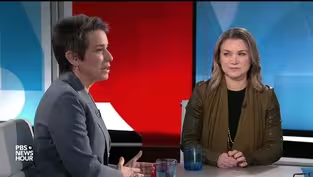
Tamara Keith and Amy Walter on the 2024 campaign
Video has Closed Captions
Tamara Keith and Amy Walter on the 2024 campaign with first primary votes just weeks away (9m 38s)

Vigilantes fight vandalism along Rhode Island shore
Video has Closed Captions
'Anti-graffiti vigilantes' fight vandalism along Rhode Island's shore (5m 37s)

What the ruling against Netanyahu's judiciary overhaul means
Video has Closed Captions
What the ruling against Netanyahu's judiciary overhaul means for Israel and war in Gaza (6m 59s)
Providing Support for PBS.org
Learn Moreabout PBS online sponsorship
- News and Public Affairs

FRONTLINE is investigative journalism that questions, explains and changes our world.

- News and Public Affairs

Amanpour and Company features conversations with leaders and decision makers.












Support for PBS provided by:
Major corporate funding for the PBS News Hour is provided by BDO, BNSF, Consumer Cellular, American Cruise Lines, and Raymond James. Funding for the PBS NewsHour Weekend is provided by...