
December 4, 2023 - PBS NewsHour full episode
12/4/2023 | 57m 46sVideo has Closed Captions
December 4, 2023 - PBS NewsHour full episode
December 4, 2023 - PBS NewsHour full episode
Problems playing video? | Closed Captioning Feedback
Problems playing video? | Closed Captioning Feedback
Major corporate funding for the PBS News Hour is provided by BDO, BNSF, Consumer Cellular, American Cruise Lines, and Raymond James. Funding for the PBS NewsHour Weekend is provided by...
Support provided by:

December 4, 2023 - PBS NewsHour full episode
12/4/2023 | 57m 46sVideo has Closed Captions
December 4, 2023 - PBS NewsHour full episode
Problems playing video? | Closed Captioning Feedback
How to Watch PBS News Hour
PBS News Hour is available to stream on pbs.org and the free PBS App, available on iPhone, Apple TV, Android TV, Android smartphones, Amazon Fire TV, Amazon Fire Tablet, Roku, Samsung Smart TV, and Vizio.
Providing Support for PBS.org
Learn Moreabout PBS online sponsorshipAMNA NAWAZ: Good evening.
I'm Amna Nawaz.
GEOFF BENNETT: And I'm Geoff Bennett.
On the "NewsHour" tonight: Evacuations become frantic in Southern Gaza, as Israel expands its ground operations into the places civilians were told were safe zones just weeks ago.
AMNA NAWAZ: The Supreme Court hears a case that could shield the Sackler family from future civil lawsuits related to the opioid epidemic.
GEOFF BENNETT: And cancer rates rise sharply among young women, highlighting the blind spots in medical care.
DR. SHARI GOLDFARB, Memorial Sloan Kettering Cancer Center: Too often, people are not taken seriously when they're young or doctors who don't see breast cancer in young women, don't think its breast cancer.
It doesn't come to their mind.
So people are given antibiotics and told to go home.
(BREAK) GEOFF BENNETT: Welcome to the "NewsHour."
The focus of Israel's invasion and air campaign in Gaza is shifting south, where roughly two million Gazans have fled, and there are few safe places left for them to go.
AMNA NAWAZ: The death toll in Gaza is nearing 16,000, mostly women and children.
That's according to the Hamas-run Health Ministry.
Since Israel's ground operations began, 81 of its troops have died in Gaza.
Aid deliveries are continuing, but in lower numbers since last week's truce ended, providing little relief to the civilians trapped there.
In Southern Gaza, Palestinians are packing up and fleeing the same areas Israel once said were safe.
Evacuations like this have become all too familiar for some, like Hamdi Zaheer.
HAMDI ZAHEER, Displaced From Northern Gaza (through translator): Two to three journeys in the war.
I headed out to Al Shifa Hospital in the north.
Then the Israeli army said we have to move to the safe areas in the south.
Today, again, we are evacuating.
AMNA NAWAZ: They're trying to escape Israel's bombardment from the air and its invasion the ground.
Israel says it's now shifting more of its focus south.
REAR ADM. DANIEL HAGARI, Spokesperson, Israeli Defense Forces: We pursued them in Northern Gaza.
We're now pursuing Hamas in Southern Gaza too.
AMNA NAWAZ: The IDF reports it hit some 200 targets by air overnight.
By daybreak, Gazans on the ground, including children, were sifting through piles of rubble.
Nesrine Abdelmoty lives with her daughter and her 2-year-old baby in Khan Yunis.
She says they were asleep on the floor when an airstrike hit their home.
NESRINE ABDELMOTY, Gaza Strip Resident (through translator): We were sleeping at 5:00 a.m. when we felt things collapse.
Everything went upside down.
Even Khan Yunis is not safe now.
Where do they want us to go?
AMNA NAWAZ: Israel says it's trying to tell Gazans where to go now.
This weekend, the IDF released a live map accessible via a smartphone that divides Gaza into small sections, telling civilians which areas are current targets.
But with limited Internet, many Gazans can't even access the map, and Israel has repeatedly hit areas it deemed safe before.
This all comes after the weeklong pause in fighting ended abruptly last Friday.
Israel says Hamas violated it by firing rockets.
The truce saw the exchange of 105 Israelis and foreigners held hostage in Gaza for 240 Palestinians held in Israeli prisons.
Israel pulled out of hostage negotiations in Qatar on Saturday, saying talks had hit a dead end.
An estimated 135 hostages remain in Gaza, mostly men.
But Israel and the U.S. also believe many women are still being held by Hamas.
And State Department spokesperson Matthew Miller today gave one reason they may remain captive, the possibility of sexual violence.
MATTHEW MILLER, State Department Spokesman: It seems one of the reasons they don't want to turn women over that they have been holding hostage and the reason this pause fell apart is they don't want those women to be able to talk about what happened to them during their time in custody.
AMNA NAWAZ: At a news conference in Tel Aviv, family members of Israelis still held captive expressed frustration toward their government.
Shelly Shem-Tov's son Omer was kidnapped at the Nova Music Festival on October 7.
SHELLY SHEM TOV, Mother of Israeli Hostage (through translator): Look me in the eyes.
Your children could have been like ours.
Would you have waited 59 days to bring them home?
Look us in the eyes.
Where are you?
AMNA NAWAZ: And over the weekend, Biden administration officials delivered their sharpest criticism of Israel's campaign in Gaza yet.
Vice President Kamala Harris at the U.N. climate summit in Dubai: KAMALA HARRIS, Vice President of the United States: Frankly, the scale of civilian suffering and the images and videos coming from Gaza are devastating.
We believe Israel must do more to protect innocent civilians.
AMNA NAWAZ: And Defense Secretary Lloyd Austin at a defense forum in California.
LLOYD AUSTIN, U.S. Secretary of Defense: You see, in this kind of a fight, the center of gravity is the civilian population.
And if you drive them into the arms of the enemy, you replace a tactical victory with a strategic defeat.
AMNA NAWAZ: Also over the weekend, concerns of the war sparking a broader regional conflict.
The U.S. military said that three commercial ships in the Southern Red Sea were struck by ballistic missiles fired from Yemen on Sunday.
Iran-backed Houthi rebels claimed responsibility.
They say they were targeting Israeli vessels, although none of the vessels nor crews were Israeli.
GEN. YAHYA SAREA, Houthi Military in Yemen (through translator): The Yemeni armed forces continued to prevent Israeli ships from navigating in the Red Sea and the Arabian Sea until the Israeli aggression against our steadfast brethren in the Gaza Strip ceases.
AMNA NAWAZ: The U.S. military also said its own vessel, the USS Carney, shot down several drones in self-defense during the attacks, but it was unclear if the ship was a target.
Before the war in Gaza resumed, the main focus of negotiations had been the release of hostages held by Hamas and Palestinians held by Israel.
But of the 240 hostages, dozens were migrant workers from Thailand, the Philippines, Tanzania and Nepal.
Nick Schifrin has some of their stories.
NICK SCHIFRIN: After the kidnapping, after seven weeks of captivity, after the release, and after the flight back home, there is reunion.
Two mothers hug their daughters after 50 days without contact.
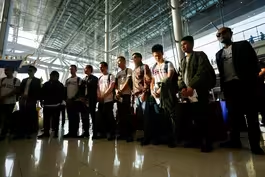
Bunyarin Srichan ties a Buddhist bracelet on her daughter Natthawaree Mulkan and Natthawaree's partner, Boonthom Phankhong, after they were held hostage by Hamas.
And Natthawaree embraces her own daughter, grateful to be home, surrounded by family.
NATTHAWAREE MULKAN, Freed Hamas Hostage (through translator): It's like dying and being reborn.
Natthawaree and Boonthom Phankhong had lived in Israel for four years, two of 30,000 Thais working Israeli agriculture, when, on October 7, Hamas and other militants rampaged through communities across Southern Israel, including theirs.
They were kidnapped together.
BOONTHOM PHANKHONG, Free Hamas Hostage (through translator): We kept encouraging each other, saying that we had to survive, that there will be agencies coming to help us.
All we could do was sit and wait, lying there, waiting and giving each other strength.
NICK SCHIFRIN: In total, 32 Thai workers were kidnapped.
So far, 23 of them have been released in a separate hostage deal between Thailand and Hamas mediated by Qatar, Iran and other nations.
KRIENGSAK PHANSUREE, Survived Hamas Attack (through translator): I want to know why Hamas hurt Thai people and took them hostage, because Thai people didn't hurt them or do anything bad to them.
NICK SCHIFRIN: Kriengsak Phansuree is also grateful to be home with his children and wife, Amornthip Pathumrath.
And he's grateful to be able to do the school run, knowing how close he was to not coming home.
He worked in Moshav Mivtahim, just five miles from Gaza.
In Hebrew, it means Safe Haven.
KRIENGSAK PHANSUREE (through translator): I heard the sounds of the rocket launchers and sounds of the bombs.
That's a normal situation I always hear.
I wasn't shocked or scared.
But after that, I heard the sounds of heavy weapons shooting inside the camp.
That had never happened before.
Not long after that, they walked into the camp.
NICK SCHIFRIN: Hamas fighters spoke to the workers in Thai to try to convince them to come out of hiding.
KRIENGSAK PHANSUREE (through translator): I hid until the evening.
Then I came back inside the camp and went to my room.
I prepared to cook dinner, because I thought the fighting was finished.
But not long after that, they came back to the camp again.
They shot at us while I cooked dinner, and I ran and hid in the crops.
NICK SCHIFRIN: In total, he hid for 20 hours.
The dormitory where he lived was burned to the ground.
AMORNTHIP PATHUMRATH, Wife of Survivor (through translator): couldn't eat or sleep.
I couldn't stay still.
So I walked around the house back and forth because I worried that he wouldn't be able to come home.
I was afraid that he was going to get killed.
NICK SCHIFRIN: On October the 7th, Palestinian militants killed at least 39 Thai workers.
And the victims were not only Thai.
Clemence Matanga, one of 200 Tanzanian agricultural students in Israel, was buried this week after being murdered in kibbutz Nir Oz.
And 21-year-old Joshua Mollel remains missing.
His family believes he's a Hamas hostage.
He derived in Israel only three weeks before the attack.
It was his first time leaving Tanzania.
He dreamed of becoming an agriculture expert.
Loitu Mollel is his father.
LOITU MOLLEL, Father of Joshua Mollel: Joshua is a kind person, hardworking.
He is a student.
He is innocent boy.
The message which I want to pass to Joshua, if he can hear this voice just to be strong.
We know that, by hoping and pray, he's going to be released soon.
So let him be strong.
NICK SCHIFRIN: Workers like him have long been Israel's agricultural backbone, but long before the October 7 attack, they were vulnerable and often invisible.
MATAN KAMINER, Hebrew University of Jerusalem: This is a population of people who are doing dirty, dangerous and difficult work that Israelis are not willing to do.
NICK SCHIFRIN: Matan Kaminer is an anthropologist at the Hebrew University of Jerusalem, who studied Israel's Thai migrant community for the last decade.
MATAN KAMINER: There are grievous violations of housing practices, health and safety protections.
These people who are among the most vulnerable, even in everyday circumstances, were among the hardest hit by the violence.
For the first time, people are realizing what sacrifices these people have had to make, murdered, some of them, in quite horrific ways, whether it is being abducted into the Gaza Strip or whether it's just being injured.
NICK SCHIFRIN: The war has triggered an exodus of more than 15,000 migrant workers.
MAN: We are coming at this difficult time to help us, to work on the agriculture.
NICK SCHIFRIN: And now they're being replaced with a new wave of 5,000 Malawians.
Sri Lanka plans to send 20,000.
Israelis who refused this kind of work before are now showing up as volunteers.
MAN: We came to help out.
NICK SCHIFRIN: Even American cowboys are temporarily pitching in.
Back in Northeast Thailand, Kriengsak Phansuree was one of thousands of Thai migrants evacuated by his government.
He says there's nowhere else he'd rather be.
KRIENGSAK PHANSUREE (through translator): This situation has changed my idea of wanting to work in Israel.
Right now, I don't have any income, but I feel more safe here.
NICK SCHIFRIN: But for Natthawaree Mulkan, it would be worth the risk.
NATTHAWAREE MULKAN (through translator): If there's a chance of going back, we want to return.
There were many good things that left a lasting impression in our hearts.
NICK SCHIFRIN: For the moment, their focus is on each other.
The two former hostages plan to get married and spend their time recovering with the family they almost left behind.
For the "PBS NewsHour," I'm Nick Schifrin.
GEOFF BENNETT: In the day's other headlines: Divers have recovered the remains of five crew members from the wreckage of a U.S. Air Force Osprey crash.
The aircraft went down last Wednesday off Southwestern Japan, carrying eight Americans on a training mission.
One body had already been recovered.
Rescue teams are searching the crash site for two others still missing.
A former American diplomat has been charged with spying for Cuba.
Manuel Rocha's two-decade career in the Foreign Service included serving as U.S. ambassador to Bolivia.
But newly unsealed court papers alleged he also was a mole for Cuban intelligence since at least 1981.
U.S. Attorney General Merrick Garland said an undercover FBI agent spoke with Rocha before his arrest Friday in Miami.
MERRICK GARLAND, U.S. Attorney General: Rocha repeatedly referred to the United States as - - quote -- "the enemy."
He told the undercover that his efforts to infiltrate the United States government were - - quote -- "meticulous" and -- quote -- "very disciplined."
And he repeatedly bragged about the significance of his efforts, saying that -- quote -- "What has been done as strengthened the revolution immensely."
GEOFF BENNETT: Garland said this is one of the highest-reaching and longest lasting infiltrations of U.S. government by a foreign agent to date, but he stopped short of describing what sensitive information Rocha shared with Cuba.
In campaign news, North Dakota Governor Doug Burgum ended his bid for the Republican presidential nomination today ahead of Wednesday's debate.
The wealthy software entrepreneur qualified for the first two Republican debates thanks to stronger-than-anticipated donor turnout, but he failed to meet polling requirements for the third and likely wouldn't qualify for the fourth.
Intense flooding in landslides in Tanzania have killed more than 60 people and injured 116 others.
Hundreds of people are still trapped by the floodwaters in the northern part of the country.
It's the worst flooding the East African nation has seen in years.
With many towns covered in mud and water, the country's president said they're making sure residents get the help they need.
SAMIA SULUHU HASSAN, President of Tanzania (through translator): I have instructed that all efforts are directed towards rescuing those who were involved in this tragedy and to prevent more deaths.
I have directed our security and health ministries to get to the scene to attend to the injured.
I have also asked officials from the Ministry of Mining to investigate what is happening in this mountainous region.
GEOFF BENNETT: Other countries in East Africa, like Kenya and Ethiopia, have suffered similar flood disasters made worse by the El Nino weather conditions.
In Indonesia, 11 people are confirmed dead a day after one of the most active volcanoes in that country erupted.
Rescue teams scoured the jungles near Mount Merapi and rushed survivors to nearby hospitals.
But their search for a dozen missing climbers was temporarily halted after the volcano erupted again today, spewing hot ash thousands of feet into the air.
And stocks gave up some ground on Wall Street today.
The Dow Jones industrial average lost 41 points to close at 36204.
The Nasdaq fell 119 points.
The S&P 500 slipped 25.
Still to come on the "NewsHour": Tamara Keith and Amy Walter break down the latest political headlines; wind and solar energy on the rise in areas traditionally known as oil country; and a rare solar system with planets orbiting in sync is discovered within our galaxy.
The U.S. Supreme Court heard arguments today in one of the most important corporate bankruptcy cases in decades.
It involves the players at the center of the opioid epidemic, Purdue Pharma and the Sackler family, who owned the company.
The court is weighing whether to approve Purdue Pharma's controversial bankruptcy deal that would give billions of dollars to victims of the opioid epidemic, while protecting members of the Sackler family from current and future opioid-related civil lawsuits.
Our Supreme Court analyst, Marcia Coyle, is with us.
Marcia, you were at the Supreme Court today for the arguments.
There were some fairly dense and technical arguments that the justices heard, but, big picture, what are they considering here?
MARCIA COYLE: Well, first of all, the real issue before the court is whether the bankruptcy court here had the authority somewhere in the code or elsewhere to approve a settlement that does give immunity basically to the Sackler family, as you said, from all civil opioid-related claims, even though the Sackler family was not part of this bankruptcy.
They themselves did not apply for bankruptcy.
So the justices were probing both sides with some skeptical questions of both sides on whether there is authority for this.
But also what was interesting, Geoff, is it was very clear that the justices had their eye on the practical implications of a decision.
If they find that there was no authority, does that -- is it possible that there's a better deal to be negotiated, as the United States trustees suggested, or will there be a race to the courthouse by individual claimants, where one claimant with a huge claim could zap all the assets of the corporation should that claimant win and nothing will be left for anyone else?
GEOFF BENNETT: And we should say some of the victims' families support the settlement.
Others oppose it.
Our team spoke with two mothers who both lost their sons to the opioid epidemic.
Here's what Ellen Isaacs -- she lost her son Ryan to an overdose five years ago, and she's against the settlement.
Here's what she said.
ELLEN ISAACS, Mother of Opioid Victim: Forty-eight thousand dollars is what the cost is for your child to be gone, that you will get a payout.
And then there's certain stipulations on top of that.
The rich should not be able to create their own system of justice that is above the law.
It's totally unfair to the more than 500,000 families and clocking that have lost a loved one and not being able to have accountability.
GEOFF BENNETT: But the vast majority of families voted in favor of the settlement, including Dede Yoder.
She's a single mom whose only son, Chris, died of an overdose back in 2017.
DEDE YODER, Mother of Opioid Victim: There is no way any family even now could go after the Sacklers.
You needed -- the bankruptcy included all the states, the municipalities, all the attorney generals of all the states.
You needed the power of all these people in order to get this kind of settlement.
It also says that my son's life was worth something, rather than worth nothing.
I mean, that -- the symbolism of it to me is also important.
GEOFF BENNETT: So how did those arguments play out in court today?
MARCIA COYLE: Well, it was interesting.
Justice Kavanaugh, for example, noted to the government's lawyer that these releases that the Sackler family got, they have been approved by courts for about 30 years.
In fact, corporations have been looking to bankruptcy when they face mass injury claims since the 1980s.
So he asked, well, why should we suddenly, after 30 years of approvals, throw this one out?
But then there was also concern like Justice Kagan raised that the Sacklers here are getting a benefit, a deal that's better than what the average person or corporation that goes into bankruptcy can get, especially with the immunity side of things.
So there was no love for the Sacklers in this courtroom today.
That's one thing that was very clear.
Justice Gorsuch raised some constitutional issues.
Some of these claims that have been released as part of the settlement are nonconsensual claims.
And he pointed out, we don't usually terminate rights without some kind of process, some kind of due process.
So I think they're really struggling with this, but, as I said earlier, they have their eye on the practical implications.
And I would like to say too, Geoff, that these families, whether they're supporting or opposing this settlement, they're not getting a windfall, by any means.
The average payout is going to be $3,500 to $48,000.
And it's over a long period of time, minus lawyers' fees, taxes, other stipulations.
What they really, really want, if you read the briefs in the cases, they want the money in the settlement that will go towards treatment and abatement of the opioid crisis.
GEOFF BENNETT: That's an important point.
You mentioned the practical implications.
What are they outside of this case?
MARCIA COYLE: OK. Well, there are real implications for bankruptcy in general.
There's a fear that corporations may see this, if the releases are upheld, as a road map for corporations and wealthy individuals who own those corporations to basically get the kind of deal that the Sacklers got.
Is this really consistent with how we view bankruptcy, as a fresh start, a reorganization for companies?
So it could affect just bankruptcy in general.
Also, it could have an effect on future mass injury claims, as well as current ones.
The Boy Scouts of America filed an amicus brief urging the court, look, if you do throw out these releases, please don't upend those that are already final or seem to be a done deal.
So there is concern, too, about how those will be affected by whatever the court decides.
GEOFF BENNETT: Marcia Coyle, thank you for being our eyes and ears in the court today and for helping us understand this case.
MARCIA COYLE: Always a pleasure, Geoff.
AMNA NAWAZ: New research is confirming something that doctors have already been noticing, an increase in cancer diagnoses among young women.
Ali Rogin explores the reasons behind the increase and the blind spots medical systems have when treating young women.
CHARISMA MCDUFFIE, Cancer Patient: For my 30th birthday, my mother actually surprised me with a photo shoot.
I was very excited, because it's my first time actually doing a photo shoot.
ALI ROGIN: For Charisma McDuffie, these photos represent more than a birthday.
They mark the end of a yearslong struggle with breast cancer.
It began in 2019 when McDuffie, then 28 and working full-time in retail, experienced recurring chest pains.
CHARISMA MCDUFFIE: I'm just like, what the heck is wrong with me?
So I go to the doctor, basically told me to take Tylenol.
So it was just like, OK, well, went about life.
It's still hurting.
ALI ROGIN: Six months and four doctors later, she finally received the diagnosis that would change her life.
CHARISMA MCDUFFIE: So, the biopsy came back positive for breast cancer.
And I'm just like, what?
ALI ROGIN: McDuffie, now 32, has no family history of cancer and was diagnosed with triple negative breast cancer, an aggressive form of the disease more common in Black women.
CHARISMA MCDUFFIE: I try to be positive.
Even when I'm not so positive, I try to project that.
ALI ROGIN: She underwent chemotherapy, which caused her to lose her hair, and had a double mastectomy followed by breast reconstruction, physical changes that still leave emotional scars.
CHARISMA MCDUFFIE: I didn't really have self-esteem issues before, until after this experience.
Obviously, because now I have a double mastectomy, I have scars.
I'm a different person completely than the normal 32-year-old.
ALI ROGIN: Studies show that young people, especially young women, are experiencing the highest rate of increase in cancer diagnoses.
So some hospitals are coming up with programs specifically tailored to young women.
At Memorial Sloan Kettering Cancer Center, young patients have access to specific support groups, mental health professionals, and fertility clinics.
McDuffie is now a patient of Dr. Shari Goldfarb who co-directs the Young Women with Breast Cancer Program.
DR. SHARI GOLDFARB, Memorial Sloan Kettering Cancer Center: Too often, people are not taken seriously when they're young, or doctors who don't see breast cancer in young women don't think it's breast cancer.
It doesn't come to their mind.
So people are given antibiotics and told to go home.
ALI ROGIN: Dr. Goldfarb says this attitude often means that by the time her young patients begin treatment, their cancer is more advanced and less survivable.
DR. SHARI GOLDFARB: What we see in these women is that they're often diagnosed later with more biologically aggressive tumors.
ALI ROGIN: A 2021 study found that women over 40 with breast cancer saw a decrease in their mortality rates.
But mortality rates in young women remained stagnant.
To Dr. Goldfarb, this demonstrates a major blind spot in the development of cancer drugs.
Younger women are often left out of the clinical trials that could save them.
DR. SHARI GOLDFARB: They're the group that needs it the most, because the biology of their disease tends to be worse.
So they don't get to experience the new drugs that really make a difference and move the needle forward.
ALI ROGIN: But it's not just the recent uptick in breast cancer that has researchers worried.
The fastest growing cancer cases among young people are related to the gastrointestinal system.
DR. ROBIN MENDELSOHN, Memorial Sloan Kettering Cancer Center: And it's been increasing steadily year by year.
So, the knowns is that it's definitely happening, and the unknown is really why.
ALI ROGIN: Dr. Robin Mendelsohn is a gastroenterologist specializing in colon, stomach and esophageal cancer.
She says typical risk factors like obesity don't fully explain what's been happening.
DR. ROBIN MENDELSOHN: In younger patients we usually think, oh, there has to be a family history or it has to be hereditary.
Though that is a small component, the majority of these patients don't have a family history, don't have a known genetic mutation.
Right now, we just don't have one answer.
MEILIN KEEN, Cancer Patient: This is me in the -- I think one of the foster homes I was in, probably 18 months old.
ALI ROGIN: Meilin Keen was born in China and adopted by American parents at the age of 2.
When she was in high school, she says she struggled to pinpoint what was causing her heartburn and acid reflux.
MEILIN KEEN: I, of course, mislabeled it as stress or due to my diet or just other external life circumstances, and not really like, oh, there might be something internally wrong with me.
ALI ROGIN: Earlier this year, the now-27-year-old graduated from law school and was studying for the New York bar exam.
But her plans changed when she was diagnosed with stomach cancer.
MEILIN KEEN: This is me being clueless that I was going to be diagnosed a month later.
It didn't feel real.
It took me a few more minutes to really absorb it, and I had to ask the doctor to repeat it clearly and say, you have stomach cancer.
My life flashed before my eyes in that moment.
ALI ROGIN: Keen tested positive for H. pylori, a bacteria common in Asian countries, which her doctors say likely led to her stomach cancer.
She just finished chemotherapy and is adjusting to the changes to her physical appearance.
MEILIN KEEN: That's why I wear hats, because the hairline.
ALI ROGIN: But her treatment also meant the bar exam would have to wait.
MEILIN KEEN: When I had to call to withdraw from the bar, that was actually the first time I verbally said to someone that I didn't know that I had cancer.
That's the first time I had actually, like, broke down crying.
DR. ROBIN MENDELSOHN: These younger folks, one night, they're out with their friends and then the next day they're diagnosed with cancer, and everything changes in that second.
ALI ROGIN: Dr. Mendelsohn also runs a program for younger patients with G.I.
cancer, each of whom fills out a questionnaire in the pursuit of common denominators among them.
DR. ROBIN MENDELSOHN: So we're trying to explore all options and asking about past history and past family history and then delving into diet habits from as far back as they can remember and medication habits from as far back as they can remember.
And the goal really is to find a high-risk group, so that we can screen that high-risk group.
If we do find cancer at a screening test, it's usually at the early stages.
And in the early stages, it's really, really curable.
ALI ROGIN: Currently, routine screenings for most cancers are not recommended for people under 40, unless considered high-risk.
But Dr. Mendelsohn encourages doctors and young patients to be vigilant.
DR. ROBIN MENDELSOHN: The majority of times, these symptoms are not cancer, but it's so important for both providers and patients to know that this is increasing, so that if they do have symptoms, to get evaluated.
WOMAN: When Charisma came out with her story, she posted the video, and I shared the video.
ALI ROGIN: McDuffie, who leaned heavily on her family for support during her treatment, wonders how things might have been different if doctors took the concerns of young women like her more seriously.
How much of their failure to diagnose you earlier do you think had to do with your age?
CHARISMA MCDUFFIE: A lot, because I still had this pain that was ignored.
By the time they diagnosed me, it's already stage 3, when that was already six, seven months after the first pain.
So it was like maybe it could have been prevented earlier.
Maybe I wouldn't have to do chemo or any other thing if they would have recognized it earlier or took it more seriously.
ALI ROGIN: Fortunately, McDuffie never stopped taking her own concerns seriously, even when she and her family were the only ones.
For the "PBS NewsHour," I'm Ali Rogin in New York City.
AMNA NAWAZ: With just six weeks until the first-in-the-nation Iowa caucuses, several Republican hopefuls made stops in the Hawkeye State this weekend.
Lisa Desjardins begins our coverage.
LISA DESJARDINS: Ron DeSantis all in on Iowa.
GOV.
RON DESANTIS (R-FL), Presidential Candidate: Iowa will begin the revival of the United States of America.
(CHEERING AND APPLAUSE) LISA DESJARDINS: As the Florida governor fights for his political survival, he finished his tour of all of the state's 99 counties on Saturday.
Inside the Thunderdome restaurant in Newton, DeSantis' political jabs at his opponent and GOP front-runner, Donald Trump, were muted.
GOV.
RON DESANTIS: I have been very frank with my views on President Trump's campaign, where he's campaigning on things that he promised to do in '16 and didn't deliver.
But I have also acknowledged the good things that were done.
LISA DESJARDINS: Trump has been in Iowa far less than his opponents, but that hasn't mattered to GOP voters.
He has a seismic 40-point lead.
He focused on the state this weekend with two rallies, mocking DeSantis for those poll numbers.
DONALD TRUMP, Former President of the United States (R) and Current U.S. Presidential Candidate: He's been falling out of the air like a very seriously wounded bird, right, to the ground.
LISA DESJARDINS: And the former president continued to spout the lie that he won the 2020 election.
DONALD TRUMP: They rigged and stole the election of 2020.
They rigged it and they stole it.
LISA DESJARDINS: Even as Trump faces state and federal indictments for his efforts to overturn the legitimate results of the election that President Biden won, and his sharpest attacks hit at the Democratic front-runner, with Trump trying to flip his own vulnerability.
DONALD TRUMP: Joe Biden is not the defender of American democracy.
Joe Biden is the destroyer of American democracy.
LISA DESJARDINS: He again alleged without evidence that President Biden has weaponized the Department of Justice to bring criminal cases against him.
While Trump continues to hold a commanding lead in GOP polls, Nikki Haley has been on the rise in recent weeks, jumping into second place in New Hampshire and South Carolina and tying for second in Iowa.
And just days ago, the former South Carolina governor began running her first TV ad in the early states.
NIKKI HALEY (R), Presidential Candidate: It's time for a new generation of conservative leadership.
We have to leave behind the chaos and drama of the past and strengthen our country, our pride and our purpose.
WOMAN: I think our country would be very blessed to have Vivek.
LISA DESJARDINS: Vivek Ramaswamy's campaign launched an ad featuring his childhood piano teacher.
VIVEK RAMASWAMY (R), Presidential Candidate: We're going to deliver a major surprise.
LISA DESJARDINS: As the entrepreneur crisscrossed Iowa over the past few days.
Ramaswamy, DeSantis, and Haley will all be back in the Hawkeye State next weekend.
But, first, they will meet up for their fourth debate Wednesday night in Alabama.
For the "PBS NewsHour," I'm Lisa Desjardins.
AMNA NAWAZ: And our Politics Monday team is here for a check-in on the 2024 campaign.
That is Amy Walter of The Cook Political Report With Amy Walter and Tamara Keith of NPR.
Good to see you both.
AMY WALTER, The Cook Political Report: Hello.
TAMARA KEITH, National Public Radio: Thank you.
AMNA NAWAZ: Let's pick up where Lisa left off there.
The candidates are going to be debating on Wednesday night.
This one's hosted by NewsNation at the University of Alabama in Tuscaloosa.
This debate does have the most strict requirements so far.
Doug Burgum, the North Dakota governor, failed to make the -- to qualify for the stage.
So he ended his presidential bid.
And this is what he said in part as he ended it.
He's slamming the RNC's debate criteria.
He says: "These arbitrary criteria ensure advantages for candidates from major media markets on the coasts versus America's heartland.
None of their debate criteria relate to the qualifications related to actually doing the job of the president."
Amy, how are you looking at this next, fourth debate?
AMY WALTER, The Cook Political Report: Well, I think the most important thing about these debates has been the fact that Donald Trump hasn't been there.
And that's -- forget about what the RNC rules are.
That has probably been the reason why the field has winnowed as quickly as it has, because there's been no opportunity for these candidates to really directly challenge the front-runner.
That said, it looks like we're going to have, as Lisa pointed out, those three who were in that piece, and maybe Chris Christie as well.
This is going to be the big challenge for Nikki Haley.
She is with all the momentum right now.
If you are Ron DeSantis desperately holding onto that second place, granted, a distant second place from Donald Trump, you need to get back into that position.
And we know that Vivek Ramaswamy and Nikki Haley have had something of a dislike-versus-dislike kind of relationship.
They have been going after each other pretty consistently.
So she's definitely the woman in the middle at this debate.
And she will be tested in a way, I think, that we haven't seen before.
AMNA NAWAZ: Likely facing a lot of fire there.
AMY WALTER: Yes.
AMNA NAWAZ: Tam, how are you looking at it?
What do you expect to see?
TAMARA KEITH: Yes.
So, as Amy said, this is really the undercard debate.
This is a debate that comes after several other debates that are all about, who can be the leader in the position of distant second?
And, at NPR, we have been working on stories where we compare the policy positions of the candidates.
And the candidates who've been in the debates, we have a pretty good idea of where they stand how they would govern, what they want to do.
With Trump, he hasn't been pressed because he hasn't been in the debates.
And so there's a lack of specificity on his positions that you don't see with these other candidates, because they truly have been pressed.
Of course, that also explains why he wouldn't want to be at these debates.
Why would he appear at a debate with a bunch of people who are not even, like, close to nipping at his heels... AMNA NAWAZ: Yes.
TAMARA KEITH: ... and where he could be forced to actually say what his position is on abortion or how he would replace Obamacare or answer to some of Ron DeSantis' charges that he's basically campaigning on things that he campaigned on in 2016 and never did.
AMNA NAWAZ: Well, Tam, we are seeing from President Trump this relatively new line of attack now.
He is now sort of flipping the script, his own attacks, people saying he is a threat to democracy, and he is now saying President Biden is a threat to democracy.
What's the Biden administration saying about that?
TAMARA KEITH: Well, so President Biden at the core of his campaign is this charge that Trump is a threat to democracy.
And it's not an academic charge.
In the president's campaign launch video, reelection video, there is footage of the January 6 insurrection, where the former president's refusal to admit the results of a free and fair election led to, and his words, led to lots of people storming the U.S. Capitol, waving Trump flags, and bludgeoning police with flagpoles.
AMNA NAWAZ: And he continues to repeat that lie.
TAMARA KEITH: And he continues to repeat that lie.
So what the Biden campaign says is -- yes, of course, there is a receptive audience among Trump loyalists, among the people who support Trump and are going to vote for Trump.
I mean, there's a strong strain of January 6 denialism among those voters.
So this is a message that works well with those voters.
But the Biden campaign feels that Biden's message that Trump is a threat to democracy, that that message stands up, that all you have to do is look at video of January 6 and that is there.
But as they see it, this isn't actually new from Trump.
AMNA NAWAZ: Yes.
TAMARA KEITH: He has claimed that the prosecutions of him are antidemocratic.
(CROSSTALK) AMY WALTER: Yes, I mean, clearly, he's trying to neutralize liability here.
And we see it going on in Congress as well.
We have Congress directly going after Hunter Biden, suggesting that they are going to use Hunter Biden's business relationship with his family as a cause for potentially impeaching the president of the United States and basically taking the message to voters that, look, everybody's corrupt, right?
He does some bad things.
This candidate does some bad things.
They're all the same.
The one thing, though, I would say, if you're the Donald Trump campaign, the one message that works best for the Donald Trump campaign is on the economy.
He has a double-digit lead right now over Biden on the economy.
I think that, yes, I understand why he's doing this, why he wants to put Biden on the defensive, but, really, the most effective campaign he can run is one that focuses almost entirely on the economy.
That requires a level of discipline that Donald Trump does not currently show or has never currently showed.
(CROSSTALK) AMNA NAWAZ: We have yet to see.
AMY WALTER: Or never seen, yes.
TAMARA KEITH: He has this longstanding pattern of, I know you are, but what am I?
AMY WALTER: Right.
TAMARA KEITH: And he did that during the Republican primary in 2016.
He does it all the time.
AMNA NAWAZ: We have seen this before.
TAMARA KEITH: So we have seen this before.
AMY WALTER: Yes.
(CROSSTALK) AMNA NAWAZ: Meanwhile... TAMARA KEITH: And it has the effect of muddying the water.
AMNA NAWAZ: I do want to talk about what's happened on Capitol Hill this week, too because the talks on Capitol Hill that could have helped to advance some of that funding President Biden has been requesting for aid in Ukraine and Israel and Taiwan, those talks have now broken down.
They were over border policy, Amy, which Republicans have insisted be part of this foreign aid bill.
We saw the OMB director, Shalanda Young, send a pretty strong letter to congressional leaders.
This is what she had to say: "Cutting off the flow of U.S. weapons and equipment will kneecap Ukraine on the battlefield, not only putting at risk the gains Ukraine has made, but increasing the likelihood of Russian military victories."
Amy, is there any realistic path forward on this aid bill right now?
AMY WALTER: I mean, they're -- I have talked to some folks who think that there might be a way that some of this aid gets through, though it may not be through this vehicle, but through a different vehicle.
But, really, where Republicans, so many Republicans, especially in the House, sit is not much different from where a lot of Americans sit right now on their views of the importance of sending money overseas or the role of America in the world.
And the Marist poll, sponsored in part by the "NewsHour<" bears this out, 50 percent of Americans saying it's crucial for the United States to be a global leader in the world versus 47 percent who say we should focus much more on domestic problems than we should about what's going on overseas.
And this isn't just Republicans, though Republicans feel this overwhelmingly.
Independents are also much more on the we should be focused more on home than overseas.
So the challenge that the White House has isn't just with members of Congress on this funding.
It's also with the public that has become increasingly skeptical that the money that we're spending there is worth it and that we should be looking more at home.
AMNA NAWAZ: Well, the White House says they won't leave Ukraine in a lurch.
Will they be forced to?
TAMARA KEITH: They don't want to.
And their negotiating position -- they can't say, oh, yes, we can throw the Ukraine money overboard and just go with the Israel money, because then the Ukraine money will be thrown overboard.
And so they are continuing to push for all of these funds that they have asked for to be linked together.
These types of things are linked until they're not.
And the Biden White House is in a really tough spot.
President Biden has gone around the world pledging that the U.S. will be there as long as it needs to be there.
Allies, you can count on us.
I speak for the United States.
America is back.
I'm the president kind of a message.
That message becomes more difficult when he can't get Congress to pass the funding that Ukraine needs, that the White House says Ukraine needs, that other allies are counting on the U.S. to deliver.
So that is a real challenge for the White House.
AMNA NAWAZ: The clock is ticking on Capitol Hill.
We will be following it all.
Tamara Keith, Amy Walter, always good to see you both.
Thank you so much.
TAMARA KEITH: You're welcome.
GEOFF BENNETT: One of the big announcements at the U.N. climate conference this weekend in Dubai was a pledge by more than 110 countries to triple the amount of renewable energy they're generating by the year 2030.
As William Brangham reports, that work is already under way in a state that might surprise you.
This story is a collaboration with the Global Health Reporting Center with support from the Pulitzer Center.
WILLIAM BRANGHAM: If you had to guess which state in America was hands down producing the most green renewable energy, what would you guess?
California?
Massachusetts?
It's Texas.
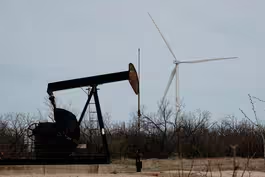
The state that epitomizes oil and gas and got rich powering the nation for decades is now the biggest producer of wind and solar.
So how did deep-red Texas turn so green?
MICHAEL WEBBER, University of Texas: It's not unusual for Texas to do all the right things for all the wrong reasons, and the rise of renewables is one of those examples.
WILLIAM BRANGHAM: Michael Webber studies the energy transition at the University of Texas in his author of "Power Trip: The Story of Energy."
MICHAEL WEBBER: We didn't do it for the cleanliness.
We didn't do it for climate change.
We did it because it makes us a lot of money for the landowners and saves us a lot of money for the consumers.
WILLIAM BRANGHAM: One study found that all this cheap renewable energy is saving the average Texas household almost $200 a year, though skeptics say that figure may be inflated.
There are a slew of factors that contributed to this boom.
Texas' geography is one.
Rob Minter works for the energy company Engie, which has major renewable projects across the state.
ROB MINTER, Engie North America: It's a big state.
There are a lot of areas where it's sunny and it's windy.
In the wide open spaces of West Texas and South Texas, there are some wonderful areas for development of renewable resources.
WILLIAM BRANGHAM: Texas also had its share of influential oilmen who saw the light on renewables, people like billionaire T. Boone Pickens.
GEORGE W. BUSH, Former President of the United States: This session will mean low electric rates for people all across the spectrum.
WILLIAM BRANGHAM: There's even one who became governor.
In 1999, then-Governor George W. Bush, working with a Democratic legislature, signed a law deregulating Texas' power market to make it more competitive and enshrined a state mandate for wind power.
EMILY FOXHALL, The Texas Tribune: He wanted to support wind power.
WILLIAM BRANGHAM: Emily Foxhall covers the energy industry for The Texas Tribune.
EMILY FOXHALL: There were landowners who were willing to lease their land for these new industries.
WILLIAM BRANGHAM: These newfangled industries.
EMILY FOXHALL: Yes, it was a new way for them to make money when perhaps they were struggling to do so with agriculture.
MICHAEL WEBBER: Texas had a mandate before England, before California, before New York.
You list all these liberal economies, and Texas had a renewables mandate before them.
WILLIAM BRANGHAM: Today, the Lone Star State generates more megawatts of wind power than any other in the nation.
When it comes to solar, Texas trails only California and actually ranks first in utility scale solar projects.
Combined with nuclear, Texas now generates almost 40 percent of its total energy needs from carbon-free sources, a huge surge in just a few years' time.
Texas, of course, like so many other parts of the country, has suffered through a string of climate-driven disasters.
They just had record-breaking heat waves this past summer.
And this area is always under threat from hurricanes.
In fact, six years ago, when I was here for Hurricane Harvey, this entire area was underwater.
EMILY FOXHALL: The interesting piece here is, climate change is the context through which we should be talking about all of this, right?
Like, the reason we have this renewable power coming onto the grid is because, in order to slow climate change, we have to slow carbon emissions.
But in the Texas legislature, you really don't hear climate change coming up.
WILLIAM BRANGHAM: In fact, Texas' renewable boom isn't always being celebrated.
During 2021's paralyzing winter storm in Texas, which caused widespread blackouts and left 246 people dead, renewables were falsely blamed for making things worse.
Governor Greg Abbott had this to say.
GOV.
GREG ABBOTT (R-TX): Our wind and our solar got shut down, and that thrust Texas into a situation where it was lacking power.
And this shows how the Green New Deal would be a deadly deal for the United States of America.
WILLIAM BRANGHAM: But a subsequent analysis showed it was unwinterized fossil fuel plants, principally natural gas, that were responsible for most of the blackouts.
MICHAEL WEBBER: The biggest failure was by far the gas system.
So about 85 percent of the gas production in West Texas froze up, about 50 percent statewide.
WILLIAM BRANGHAM: In this year's legislative session, Republican legislators, many with the support of the fossil fuel industry, introduced a slew of anti-renewable bills, including a new tax on owners of electric cars.
MICHAEL WEBBER: I have to pay a $200 annual fee in Texas to register this car.
I'm subsidizing gasoline and diesel drivers around the state.
The focus was on how to punish renewables, how to punish wind and solar.
The grid needs to be reliable.
Wind and solar are not reliable, so goes the story.
Therefore, we need to punish wind and solar.
WILLIAM BRANGHAM: But in a surprising turn, almost none of the anti-renewable bills passed and made it to Governor Abbott's desk, proof, Michael Webber says, that green energy in Texas has become more or less politically bulletproof.
MICHAEL WEBBER: The urban Democrats like it because it's clean and renewable, and the rural Republicans like it because it's good for economic development.
WILLIAM BRANGHAM: Texas' clean energy boom is also being driven by its ready-made army of workers and entrepreneurs coming directly out of the oil and gas industry.
Tim Latimer is the CEO of the geothermal company Fervo Energy.
Geothermal energy comes from drilling underground to tap the heat below the earth's surface to spin electrical turbines.
TIM LATIMER, Founder and CEO, Fervo Energy: And because we're not burning anything or combusting anything, we're just using the natural heat of the earth, what we can do is produce electricity around the clock 24/7, and do so without carbon emissions.
WILLIAM BRANGHAM: It's an ironic twist.
Today's advanced geothermal would not be possible without the drilling and fracking technology developed for natural gas.
TIM LATIMER: When I started my career in oil and gas over a decade ago... WILLIAM BRANGHAM: Latimer, like so many within Texas' larger renewable industry, started his career in fossil fuels.
TIM LATIMER: What we see as time goes on is people have realized that climate change isn't a far-off problem.
They're still passionate about providing affordable energy to the world, but the priorities shift a little bit because of how urgent the climate crisis is.
And I think there's a lot of people who have made that realization, just like I have.
WILLIAM BRANGHAM: None of this means that Texas has turned its back on fossil fuels.
It is still by far the national leader in oil production and natural gas production.
And this is the essential challenge for negotiators gathered in Dubai.
How quickly can the world's powers shift this balance and transition as fast as Texas, if not faster?
For the "PBS NewsHour," I'm William Brangham.
GEOFF BENNETT: Astronomers have discovered a rare solar system with six planets moving completely in sync with one another, a perfect cosmic dance.
Estimated to be billions of years old, the formation 100 light years away may help unravel some mysteries of our solar system.
Science correspondent Miles O'Brien joins us now.
So, Miles, astronomers have found thousands of these so-called exoplanets since the first one was discovered back in 1995.
What sets this discovery apart?
MILES O'BRIEN: This one is pretty special, Geoff.
The idea that they found a star, a solar system, with six planets orbiting as if they were in harmony has really struck them as extremely unusual, almost to the edge of truly unique.
They think what they found is essentially like going to a barn and finding a classic antique vehicle.
It's just pristine.
Nothing has touched it over these years, and it helps them understand a little bit better the origins of our very own solar system.
GEOFF BENNETT: What do we know about the size and nature of these planets, Miles?
MILES O'BRIEN: These planets are like Neptunes, a little bit smaller than Neptune, and they're all -- just to put it in perspective, they're all in orbits that would be inside Mercury in our solar system, so orbits that are a matter of days around the star.
And the ratio of those orbits is exactly the same as you go out.
As a matter of fact, they found a couple of inner planets.
Then they found the outer planet.
Then they did the math and said, you know what, we will probably find some planets here.
And there they were.
GEOFF BENNETT: So, as I mentioned, this formation is 100 light years away.
What instruments did scientists use to even find it?
MILES O'BRIEN: Well, there's two instruments involved.
There was a NASA instrument called the Transiting Exoplanet Survey Satellite, or TESS.
TESS has been in orbit for about five years, and it has been very busy.
It has found no less than 7,000 planet candidates; 500-plus of them are confirmed, and it's just getting started as it looks all throughout the heavens.
So the planet-hunting business is very busy.
There was also a European satellite called the CHaracterising ExOPlanet Satellite involved.
Now, the follow-up will be with the James Webb Space Telescope.
They will take a look at these six planets and try to characterize their atmosphere.
Is it a bunch of gas, hydrogen, or could there possibly be some water on those planets?
GEOFF BENNETT: And what's the significance of finding these planets that are so in sync?
MILES O'BRIEN: Well, it gives us an idea of what a solar system looks like maybe at the beginning.
Our solar system, we're in a tough neighborhood.
We have been bounced around, asteroids have hit planets, and the planets have gotten way out of sync over the course of the many billions of years.
This one apparently is in a very quiet corner of the cosmos and is just the way it was, evidently, when it was first created.
And that just has astronomers completely, well, not mystified, but they're quite curious and they want to continue looking at it and seeing what other instruments tell us.
GEOFF BENNETT: It's fascinating stuff.
Miles O'Brien, thanks so much.
MILES O'BRIEN: You're welcome, Geoff.
AMNA NAWAZ: And that is the "NewsHour" for tonight.
Join us tomorrow night, when we will have the story of one of the youngest Palestinians released from Israeli detention during the temporary cease-fire.
I'm Amna Nawaz.
GEOFF BENNETT: And I'm Geoff Bennett.
Thanks for spending part of your evening with us.

Cancer rates among young women highlight medical blind spots
Video has Closed Captions
Rising cancer rates among young women highlight gaps in medical systems (7m 19s)
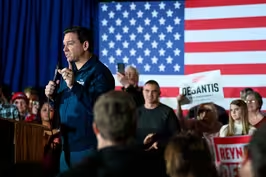
How Republicans are campaigning with 6 weeks until Iowa
Video has Closed Captions
How Republican hopefuls are campaigning in Iowa with 6 weeks until caucuses (2m 42s)
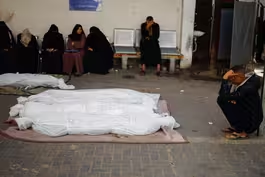
Israel expands Gaza invasion south, forcing many to flee
Video has Closed Captions
Israel expands Gaza invasion south, forcing many to flee areas previously considered safe (4m 59s)

Solar system with 6 planets orbiting in-sync discovered
Video has Closed Captions
Solar system with 6 planets orbiting in-sync discovered in Milky Way (3m 28s)
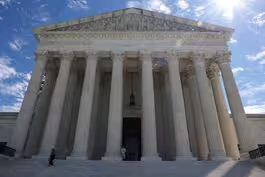
Supreme Court hears Purdue case that could shield Sacklers
Video has Closed Captions
Supreme Court hears case that could shield Purdue Pharma owners from opioid lawsuits (6m 11s)
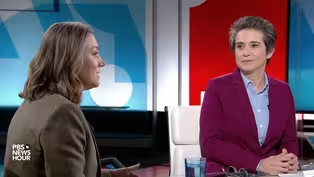
Tamara Keith and Amy Walter on Trump avoiding GOP attacks
Video has Closed Captions
Tamara Keith and Amy Walter on the next GOP debate and how Trump is avoiding attacks (9m 8s)
Texas goes green: Leads nation in renewable energy
Video has Closed Captions
Texas goes green: How oil country became the renewable energy leader (7m 34s)
Thai workers held hostage in Gaza describe kidnappings
Video has Closed Captions
Thai workers held hostage by Hamas describe kidnappings and recovery after release (6m 27s)
Providing Support for PBS.org
Learn Moreabout PBS online sponsorship
- News and Public Affairs

FRONTLINE is investigative journalism that questions, explains and changes our world.

- News and Public Affairs

Amanpour and Company features conversations with leaders and decision makers.












Support for PBS provided by:
Major corporate funding for the PBS News Hour is provided by BDO, BNSF, Consumer Cellular, American Cruise Lines, and Raymond James. Funding for the PBS NewsHour Weekend is provided by...