
Aug. 5, 2026 - Full Show
8/5/2026 | 26m 47sVideo has Closed Captions
Watch the Aug. 5, 2026, full episode of "Chicago Tonight."
Can Chicago Public Schools count on more state funding? Lawmakers weigh in. And another step toward more nuclear power in Illinois.
Problems playing video? | Closed Captioning Feedback
Problems playing video? | Closed Captioning Feedback
Chicago Tonight is a local public television program presented by WTTW
WTTW video streaming support provided by members and sponsors.
Aug. 5, 2026 - Full Show
8/5/2026 | 26m 47sVideo has Closed Captions
Can Chicago Public Schools count on more state funding? Lawmakers weigh in. And another step toward more nuclear power in Illinois.
Problems playing video? | Closed Captioning Feedback
Where to Watch Chicago Tonight
Chicago Tonight is available to stream on pbs.org and the PBS app.

WTTW News Explains
In this Emmy Award-winning series, WTTW News tackles your questions — big and small — about life in the Chicago area. Our video animations guide you through local government, city history, public utilities and everything in between.Providing Support for PBS.org
Learn Moreabout PBS online sponsorshipjoining us on Chicago tonight.
I'm Brandis Friedman.
Here's what we're looking at.
>> Chicago Public Schools, new budget relies on more state funding.
But what's the appetite for that in Springfield?
2 state lawmakers share their thoughts.
Reaching out to local governments to identify sites for new reactors.
>> And we hear from communities in Illinois better opening the door to new nuclear reactors.
>> First off tonight in battled U.S.
Attorney Andrew Boutros as there's no need for a special prosecutor or contempt hearing over his office's handling of the so-called Broadview 6 case in a 52 page court filing the city's top federal prosecutor says, quote, There can be no doubt that mistakes were made in the prosecution of this case.
He also noted his office has been working to rectify those issues by dismissing the case, not contesting the former defendants efforts to recoup legal fees and instituting a remediation plan in his office last fall.
6 protesters were charged after a confrontation with federal immigration agents outside a holding facility in Broadview.
A federal judge is expected to rule on the former defendants special prosecutor request later this month.
Chicago State University's inaugural football team is gearing up for its upcoming season.
And one player still confident they're ready for a promising first season.
Am I ready?
>> Over the red.
Reddy is on I feel like we're trying to make history here.
>> We've been ready to go releases this great.
like a lot of people spring practice.
But we still out here putting work with the married a condition in their day.
get closer that age.
You don't have Biden summer came just came out together.
I'm just blessed to be able to have you noticed opportunity here in the city.
You know, I know the whole city is looking forward to it.
And I know we've been putting in the hard work to get to show that off.
>> Well, CSU doesn't have an on-campus stadium just yet.
They're using SeatGeek stadium in Bridgeview for the time being their season kicks off August 29th against Roosevelt University.
musician known as the first Lady of Chicago Jazz has died.
Geraldine to Haas Rose to musical fame in the 50's and 60's with her sibling group Andy and the Bay Sisters, blending jazz gospel and soul sounds Hossa later became a tireless jazz patron in Chicago for more than 4 years for decades, creating the Duke Ellington Tribute concert in Grant Park back in 1974.
Paving the way for the now famous Chicago Jazz festival.
She was also part of a group of advocates who work to save the South Shore Cultural Center.
And she found a Jazz unites a nonprofit that work to bring jazz to the public.
Here she is on Chicago tonight.
Back in 2013 explaining why she believes jazz can unite.
People point to be.
>> The the the ability to have people come together to express how they feel about certain situation of certain song, but they can all come together on on on that kind of situation because that's the the elements of the music.
When if you played with the band, you can express yourself how you feel about a certain 2 and somebody else could come up a minute later and express how they feel about it.
>> Gerald into Haas was 91 years old.
Up next, state lawmakers discussed possible funding for Chicago public schools right after this.
>> Chicago tonight is made possible in part why the Alexander and John Nichols family.
The Pope Brothers Foundation.
And the support of these donors.
>> After closing their own 2 billion dollar deficit.
Illinois lawmakers may spend the fall veto session looking for more funding for Chicago.
Public Schools.
The Chicago Board of Education recently passed its budget, assuming 150 million dollars in additional state funding.
That hasn't been approved.
Money that board members say is needed to avoid layoffs.
House Speaker Emanuel, Chris Welch and Senate President Don Harmon say they're ready to pursue more funding for CBS.
But the effort faces an uphill climb as lawmakers outside Chicago argue their school districts need more state support, too.
Joining us now are state representative.
Will Davis, a Democrat from east Hazel crest who chairs the elementary and secondary education, Appropriations Committee and Zoom State, Senator Dave Seaver sent a Republican whose district includes portions of DeKalb Kane and McHenry counties.
Gentlemen, thank you both for joining us.
A few Representative Davis, any changes to the state spending plan that would reach CPS in time to avoid midyear cuts would require a three-fifths supermajority.
Indoor 3. right.
3 fifths.
majority vote in both chambers is there the political will in Springfield to get that done?
>> I don't know.
Specifically does the political will to address just the CPS problem?
My position has been that we need to look at using education funding We have our evidence based funding formula that we have to not only address funding needs for CPS, but also funding needs for school districts throughout the state.
If we look at their distance away from advocacy using adequacy target as the benchmark, then you could say that all school districts are in deficit.
So therefore, in order to try to address those broader funding needs, we must look at the evidence base funding model as a way to do it.
Senator.
>> Well, there is a formula in place and that's our concern is if if we take away from that formula and we try to give more funding to Chicago that that is going create a significant problem because as you mentioned, other school districts suffering too.
And so if we change the evidence base funding formula that we have in place that is going to, you know, thing start an uproar from suburban school districts that seen so much growth from people leaving Chicago and their schools are struggling to all way to downstate.
And so to change the formula now, I think just opens up the floodgates.
Chicago is going to have to make the tough decisions like every other school district has had to do over the last few years.
>> So Senator Severson, you know, as we've obviously, lots of other school districts across the state, very few of them, not all of them.
Nowhere near all of them are at their their benchmark or level for adequacy under the state's evidence-based funding formula.
Could this be sort of a pivot if if you all said get back to Springfield in and realize, you know what, maybe we need to just its Chicago's raise.
The problem.
But all districts are facing.
This.
Could we find money for more districts?
>> Well, certain right down the state can find that that kind of money.
They're facing a significant budget shortfall going into this next year already.
So finding those kinds of dollars would I think early be an issue, but we still think Chicago room to make some, you know, tough decisions like other schools have done when you have over 100 schools that are less than 50% vacancy.
You've got a number schools that 30% vacancy or I can see in the schools they need to make tough decisions in Chicago just like our suburban school districts have had to make.
So I think before they come for more money, they need to look at one making the same decisions and tough, tough budget decisions are districts have had to make to look at their own, you know how they can solve their own problem.
Just like every other districts had to do.
Representative Davis?
Well, kind of disagree with the senator and that the adus adequacy targets are based on student population.
What it needs educate the students in that district.
>> So that's a number that we can come up with.
So not the disc how schools that aren't field appropriate as the senators say it.
But we know what the adequacy target is for Chicago.
Public schools and we can get there.
And I think if we continue down the road of progressive revenue like we have done in the past budget year and put more on the table that we can get to the amount of resources that's necessary to help all school districts.
Again, this is not just a Chicago public school system problem.
It is a statewide problem to help districts get to adequacy target.
So that said, do you think in a potential fall veto session that you and your colleagues could come up with a plan?
>> To bring more school districts to adequacy.
Oh, absolutely.
I mean, if it's a matter of finding money, there are some things that were left on the table in terms of progressive revenue options that we didn't address digital at acts, you know, could possibly bring 1.2 billion dollars in revenue to the state of Illinois.
couple of tax decoupling from the federal government tax breaks like tax breaks investors who invest in opportunity zones as well as closing the loophole that allows corporations to put money in tax countries and not account for if we close those loopholes and make that accountability measure available to us that those last 2 could bring 450 million dollars.
And so there are things that we can consider.
And that's not to say that you shouldn't work to try to make the system work better as the senator said, but we still need revenue just to address our adequacy targets within school, school districts that are below that adequacy target.
If we put more money on the table using some of these mechanisms, that is a way we can do it.
I want to thank my colleague Lindsey Lapointe for giving me this information and helping me to understand how we can get there.
Even if you were to come up with those other, maybe progressive revenue measures this fall.
That does not give see.
But it's going to be some time before that money starts to come in.
Cps is not going to have $150 in hand.
>> In fall, what I agree with you did not go necessarily have it in hand this fall.
But again, we've been putting 300 million new dollars into the tier distribution.
For my let's continue to do that.
>> So CPS really wants to help us less work to make sure that we raise the amount of money going into the formula and with of which CPS is a direct beneficiary of those resources.
I've even asked the state Board of Education to come up with numbers that if we were even to remotely look at what they need, what does that mean in terms of the allocation and must go into the formula in order to get there?
I'm still waiting for them to come back with some data on that.
But I think there's opportunities to get it done.
That benefit CPS in all school.
Senator Severson, what do you say to some of those some of those options that Representative Davis just named as ways to >> generate revenue for school for all school districts.
Not yes.
Well, we can always look at raising taxes.
The answer, you know, that was the answer a few years ago, we've raised taxes were back in the same problem that we're in.
So.
>> Raising taxes may solve a short problem for a year or 2.
But if you don't get a handle on spending, if you don't go the to the common sense reforms, then other districts have done.
We're going to be right back in the same situation.
Except then we have more taxes and more businesses leaving.
So as the state we need to look at and growing our economy, improving our jobs, climate.
But as school districts, they have to make the tough decisions and the tough cuts to live within their means just like every other business and every other taxpayer has to do and local governments and school districts around the state of had to do.
Chicago needs to make those again.
Those tough decisions like other school districts have had to do.
So they do that first and then they come back.
Then we can talk about it.
But we don't think they've made the the same painful decisions that other school districts have done by the painful decision.
Senator we've heard CPS mentioned multiple times layoffs and they've had, you know, some layoffs this year.
>> But they've all the district has also said a lot of those teachers aides will be rehired at other schools.
Just it's part of a normal shift, but they are down 160 for school-based positions overall in the outback get this year.
Are those the kind of tough decisions that you think the districts we'll have to thousands.
>> Yeah, since.
Well, since 2019 there at about maybe get my 10,000 lead, 10% less students.
And they've added about 15% increase in staffing.
So when you're losing student population and increasing staffing.
That tells us that there's room there.
As we mentioned, there are there are numerous numerous schools that over 50% vacancies.
There needs to mergers of those districts which would save significant dollars those are the decisions that every other school districts have had to make with closing schools, merging schools, reducing staff.
That's not classroom related staff.
Those are things other schools have had to do.
Chicago needs to make those tough, same tough decisions that are districts have had before they come back to look at them, you know, asking for more money from the state.
All right.
So so we're out of time.
But just so that our viewers know, want them to know that under the Illinois evidence-based funding formula, 63% of Illinois school districts are below.
>> Than 90% funding adequacy bar.
That was set by the uvf funding formula that was passed.
>> 10, 11 years ago, 2017 2017, OK?
That's where we'll have to leave it.
Best of luck to both.
Senator Severson representative Will Davis, we appreciate Thank you.
My pleasure.
Thank you.
Up next, why some communities across Illinois say they are interested in landing new nuclear facilities as the state lifts its moratorium.
>> In education, reporting on Chicago tonight is brought to you in part by press forward.
Chicago.
>> Illinois is one step closer to building its first new nuclear reactor in nearly 40 years in February, Governor JB Pritzker directed state agencies to seek proposals for possible sites.
And now response is Iran from a prototype microreactor at the University of Illinois into communities that are navigating the energy transition.
The state that leads the nation in making nuclear power is looking at what's next.
Joining us, our Nancy Norton, president of the Grundy County Economic Development Council.
And Scott's oral Peoria County administrator, as well as James Walker, the CEO of Nano Nuclear Energy.
Thanks to all 3 of you for joining us.
So Nancy Grundy County, why?
Why is it suitable for new nuclear plant?
Well, Grande counties been home to nuclear for over 60 years.
>> We find ourselves really in the center.
We are the host to the Dresden, Clean Energy Center owned by Constellation 20 miles to the east.
Is Braidwood nuclear station in 20 miles to the West is live South station.
So we have a comfort with nuclear.
We have the workforce for nuclear.
We have the safety mechanisms in place and frankly the infrastructure and the transmission to get power to get the power out to the customers.
So we think it's an ideal location.
And you mentioned Constellation.
That's the owner operator of the existing, many of the existing nuclear facilities already in state of Illinois.
Absolutely.
Yes, one of the existing plants contribute to the state.
>> Well, I can't speak for all the plants, but I can tell you what they contribute in our community.
So, you know, it's almost 1800 megawatts of power, 700 Probably.
26.
Approximately 26 million dollars a year in property taxes to our local districts and apart from economic impact directly.
We also have the benefit of being able to market our location to have power.
As we all know, powers are real scarce commodity these days.
And we have transmission lines.
We have power sources, power assets.
And that's a really compelling case for advanced manufacturing and other renewable opportunities as well.
Scott, why Peoria County?
Well, we're in a different position.
We have a closed coal-fired power plant that home by district energy.
>> We have the same workforce qualities that the committees that have a nuclear power plant already have.
We have the connectivity to the grid.
That committee has communities have.
I think where we separate ourselves as we've been very supportive in Gnostic of all turn, alternative energy sources.
We have some of the highest number of locally approved utility scale solar projects in the state.
We've we're going to have to large utility scale wind turbine projects.
Each one is going to be in excess of 100 turbines and we at this point in time, not closing the door to clear, but making sure that that door stays open and if the opportunity presents itself to walk through that door.
>> James, what's different about what your company is working on at the University of Illinois?
ever on the prairie familiar with the traditional new systems, the big the big systems, but >> the new generation directors is just much It's been essentially shrunken down and it's allowed for UK to be deployed in ways.
It's never been deployed before.
So.
Mining sites, oil and gas sites, remote communities islands.
But reactors in the middle of the university.
It's going to be powering the the campus you could call.
It has never been deployed in that kind of flexible deployment model where?
The director will be or can put will shift to sites as much of the system assembled and then begin to maybe output power and the amazing thing about this new little tech is it can be co-located with the customer.
In this case, it's going to be surrounded by universities run by dorm rooms.
it just put power into of how plot it's, know, this could be very transformative, not just for that.
The university in the state, but but clearly, this is ploy new, caring ways as they've been put full.
>> Nancy, what what do you think the timeline would be like for construction of a new facility?
>> It really depends on the facility.
you know, the long lead times for what we're historic, big reactor nuclear facilities.
The lead times are significant.
But the Mars, this mom largely reactors, the micro reactors, all of those sorts of things.
There's lots of technologies out there.
We understand that there may be about 8 years out to their absolutely, you know, to market and ready for market but, you know, we're we're kind of waiting and seeing, but I know that the large reactors take a lot longer.
>> And when you see the large reactors, me like these that we're seeing on screen right now, the big silos that everybody's used to when we're talking to friend.
Scott, how long could a possible lead time before construction?
How could that affect planning for you?
I think from our perspective.
>> We we have we've identified a site, but it's in private ownership.
It is a ready to go.
just a it's a business decision for Vistra energy.
Whether or not they want to pursue it and then you get into that lead time for how long it would take to produce a reaction.
realistically, thinking along the lines of the small modular reactors as well in terms of what would fit our site terms how that, you know, works for us.
We want to see it just inmate a timely fashion and and then we can plan to make sure that we've got, you know, at what workforce or supplement the work force that we already have.
And continue to work on, having, you know, good affordable housing, which our community has and having, you know, no can check traffic congestion in our community, which you know is is very prevalent up in the Chicago Land area and where most of the nuclear power plants are today.
Okay.
>> James, what are some of the bottlenecks right now for building more reactors like the one that you're planning?
>> I wouldn't say technology is the challenge.
I would say that's been under investment into new care infrastructure in general right across the country and that's meant investment into conversion community in Richmond.
That whole fuel supply chain and the government's book.
It's putting money back into it right now.
I think the Biden administration, I think during his tenure there was something like 10 billion dollars that was put back into infrastructure building.
So it's happening.
It's what it's one of the bottlenecks.
I think if the plane wreckage on mask, but France is that the reactors themselves like you take all as an example.
It's it's known tech high temperature gas wrecked even the fuel type that rice.
If you've been qualified by the Department of Energy, the that timeline and the road map to the commercial launch of the systems is it is pretty much certain.
But and it's it's having all of the components to be able to mass manufacture directors.
That's going to be a challenge and one of the nation's will be that few supply chain.
>> Scott County, you mentioned, you know, of course, having a call plant shut down several years ago.
also mentioned, you know, sort of being agnostic.
You've also got some some wind and some solar going on.
What has that energy transition been like for your community?
>> So we're in a different to energy grid.
Then the Chicago Land area were in my son, which is part of the Ameren service territory that's downstate and we continue to see a significant rate increases for our residents and the and small businesses alike and, you we want to Rick Perry relief is a method getting to that repair relief.
having more nuclear power available so that it whether data centers are large election Caesars have guaranteed energy sources that are draining the existing power system.
Absolute.
Those are things that we're looking to see.
>> Nancy, you know, we talked about new reactors.
You know, new reactors not having been built for decades.
Talk a little bit about season the workforce, in the expertise and where that would come from with this new new 8 nuclear reactors that we're talking about.
So we're pretty fortunate to, like I said, you know, dressed in station operated by Constellation safely for over 60 years.
So we have the construction workers that have been maintaining these nuclear plants.
>> All around again.
You know, we have 3 right in our area every year.
They do outages and turnarounds.
So our trades are very skilled.
They have the certifications to operate in the plants.
They know how to build them.
And then also just from operation perspective, again, we have over 700 employees at the dressing station alone.
And so in our region, you figure probably have a couple of 1000 employees that understand how nuclear reaction and nuclear reactors work.
And so I don't know to scale up would be that difficult for us actually were really already there.
>> James, how do you expect smaller reactors like yours to be used in the future?
It's a good question because some of them we're seeing is very type citation I've been a big conversation in the recent years because >> even seeing that big day, even if they battle the gas, they want reaching capacity, the grid devil to be able to output that necessary power.
So.
I mean, that's going to be one big uptake of of the power system.
that piece of commend the grid stop utility bills.
Rising is a consequence of tech to take a power off the grid system.
I see Taylor's being deployed quite well white you can see it across.
I said, you know, projects gas remember take the 7 nations will phones.
Yeah, you can.
You can this in some remote communities that subsist off the a lot for us write a lot for us to keep our eyes on.
I'm sure a lot a lot of work for the 3 of you.
>> As as you're looking to the future, that's what we'll have to leave it for now.
Thanks so much to James Walker, Scott Sorrel and Nancy Norton.
Thanks everyone.
Thanks.
Thank you.
And that's our show for this Wednesday night.
You can stream Chicago tonight on our W T Tw YouTube Channel every evening.
>> And catch up on any programs you may have missed and join us tomorrow night at 5, 30 10 now for all of us here at Chicago Brandis Friedman, thank you for watching.
Stay healthy and safe and have a good night.
>> Closed captioning is made possible by Robert a cliff and Clifford law offices, a personal injury law firm, working to preserve the
 New
NewNew CPS Budget Relies on More State Funding. Lawmakers Weigh In
Video has Closed Captions
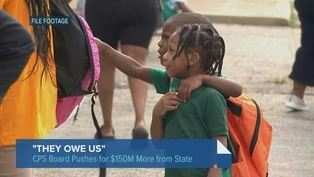
The new CPS budget assumes an additional $150 million in state funding that hasn't been approved. (10m 35s)
 New
NewSome Illinois Communities Say They’re Interested in New Nuclear Facilities
Video has Closed Captions
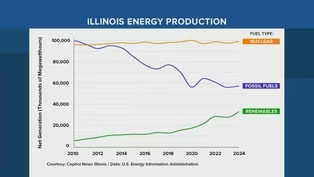
Hear from communities that are opening the doors to new nuclear reactors. (9m 58s)
Providing Support for PBS.org
Learn Moreabout PBS online sponsorship New Episode
- News and Public Affairs

Top journalists deliver compelling original analysis of the hour's headlines.
 New Episode
- News and Public Affairs

Today's top journalists discuss Washington's current political events and public affairs.



 New Episode
 New Episode
 New Episode
 New Episode

 New Season
Support for PBS provided by:
Chicago Tonight is a local public television program presented by WTTW
WTTW video streaming support provided by members and sponsors.