
Pluto and Beyond
Season 46 Episode 1 | 53m 30sVideo has Audio Description
The New Horizons spacecraft zooms toward an object 4 billion miles from Earth.
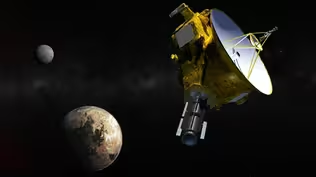
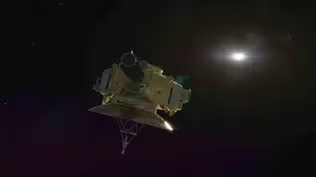
Since it explored Pluto in 2015, the New Horizons spacecraft has been zooming toward NASA’s most distant target yet. Join the mission team as the probe attempts to fly by Ultima Thule, an object 4 billion miles from Earth.
See all videos with Audio DescriptionADProblems playing video? | Closed Captioning Feedback
Problems playing video? | Closed Captioning Feedback
National corporate funding for NOVA is provided by Draper. Major funding for NOVA is provided by the David H. Koch Fund for Science, the Corporation for Public Broadcasting and PBS...
Support provided by:


Pluto and Beyond
Season 46 Episode 1 | 53m 30sVideo has Audio Description
Since it explored Pluto in 2015, the New Horizons spacecraft has been zooming toward NASA’s most distant target yet. Join the mission team as the probe attempts to fly by Ultima Thule, an object 4 billion miles from Earth.
See all videos with Audio DescriptionADProblems playing video? | Closed Captioning Feedback
Where to Watch NOVA
NOVA is available to stream on pbs.org and the PBS app.
Buy Now
Keep Exploring

NOVA Labs
NOVA Labs is a free digital platform that engages teens and lifelong learners in games and interactives that foster authentic scientific exploration. Participants take part in real-world investigations by visualizing, analyzing, and playing with the same data that scientists use.Providing Support for PBS.org
Learn Moreabout PBS online sponsorshipNARRATOR: Four billion miles from Earth, a spacecraft closes in on its target, a mysterious object far beyond all the known planets that could reveal new secrets about the birth of the solar system.
(explosion echoes) But the mission is risky.
ALAN STERN: Even being hit by something smaller than a single pellet of rice at 32,000 miles an hour would be catastrophic, and we would lose the mission.
NARRATOR: The spacecraft that brought us to Pluto is now attempting an even more challenging final quest.
Can it succeed?
FRED PELLETIER: There's only one shot, and if you make a mistake, that could be it.
NARRATOR: "Pluto and Beyond."
Right now, on "NOVA."
♪ ♪ ♪ ♪ NARRATOR: January 1, 2019.
It's the arrival of a new year.
♪ ♪ But here at Mission Ops, the mood is tense.
The team is feeling a little stressed.
NARRATOR: A team of scientists, along with their families and friends, are waiting in anticipation... I'm getting a little bit nervous.
NARRATOR: ...for the arrival of a signal from a tiny spacecraft on a dangerous mission.
Its name: New Horizons.
We are really pressing the limits here.
NARRATOR: "New Horizons" is attempting to fly by a mysterious object far beyond the planets we've come to know, a billion miles beyond Pluto, in the outback of the solar system.
STERN: This is the farthest exploration in the history of humankind, and nobody's planning anything like it ever again.
CATHY OLKIN: This is really challenging.
We're going to a small object that we don't know a lot about.
NARRATOR: In fact, one of the biggest, baddest space telescopes in our arsenal, the Hubble, can only capture a pixelated image of this tiny speck.
Its official name is 2014 M.U.69, but the New Horizons team also calls it by the Latin name Ultima Thule.
We gave it this nickname Ultima Thule that means "beyond the farthest frontiers."
JOEL PARKER: And in fact, it really is beyond the known world or part of our solar system that we have explored.
NARRATOR: Here, objects like Ultima Thule have been frozen in time since the solar system formed four-and-a-half billion years ago.
STERN: We believe this object, like many others out there, are actually planetary embryos.
And to study those objects will give us a great window into the process of planetary formation.
NARRATOR: For the New Horizons team, taking their spacecraft into the unknown is not only a monumental task, it's risky.
An object the size of a pea or even smaller would be capable of literally taking out the spacecraft.
NARRATOR: Tests have revealed that as the spacecraft travels at 36,000 miles an hour, even something as small as a grain of sand could rip a hole right through it.
ALICE BOWMAN: At this point in the mission, you really have to be prepared for anything.
♪ ♪ NARRATOR: But for now, all the team can do is wait, and hope that years of work will pay off and that the tiny explorer manages to stay on target-- and survive.
HAL WEAVER: I love this spacecraft.
I've put my blood, sweat, and tears into helping to put this thing together, going back to 2002.
It's just made us feel so proud.
NARRATOR: Proud, because when it comes to exploring our solar system, New Horizons is already a pioneer.
January 19, 2006.
New Horizons is prepared for launch at Cape Canaveral.
MAN: Two... one.
We have ignition and lift-off of NASA's New Horizons spacecraft on a voyage to visit the planet Pluto and beyond.
NARRATOR: The spacecraft sets out on a journey to reach not one, but two distant targets.
♪ ♪ Along the way, Alice Bowman, missions operations manager-- also known as MOM-- will help guide it through a voyage that will last more than a decade.
BOWMAN: We talk about the spacecraft as if it's our child.
When we launched, you know, we referred to it as a baby.
When it does something that we don't expect, we relate it perhaps to terrible twos or something like that, so it really, it becomes part of us.
NARRATOR: 78 days after launch, New Horizons passes the orbit of the red planet, Mars.
Just two months later, it flies through the asteroid belt.
In a year, it passes by Jupiter, where it captures spectacular images of a volcanic eruption on the gas giant's moon Io.
STERN: It was the first time that time-lapse had ever been made of any volcano anywhere in the universe off the Earth.
So it was really unique.
NARRATOR: The spacecraft travels another two-and-a-half billion miles past the orbits of three more giant planets-- Saturn, Uranus, and Neptune.
Finally, nine years after launch, New Horizons closes in on its first fly-by target-- Pluto and its moons.
They have only been observed from billions of miles away, our best images nothing more than a blur.
Until, in the summer of 2015, it slowly comes into view.
MARC BUIE: Every day, it was getting bigger and bigger and bigger and starting to reveal this world.
It was an incredible ride.
NARRATOR: The mission is proceeding without a hitch.
All is working as planned, but then... On July 4, 2015, just ten days before the Pluto fly-by... WEAVER: I got a call from the New Horizons principal investigator, Alan Stern.
I could hear that he was panting.
He was running down the hallway here at APL.
He said, "We lost contact with the spacecraft," and I said, "You've got to be kidding."
You know, this has never happened before.
You just feel, you know, that pit in the bottom of your stomach.
GLEN FOUNTAIN: Your pulse goes up a little bit.
Could it be, you know, these millions of miles away, we hit something?
NARRATOR: Is the spacecraft still in one piece?
The team races to figure out what's gone wrong.
WEAVER: It took a little while, but we realized exactly what had happened is, we had overloaded the computer.
MARK HOLDRIDGE: That's sort of like your worst nightmare a week before an encounter.
BOWMAN: We knew that we could fix it.
The question was: Were we going to be able to do that in enough time?
FOUNTAIN: Alice, I swear, didn't get any sleep, but she said she slept on the floor for a few minutes one night.
(Bowman laughs) For a couple of nights, slept there, you know, just like a child that's sick.
You want to be there to help it recover along the way.
NARRATOR: The team works round the clock, re-uploading instructions to the spacecraft's computer.
WEAVER: Alice Bowman, our mission operations manager, and her team did a fantastic job of putting everything back together again with only six hours to spare.
NARRATOR: Just in time for the fly-by.
♪ ♪ Okay, we're in lock with carrier.
NARRATOR: July 14, 2015.
Three billion miles from Earth, New Horizons should have just flown above Pluto's surface, taking pictures and gathering data.
But did it make it?
Stand by for telemetry.
NARRATOR: Alice waits to hear back from the spacecraft-- a sign it has safely completed the fly-by.
New Horizons is so far away, it takes four-and-a-half hours for that signal to reach Earth.
MOM on Pluto 1.
We have a healthy spacecraft.
We've recorded data of the Pluto system.
(cheering and applauding) It was a huge sense of relief and accomplishment.
I think mostly accomplishment.
(cheering and applauding) We did it.
MAN: We did, we did.
It's just great.
♪ ♪ NARRATOR: The first up-close images come in.
And they shock the world.
♪ ♪ JOEL PARKER: When the images first came down from New Horizons, I was stunned, excited, tired-- every emotion and feeling you can imagine, but really just amazed at what they looked like.
NARRATOR: This tiny world, with a diameter less than 1,500 miles, turns out to be incredibly complex, with mountains more than a mile high.
JOEL PARKER: The Rocky Mountains here are beautiful, and the Flatirons in the background, but instead of rock, the mountains on Pluto were made of ice, and at those temperatures, ice is so cold, it's like bedrock.
NARRATOR: Pluto's most famous feature, its heart, contains a massive glacier that flows across its surface.
OLKIN: I certainly did not expect a glacier of nitrogen and methane ices.
Never in a million years did I expect that.
JOHN SPENCER: We're seeing processes, some of which look quite familiar from the Earth, but are happening in a completely alien environment with completely alien materials.
NARRATOR: Pluto even has volcanoes made of ice.
OLKIN: There is something that looks very much like an ice volcano on Pluto.
We didn't see it erupt, but it sure looks like a volcano.
NARRATOR: Using images and data collected by the spacecraft, the team created this simulation of what it would feel like to fly over Pluto's surface.
STERN: Some of the geologists on our team have taken to calling Pluto the new Mars, because it's every bit as complicated.
NARRATOR: What could be driving such geological diversity on such a tiny world?
One theory: Pluto's surface may change with the seasons.
Pluto doesn't really have the sort of four seasons that we have.
We have very even seasons: We have a hot summer and a cold winter that's about the same length of time in each one, because Earth is in a circular orbit around the sun.
Pluto's not.
It's in this very eccentric orbit around the sun.
NARRATOR: As Pluto, along with its largest moon, Charon, gets closer to the sun, its surface warms.
But as it continues on its 248-year orbit, getting farther and farther from the sun, its surface becomes colder.
So there are these extreme seasons.
In summer, ices on the surface can evaporate.
In winter, they can re-condense, so when you see it today, it is not going to look the same as it looks in a hundred years, when it's in the opposite season.
NARRATOR: But there could be another strikingly different reason for Pluto's complex surface.
Based on measurements of its density and chemical composition, scientists believe it has a rocky core.
All rock contains radioactive elements, which as they decay, release heat.
So there's a continual flow of heat from the interior of Pluto to the, to the outside.
But it's a very small amount of heat, because Pluto is pretty small-- it doesn't have that much rock in it.
But we think that even that tiny amount of internal heat is enough to move mountains, literally.
NARRATOR: And it may also be enough heat to create something extraordinary beneath Pluto's icy crust.
CALEB SCHARF: Right now, Pluto is covered in frozen water and frozen nitrogen and a few other compounds.
It's quite possible that in the past, there was enough heat internal to Pluto to melt some of that ice and create a layer of ocean.
SPENCER: We suspect that Pluto has an ocean of liquid water deep in the interior, hundreds of miles below the surface.
SCHARF: It raises what seems like an extraordinary possibility, that if you have liquid water and rock deep inside Pluto in contact with each other, well, that's an environment that life could exist in.
STERN: I think one of the most mind-blowing things is to hear the astrobiologists talk about the fact that that could be an abode for life, potentially.
Here we have a world whose surface is just 40 degrees above absolute zero.
It's three billion miles from the sun.
You would never expect life at those kinds of temperatures.
NARRATOR: Whatever's causing the extraordinary geology on Pluto's surface will be debated for years to come.
STERN: There are a lot of theories and there are a lot of ideas, and we don't know which one is right or if none of them are right.
We're in this wonderful position of knowing volumes compared to what we knew before, but it's maddening, because unlike Mars, which is around the corner, and you could fly to very quickly again, it's a big undertaking to cross the entire solar system.
♪ ♪ NARRATOR: As its historic fly-by comes to an end, and the tiny spacecraft leaves Pluto, New Horizons looks back to take one last breathtaking image.
My real favorite, favorite picture is one after we flew by Pluto, and we're looking back and we see the horizon of Pluto, with the sun lighting the atmosphere from behind.
You can see layers of haze and shadows of mountains streaming across the surface, and that is where you really understand that Pluto is a world.
BUIE: Whenever I see that picture, it's as if I'm sitting on the spacecraft, looking out the window as Pluto goes whizzing by, and it, more than any other picture that we took, puts me there.
STERN: That photograph for me is the crowning achievement.
We were really there and we really did it.
And we made our own little contribution not just to science, but actually to history.
NARRATOR: That history begins back in 1930, when Pluto is discovered by Clyde Tombaugh, a young farm boy with a passion for astronomy.
For nearly a century, Clyde has the honor of being the only American to discover a planet.
But almost from the get-go, many astronomers aren't buying it, because when it comes to being a planet, size matters.
KONSTANTIN BATYGIN: When you discover an astronomical object far, far away, you have no direct way of measuring its mass.
You don't actually know how massive it is.
And so people speculated about, maybe Pluto was one Earth mass, and then people kept revising their estimate down and down and down.
Until people realized, "Oh, my gosh, this thing is really, really small."
NARRATOR: It turns out Pluto is smaller than Earth's moon, but size wasn't Pluto's only problem.
So was its location.
A tiny little planet in the outer solar system just didn't make sense.
DAVID JEWITT: Pluto was regarded as a planet, but it was always regarded as a kind of funny planet, a weird planet, somewhat out of place.
So the sun sits in the middle.
The sun is this massive body made of hydrogen, it's a million times the mass of the Earth and about a hundred times the diameter of the Earth, and it's orbited by planets, which are moving in nearly circular orbits.
And then at the very edge, the outer edge of this system of planets, we knew of Pluto.
Pluto is not really like a terrestrial planet, because it's got quite a bit of ice in it.
Pluto is not at all like a giant planet, because it's tiny and it's not made of gas-- it's made of solid material.
And it also has a very strange orbit with a high ellipticity and a high inclination.
It's tilted up relative to the plane of the solar system.
Beyond Pluto, uh... there was nothing, and people actually didn't think about that in general, because it's just an empty space.
And next stop, uh, the stars.
NARRATOR: Is the solar system's little misfit really alone out there?
For decades to come, astronomers look for another planet beyond Pluto.
But as hard as they look-- and they look hard-- no one finds anything.
Until two astronomers, David Jewitt and Jane Luu, take on the challenge.
JEWITT: The original thought that we had was simply that the outer solar system is weirdly empty.
NARRATOR: David and Jane get access to one of the most powerful telescopes on the planet, and they start a search that will take a lot longer than either one of them expects.
While it's easy to see distant stars, because they radiate their own light, other celestial bodies are much harder to see.
That's because light has to travel all the way from our sun to the object, reflect off its surface, and then make the long journey back to Earth.
By then, it's barely visible.
David and Jane hope that advances in digital detectors, which are far more sensitive to light than film, will help them see a whole lot more.
August 1992, Mauna Kea Observatory, Hawaii.
After searching for six years, they finally find an object moving in the night sky.
JEWITT: Here is the set of discovery images for the first object.
So you can see this object drifting from this picture to this one to this one.
It's drifting slowly to the left.
NARRATOR: A tiny object beyond Pluto orbiting the sun.
Then they find more.
And more.
So the space beyond Neptune basically, is full of objects that we just didn't know about before because they're too faint.
NARRATOR: David and Jane discover an entirely new region of the solar system.
Now known as the Kuiper Belt, it's believed to be home to hundreds of thousands, possibly millions, of icy objects-- including Pluto.
JEWITT: The Kuiper Belt has a thousand times more objects in it than we have in the asteroid belt, completely unknown until these first observations.
BATYGIN: The Kuiper Belt stretches out billions of miles.
It is just difficult to imagine how expansive this field of icy debris is.
NARRATOR: Think of it as a giant doughnut surrounding the planets, on average, each Kuiper Belt object separated from the next by a million miles.
That's how massive the Kuiper Belt is.
BROWN: The day that the first new Kuiper Belt object was discovered by Dave Jewitt and Jane Luu, it clicked in everybody who was paying attention's head, it was, like, "Oh there's a ton of objects out there.
"That's what Pluto is part of, Pluto's part of the Kuiper Belt.
It suddenly all makes sense."
JOEL PARKER: For me, Pluto was the harbinger of things to come.
We didn't realize that its being an oddball was telling us something, it was telling us the secret of the third zone of the solar system.
This really sort of restructures our understanding of how our solar system is built and how we should think about the membership of our solar system.
♪ ♪ NARRATOR: August 2006, Prague.
Just a few months after New Horizons set out to explore the ninth planet of the solar system, an international association of astronomers votes to demote Pluto.
And the official planet count goes back down to eight.
While some members of the public are outraged, not everyone sees this as a demotion.
(crowd chanting) PITTS: One could argue that Pluto actually made out better with this change, because in its previous instance, it was the smallest planet of the solar system.
It now has become the king of the Kuiper Belt, and so, in a sense, its status has gone up.
NARRATOR: Over the last few decades, astronomers have discovered that Kuiper Belt objects vary in size, shape, and also in their orbits.
There are larger objects, like Pluto.
These are known as dwarf planets.
We've discovered that the outer solar system is littered with small planets.
These are typically rocky and icy objects.
Many have atmospheres, many, possibly most, have moons.
There's a great variety in terms of their physical properties, their colors, their compositions-- many of the things we're used to in the planets we're familiar with, but in miniature.
I think a decent analogy is, when you see a Chihuahua, it's still a dog, because it has the characteristics of the canine species, just in miniature.
NARRATOR: Then there are objects like Ultima Thule.
Astronomers think these objects have been frozen in time since the birth of our solar system four-and-a-half billion years ago.
ALEX PARKER: So what we think we're seeing is a fossil structure that's left over from the formation of the solar system.
It's this tiny remnant of the ancient past that we can visit.
PITTS: Objects like M.U.69 retain the pristine conditions of the early solar system.
This now lets us look at these objects with the idea that an examination of them will help us better understand what the early solar system was like.
NARRATOR: Unfortunately, our best images of these primordial objects are only single pixels of dim light, almost impossible to see.
If only we could get a spacecraft out to the Kuiper Belt to take a closer look.
But of course, there's one already out there.
SPENCER: When we launched the New Horizons spacecraft back in 2006, we knew we wanted to fly to an object beyond Pluto, but we didn't have a particular object that we knew we could reach with our spacecraft.
So we started doing deep searches of the sky beyond Pluto.
NARRATOR: April 2011.
While New Horizons is traveling through the solar system, at the Southwest Research Institute in Boulder, Colorado, Marc Buie leads the search for New Horizons' next target.
But the team faces extraordinary limitations.
The region their spacecraft can safely reach is extremely small.
OLKIN: There's certain things we don't have an infinite supply of, like fuel.
And our thrusters, we only want to put so many thruster counts on them.
NARRATOR: Thrusters make it possible to redirect your spacecraft as you zero in on a target.
Without them, there's no way to steer the ship.
If you use them beyond the lifetime that they were designed for, they could have a failure.
NARRATOR: But an aging spacecraft is just one of many challenges.
Where you need to look is probably one of the hardest spots in the sky to look.
It's right in the middle of the Milky Way.
SPENCER: The densest star fields in the entire sky, where you would see a million stars brighter than the objects you were looking for, and you had to try and sift it out between all those stars.
NARRATOR: They search for several years, and find nothing.
BUIE: We were starting to say, "What's going to happen?
"We have to find an object in 2014.
"If we don't find one in 2014, "we won't know well enough where the object is to redirect the spacecraft to get there."
NARRATOR: The clock is running out.
It's time for the big guns.
It's time for Hubble.
From its vantage point far beyond the Earth's atmosphere, the Hubble space telescope has a better chance of spotting faint objects, and that makes all the difference.
SPENCER: After a big effort with the Hubble telescope in the summer of 2014, we found an object.
WEAVER: Wow, it was truly exhilarating.
(laughing): Yay, we've done it!
HOLDRIDGE: This is kind of a first, to discover an object while you're in flight, and then redirect the spacecraft to fly by it, and determine its orbit along the way.
NARRATOR: Nailing down Ultima Thule's orbit is critical for the success of the mission.
(gunshot echoes) Think of it like skeet shooting.
You have to predict where your target will be... (gunshot echoes) ...in the future.
So we do shooting and targeting in the outer solar system.
You're going to tell me here how you do shooting and targeting on Earth.
NARRATOR: New Horizons team member Anne Verbiscer and sharpshooter J.R.
Pierce demonstrate.
It's not a space vehicle, but... We'll get our point across here.
♪ ♪ PIERCE: Pull.
(launcher rattles) NARRATOR: If J.R.
aims directly at the target... (gunshot echoes) He's gonna miss.
Launch.
I'm initiating the launch sequence.
Pull.
NARRATOR: But if he aims ahead of the target... (gunshot echoes) It's a hit.
(gunshots echo) Again and again.
(laughing) (gunshot echoes) And again.
You need to focus on where your target is going to be, not where your target is.
(gunshot echoes) So this reminds me of when I was a child and watching the Apollo launches.
MAN: All engines running.
We have a lift-off.
VERBISCER: It fascinated me that they were targeting where the moon was going to be three days after the launch happened, and that's when the astronauts would arrive to try and land on it.
So for New Horizons, the concept is basically the same as it was for Apollo, but the distances are far greater.
STERN: We have to intercept where it will be years down the road.
So we have to calculate where it will end up on the exact day and hour and literally minute of the fly-by from years in advance.
NARRATOR: Images taken by the Hubble space telescope help the team track Ultima Thule's orbit.
But they still need to know more.
They don't know how big it is, or even what shape it is.
JOEL PARKER: Ultima Thule is a completely, almost unknown object.
This is terra incognita.
It's a new world.
Details we don't know.
NARRATOR: But there may be a way to find out more by observing a rare celestial event.
An occultation in its simplest form is when something gets in front of something else.
If you've ever been on a beach, and you're just enjoying a nice sunny day, and then all of a sudden the sun goes away because somebody just walked in between you and the sun, and there's that shadow passes across your face, the same exact thing is happening here, except instead of our sun, it's a star, and if the star is hidden from your view, you are in the shadow of the Kuiper Belt object.
♪ ♪ If you can measure the edge of that shadow, it shows the shape and size of the object.
Suppose it's moving 20 miles per second across the sky, and the star disappears for one second, now you know that it's 20 miles across-- easy.
You just have to be in the right place at the right time.
NARRATOR: But how do you get to precisely the right place at the right time?
BUIE: There's two pieces to this.
You need to know where the object is, and that's what Hubble does for us, but you also need to know where the stars are.
NARRATOR: And that's where the Gaia Mission comes in.
The Gaia Space Observatory has been creating the most precise three-dimensional star map of our galaxy that has ever been made.
BUIE: And we knew that when we had those star positions, we had a chance of actually predicting an occultation with M.U.69.
NARRATOR: In the summer of 2017, the New Horizons team finds a match.
The two best places to view this occultation-- where their telescopes can detect Ultima's shadow-- are in the mountains of Argentina and the countryside of South Africa.
Much like the solar eclipse that many people saw in 2017, you have to be in the right place at the right time to be in the path of the shadow.
So we're here.
Let's hit that first.
VERBISCER: 54 people going to two different continents to watch an event that takes two seconds to happen?
Overwhelming.
♪ ♪ NARRATOR: The teams set up their telescopes in the middle of nowhere... And hope for clear skies.
BUIE: We sent 13 telescopes to South Africa.
12 telescopes to Mendoza, Argentina.
NARRATOR: Searching for a blink four billion miles away.
BUIE: And saw nothing.
(sighs) All of that work and nothing.
NARRATOR: It turns out that their estimations of Ultima Thule's orbit are off.
The star that was supposed to blink continued to shine.
BUIE: Everybody was a little depressed about that.
♪ ♪ NARRATOR: A month later, they get a second chance to find out whatever they can about Ultima Thule's size and shape, but to be in the right place at the right time is going to be even harder.
On July 10, of 2017, there was another occultation observable only over the South Pacific Ocean, and really accessible only to the SOFIA aircraft.
NARRATOR: The SOFIA Airborne Observatory is a specially modified Boeing 747, with a telescope on its side.
What we're doing here with SOFIA is putting a very large telescope into the occultation path at just the time the shadow is there.
BUIE: The reality is there are so many details, what are the winds doing, we had to worry about a turbulence zone that we might have to fly around.
NARRATOR: The moment of truth arrives.
They wait for the star to blink out.
Are they in the right place at the right time?
Again, they see nothing.
So everybody is kind of depressed again.
Okay, we've done it a second time and we've got nothing.
NARRATOR: After two misses, reality sets in.
BUIE: We thought we struck out twice.
Okay.
What's going to happen next?
NARRATOR: But they get another chance.
VERBISCER: The next occultation in Patagonia was only seven days later, on July 17.
So we really had to shift gears quickly and get ready to do this next ground-based effort.
STERN: The stellar occultations that we have been attempting, are the most challenging stellar occultations ever attempted in history.
Because Ultima is so much further away than anything else, and it's tiny.
The night of the occultation, winds were, were pretty bad.
(wind howling) These telescopes we use are really great however, they are very wind-sensitive.
We wanted to shield that telescope from every possible vibration, and that meant we had to do whatever it took to get the data and observe the star without it jiggling around all over the place.
(wind howling) NARRATOR: For that, they need a few volunteers.
If you just started out with, "We're from NASA," people just come out of the woodwork.
We had two people show up-- a father and his daughter.
They brought a spare battery.
Perfect, so we put them to work.
♪ ♪ NARRATOR: Together, for 45 minutes, they blocked the wind with a truck, some plywood, and a tarp.
Did they catch it?
We spent hours after people came back with the data to see whether we got it or not.
(indistinct chatter) NARRATOR: Does the star blink or have they failed again?
(cheering and applause) VERBISCER: We'd finally had success and saw the star blink out.
This is what we came for.
This is it.
MAN: Oh, my God.
That's what's it's all about.
Six months worth of work.
Just two frames and the star is gone.
Unbelievable.
NARRATOR: In fact, five telescopes capture the blink.
Each from a different perspective.
When pieced together, their data suggests that Ultima is about 20 miles long, but its shape is more complex than anyone expected.
Immediately I could tell this is not just some simple spherical object that we're looking at.
It's a much more complicated shape.
NARRATOR: They come up with three possibilities.
One is, you have two circular objects that are close to each other but they're orbiting each other.
Or it could be just some lumpy potato-shaped thing.
♪ ♪ And then the third is what we call a contact binary-- two balls stuck together.
♪ ♪ And we think it could happen for Kuiper Belt objects.
We don't know, we've never seen one of these things before.
NARRATOR: But when New Horizons finally brings Ultima Thule into focus, the results could be profound.
This elusive object could revolutionize our understanding of how the planets in our solar system formed.
If the solar system is an intricate and complicated castle, then M.U.69 is a brick, and you don't know how this castle was made until you understand what the brick looks like.
NARRATOR: Four-and-a-half billion years ago, the planets in our solar system formed from a massive disk of gas and dust.
Scientists have detected the beginning of this process in striking images of distant solar systems like this one known as HL Tauri, a young star about 450 light years from Earth.
We have these beautiful observations of disks of gas and dust around other stars.
So we know that planet formation starts from small dust grains.
NARRATOR: In our own solar system, scientists theorize that through a process called accretion, gas and dust stuck together, a lot like those clumps of dust and dirt that collect under your bed.
Dust bunnies, held together by a powerful force-- static electricity.
SCHILICHTING: So you can think of planet formation, the initial stages, very similar to just letting your dust bunnies under your bed grow for millions of years into bigger and bigger objects.
NARRATOR: If you don't vacuum, those dust bunnies will just keep getting bigger.
But for the seeds of planets to grow, they need more.
They need the power of gravity.
(explosions) After objects reach a certain threshold in their mass, they can grow more rapidly than they could before, because they have substantial gravity.
NARRATOR: But there's a catch: There's a gap between making something this big and making something the size of a planet.
NARRATOR: How does an object grow from the size of a marble to the size of a planet?
In the last decade a new theory has emerged.
CAREY LISSE: A stream of marbles will come along and as it's moving around the sun and some of them will clump and you'll suddenly get a huge amount of clumping action and that's called pebble accretion.
And one of the things we can do by looking at Ultima Thule is look to see whether it was formed by pebble accretion.
If we see lots of BB- to marble-sized pieces on the surface of M.U.69, we're gonna go "A-ha, this is a loose collection of pebbles."
And pebble accretion argues for things that are elongated or potato-shaped, which is what we seem to see for Ultima Thule from our ground base occultation.
JOEL PARKER: We're interested scientifically how planets formed, although in our hearts we're also interested about where we came from, how we got here.
What were the elements?
And the outer solar system objects like Ultima Thule are the raw materials.
And so we're getting a chance to look back at these well-preserved raw materials to see really what was the starting point, what were the ingredients that went in to the magic recipe that makes life.
NARRATOR: October 4, 2018.
89 days before fly-by, New Horizons is 30 million miles from Ultima Thule and closing.
Fred Pelletier and a group of vigilant navigators are tracking Ultima's orbit to ensure their spacecraft won't miss the mark on New Year's Eve.
They rely on images like this taken by New Horizons' long-range telescope, named Lorri.
But at this distance, tracking tiny Ultima among a dense field of stars is no easy task.
FRED PELLETIER: It's a very crowded star field-- these are all stars and Ultima is in the center right there.
So what we do is we have a catalog of the starfield that we use to remove the stars.
We end up with this image that highlights our target, Ultima Thule, here.
NARRATOR: Next they zoom in to take a closer look and discover their estimate of Ultima Thule's orbit is off.
PELLETIER: The yellow cross represents where we thought Ultima Thule would be before we took the picture, and the blue greenish one represents, well, where it actually is.
So, as you can see, we're a little bit off.
And the difference here doesn't seem too much on this scale, but it's actually 600 miles from the target.
BOWMAN: Because this object is so very, very small, it's possible that if we are a little bit off, we could just miss seeing the object and we certainly don't want to do that.
PELLETIER: There's only one shot and if you make a mistake, that could be it.
NARRATOR: For the next few weeks, the navigators will carefully follow Ultima's path, examine every pixel of every frame to help guide New Horizons to its target on New Year's.
If their calculations are right the spacecraft will fly just 2,200 miles above Ultima's surface.
PELLETIER: This is a comparison of about 30 days out.
What Pluto looked like and what Ultima Thule looks like right now.
So you're asking me what the challenges are of this mission, this image is worth a thousand words.
The size of Ultima Thule is a small dot still, and it will be the case until a few days before the fly-by.
That makes it very different from Pluto.
NARRATOR: As the weeks go by, New Horizons sends back more images of the distant dot.
December 29, 2018.
Three days away from the fly-by and the anticipation is certainly building.
We thought we'd know a lot more by now.
VERBISCER: I think everyone would have said, "You'll know how fast it's rotating, can get an idea of what the shape is like.
NARRATOR: But so far, answers remain tantalizingly out of reach.
VERBISCER: It is holding its secrets to the last possible minute.
I mean we keep saying, "Well, we're gonna know eventually, right?"
But right now, it's still a mystery.
NARRATOR: As the fly-by approaches, preparations continue all night.
This evening I'll be sleeping in my office, so I brought my little backpacking tent in.
I'll have time for sleep later.
BOWMAN: Things have been happening so fast.
Don't ask us what day it is.
(laughs) Most of us cannot remember whether it's Monday, Tuesday, or whatever.
We know how many days it is to fly-by.
CROWD: Ten... Nine... Eight... NARRATOR: January 1, 2019.
12:33 A.M.
CROWD: One!
Go New Horizons!
NARRATOR: As the world brings in the new year, the New Horizons team celebrates the moment of the spacecraft's closest approach to Ultima Thule.
But it will be hours before anyone knows if the fly-by is successful.
PARKER: Ultima Thule is so far away that it takes six hours to send a signal from the spacecraft to Earth.
Which is crazy, it's a really long time to wait.
NARRATOR: Later that morning, team members, family, and friends wait anxiously for New Horizons' signal to finish crossing four billion miles of space and reach Earth.
Go ahead, RF.
MAN: What the green screens will tell you and RF is in fantastic shape.
Copy that, RF is green.
NARRATOR: The signal comes in.
But Alice Bowman, New Horizons' MOM, waits for confirmation that each system on the spacecraft is working.
Copy thermal is reporting green status.
NARRATOR: Most crucially, she wants to hear if the digital recorders are full of precious data.
Go ahead, CNDH.
MAN: CNDH is nominal.
Our SSR pointers are right where we predicted.
(crowd cheering, applause) Copy that.
Whoo!
(applause) HOLDRIDGE: What that means is that the solid state recorder, the pointers are where they should be, that tells me that we observed something.
Something filled that camera.
(applause) We have a healthy spacecraft.
We've just accomplished the most distant fly-by of our solar system.
(applause) ♪ ♪ NARRATOR: That night, first close-up image of this distant object comes in.
Well, what we saw today blows out of the water anything we've seen.
The first image was two or three pixels across.
Yesterday, you could see kind of two lobes.
And today's image we see it for what it really is: basically two spheres stuck together.
Like this really is two things that formed as two different objects.
VERBISCER: It's confirmation of what we saw in the occultation.
The shape that was predicted from that was almost exactly correct.
SPENCER: It's the kind of thing we were looking to see is planetary formation frozen in time and here it is right in front of us it's just wonderful.
VERBISCER: We got what we came for.
(both laughing) SPENCER: I think it's tending to substantiate the ideas that these objects form as clumps, as pebble accretion.
I think it's so far looking like a really nice confirmation of those theories.
♪ ♪ I just was staring at it with tears in my eyes because we've been working for so long to do this, and it worked, and I just couldn't get over that yet, I still haven't gotten over that.
Absolutely amazing to see that.
OLKIN: This is exploration at its purest.
When you think about it, it's remarkable.
We didn't know this object even existed when we were building the spacecraft.
JOEL PARKER: Going into the unknown is fundamentally important for the human spirit from every aspect-- from scientific, to artistic, to just wondering where we came from and why we're here.
NARRATOR: It will take 20 months for New Horizons to send back all the data and images collected of Ultima Thule.
And with many years of power left on the spacecraft, the team hopes it will continue to explore the far regions of the solar system.
But already, this tiny probe, and the humans who built and guided it on its journey, have made gigantic discoveries, taking us to new worlds, making the unknown known, and bringing the impossibly distant finally within reach.
♪ ♪ ♪ ♪ ♪ ♪ ♪ ♪
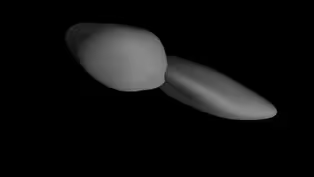
Ultima Thule is Surprisingly Flat
Video has Closed Captions
Clip: S46 Ep1 | 1m 38s | This discovery could have a big effect on how scientists think about planet formation. (1m 38s)
Days Before Flyby, Ultima Thule Still Mysterious
Video has Closed Captions
Clip: S46 Ep1 | 1m 45s | NASA's New Horizons spacecraft is about to visit the most distant object ever explored. (1m 45s)
New Horizons Makes Historic Flyby on New Year's Day
Video has Closed Captions
Clip: S46 Ep1 | 2m 9s | The New Horizons spacecraft made history by conducting the farthest ever flyby. (2m 9s)
Video has Closed Captions
Preview: S46 Ep1 | 26s | The New Horizons spacecraft zooms toward an object 4 billion miles from Earth. (26s)
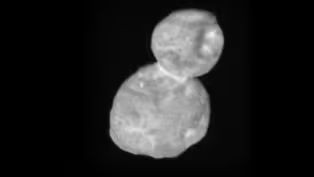
Ultima Thule Comes Into Focus as New Images Reveal Secrets
Video has Closed Captions
Clip: S46 Ep1 | 1m 13s | NASA scientists received the most detailed images from its spacecraft, New Horizons. (1m 13s)
Providing Support for PBS.org
Learn Moreabout PBS online sponsorship New Episode
- Science and Nature

Capturing the splendor of the natural world, from the African plains to the Antarctic ice.

 New Episode










Support for PBS provided by:
National corporate funding for NOVA is provided by Draper. Major funding for NOVA is provided by the David H. Koch Fund for Science, the Corporation for Public Broadcasting and PBS...