
I-80 Art Sculptures and More
Season 17 Episode 12 | 25m 10sVideo has Audio Description
Revisit the story behind I-80’s rest stop art, exploring Omaha’s historic role in women’s bowling.
Revisiting the story behind I-80’s iconic rest stop art, exploring Omaha’s historic role in women’s bowling, and tracking the elusive swift fox. Nebraska transformed I-80 rest stops with iconic sculptures as part of the bicentennial. Erin McCarthy is an Omaha bowler who was part of the 3009 NCAA women's championship bowling team and the 2022 US women's open champion.
See all videos with Audio DescriptionADProblems playing video? | Closed Captioning Feedback
Problems playing video? | Closed Captioning Feedback
Nebraska Stories is a local public television program presented by Nebraska Public Media
I-80 Art Sculptures and More
Season 17 Episode 12 | 25m 10sVideo has Audio Description
Revisiting the story behind I-80’s iconic rest stop art, exploring Omaha’s historic role in women’s bowling, and tracking the elusive swift fox. Nebraska transformed I-80 rest stops with iconic sculptures as part of the bicentennial. Erin McCarthy is an Omaha bowler who was part of the 3009 NCAA women's championship bowling team and the 2022 US women's open champion.
See all videos with Audio DescriptionADProblems playing video? | Closed Captioning Feedback
Where to Watch Nebraska Stories
Nebraska Stories is available to stream on pbs.org and the PBS app.
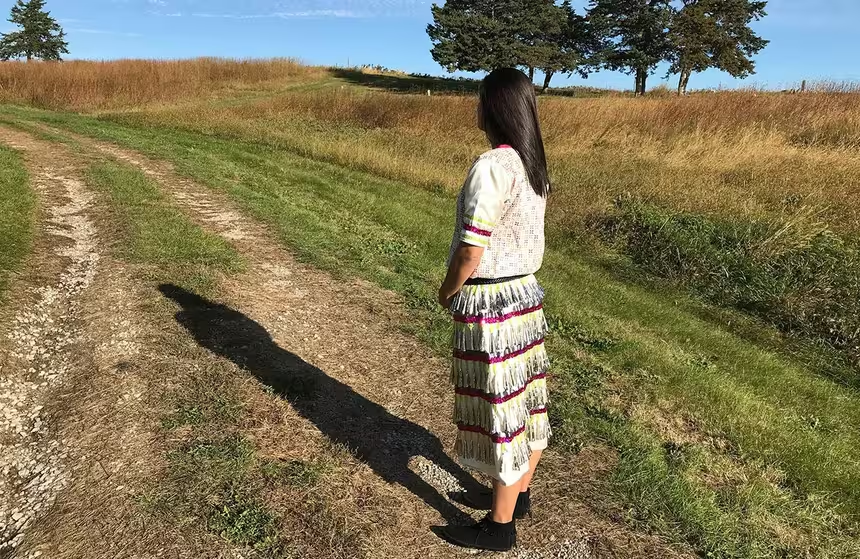
Do you have a Nebraska Story?
Do you have a story that you think should be told on Nebraska Stories? Send an email with your story idea, your name, your city and an email address and/or phone number to nebraskastories@nebraskapublicmedia.org. Or, click the link below and submit your information on nebraskastories.org.Providing Support for PBS.org
Learn Moreabout PBS online sponsorship(upbeat music) -[Narrator] Coming up on Nebraska Stories.
The once controversial and now iconic art along I-80.
How Omaha bowling past produced a modern champion and tracking Nebraska's most elusive wildlife.
(upbeat music) (upbeat music) (upbeat music) - When they heard sculpture.
So many people imagined in their own minds what it would be.
And no one could imagine what we actually came up with.
(upbeat music) - Recent history records no bigger controversy than the Great debate in 1975 on the I-80 sculpture project.
Everyone had an opinion.
(upbeat music) - What makes this project particularly unique was the expansiveness of of distance and time.
(upbeat music) - This was kind of a bold new idea, and Nebraskans tend to be a little stubborn with new ideas.
(upbeat music) - We will, in the course of these next 12 months, create a series of ten major pieces of large scale sculpture located at ten rest stops stretching across Nebraska's 455 mile span of U.S.
Interstate 80.
(upbeat music) (upbeat music) -[John] Every state was doing something for the bicentennial, not just a parade.
(upbeat music) There was enthusiasm.
(upbeat music) There was hope.
(upbeat music) There was a real pride in the country.
- It was an exciting time being in the Sheldon.
I was certainly aware of a major project that was happening under the leadership or the guidance of then director Norman Geske.
(upbeat music) -[Art] Norman had started to assemble.
I think one of the the great collections in the world of 20th century art right here in Lincoln, Nebraska.
(upbeat music) -[Karen] So people were beginning to understand the whole concept of public sculpture.
(upbeat music) - Tom Yates, who was at the time working with the Department of Economic Development and Tourism.
He came up with the idea of creating a monumental sculpture.
- His idea was to put a giant mastodon out on the interstate north of Lincoln that would draw people into Lincoln.
- Nebraska was the first state in the nation to complete the mainline interstate highway system.
- It just so happened it coincided with the bicentennial celebration planning.
So Norman got the idea of spreading it all across the state, combining it with that that new ribbon of highway.
- The federal government gave every state $100,000.
To do something.
Other people, you know, they did pageants or they did events.
- We went to the state Bicentennial Committee with the idea and asked for their financial support, and they agreed.
They thought it was a good idea.
(upbeat music) -[Santiago] More than anything in the world I wanted to do that project.
I remember when I got the telegram saying that I had been awarded the Sculpture Commission for the Grand Island location.
(upbeat music) I was just thrilled.
(upbeat music) -[Dan] It was unusual at the time to see sculpture on the interstate.
-[Art] It just so happened that the art was abstract in nature.
-[Karen] And the whole concept was not to be looking backward, but to be looking toward the next century.
- Public generally has a very strong belief on what they find aesthetically beautiful.
You're never going to get full consensus on what what is acceptable or not acceptable.
- Well, it wasn't cowboys on horseback.
I think they felt bamboozled by the fact that they weren't traditional sculptures.
-[Karen] But the other problem with this project was that there were no Nebraska or Midwest artists represented.
- The legislature decided they needed to have public hearings.
(static) -[Varner] I think it should be emphasized that this project was conceived and developed by Nebraskans, and the majority of funding is being voluntarily raised by Nebraska businessmen.
- I can't get this money straight.
Somehow I feel that it's coming out of the taxpayer's pockets.
- And just because you don't understand one of the sculptures is no reason to throw it out, because maybe someone will get it right off.
And if you don't appreciate it, nobody's going to make you sit there and look at it.
- I think the art organizations have done a real good job in representing their case, but I don't think this is a true cross section of the opinion of the citizens.
- When I get to these locations, people were either suspect of the project or angry about it.
Not everybody, but enough people to to notice.
- We thought the injustice of the whole thing was that none of our tax money was was involved in this.
(static) Therefore, it's a free gift and all we have to do is accept it or not accept it.
- These people say that we, uh, that they should have self-expression.
(static) What about the people who are against it?
How about their self-expression?
- We have to spend the year earning monies to take students on field trips to Lincoln (static) and to Omaha, and this is going to be a tremendous opportunity for my classes to have an sculpture of this nature close by.
- My question is, "Does any art object have a place on our interstate rest areas?"
- But by the time I got through with the presentation, whatever, those feelings kind of evaporated.
(upbeat music) -[John]I would fly out to meet with the engineers.
The fabrication house I was using the steel company.
We used a company called chief as a young man who owned the company, and he let me work there.
When the sculpture was completely welded, now we had to grind off all the welds because that's the way I like to finish my pieces.
(upbeat music) - Hans van de Bovenkamp's piece out in Sidney.
had one problem almost from the beginning and George Baker's piece in high winds, it got away.
It got loose and floated down to the end of the lake.
Now it's on dry dock as a result.
(upbeat music) -[Dan] Art and I basically said, you know, we have to be a little more proactive on how we start to treat these sculptures.
We need to make sure that we lay the groundwork for their care and preservation into the future.
I felt that the first step in that was to get them listed on the National Register.
-[Santiago] These are very notable artists, right?
And these works are significant works of art, and they've now become ingrained in the communities that they're a part of.
This is an assembling of significant works from this particular time, and it's here in Nebraska.
And I think that that's really incredibly important.
(upbeat music) -[John] The I-80 sculpture project was extremely, profoundly important in my career, and the people were so wonderful.
(upbeat music) I mean, Nebraska will always be (upbeat music) very, very important part of my life.
- I mean, for me, it was an incredible opportunity.
And I learned so much working with sculptors.
On the one hand, the Department of Roads, on the other hand, and golly, it really changed my life.
(upbeat music) ♪ ♪ (gentle music) (gentle music) -[Erin] I don't know who I would be or what I would do without the sport of bowling.
It's brought me my best friends in life.
It's taught me resilience.
It's taught me work ethic doesn't define me, but it's a huge, a huge piece of who I am.
It changed my life.
-[Announcer] A little bit.
They know they have to have it.
-[Announcer 2] To the victor go the spoils.
The Nebraska Cornhuskers are your 2021 champions.
-[Karla] My life is what it is because of bowling.
I came to Nebraska because of bowling.
I stayed in Nebraska, built a life here in Lincoln and the reason I came to Nebraska was to bowl for Nebraska.
So it set the stage for the whole trajectory of my life.
(gentle music) -[Narrator] In the center of the country, bowling has deep roots.
Nebraska's kingpin culture has been passed down for generations.
-[Karla] I was one of those bowling kids who just grew up in the bowling alley I would go with on Saturday mornings with my brother and I won City Tournament my first year and was like, this is winning's fun.
(gentle music) So I stuck with it and the rest was history.
-[Erin] My parents bowled like a Saturday night fun league, so they let me throw a ball occasionally when they were done.
But I rolled my first league when I was probably 5 or 6.
-[Narrator] From that young age, Erin McCarthy followed her path down the lane to professional bowling.
(gentle music) In 2015, the Professional Women's Bowling Association relaunched.
That allowed herself and others like her to chase their dreams.
(gentle music) -[Erin] Everyone was super excited, especially some of the women who were on the old tour where it just ceased operations and they had no idea what they were going to do.
So special in many different ways.
-[Bill] There's a whole lot more female bowling on television, especially on ESPN, than there used to be.
You're sitting with your daughter and watch people bowl.
I want do that, dad.
That's.
I think it's a biggest plus is the advertising applied by television channels.
-[Erin] We're going to bigger centers, more exposure.
The women that are bowling in college now now have something to look forward to, which is not something that we had, you know, 2010, 2011, and so on and so forth.
(gentle music) -[Narrator] Women's bowling is as popular as ever in Nebraska.
That popularity began in Omaha in 1924.
The Ladies Greater Omaha Bowling League became one of the first women's leagues in the United States.
(upbeat music) -[Sharon] The women had dress code, and if you didn't qualify to go on the lanes looking the way you did, there was a room over there's with clothes and you will go change your clothes and when you come out, you better be presentable.
(upbeat music) -[Narrator] In the late 1950s and early 1960s, Omaha was the Mecca of bowling across the country with nearly 500 lanes at 25 different alleys.
-[Sharon] Per capita, we had the most bowling lanes in existence.
That was one of the only things we had to do.
(upbeat music) I mean, you didn't have soccer and all the other activities that they've got going for them now.
(upbeat music) -[Narrator] Today, the game has evolved, challenging players more than ever.
(upbeat music) -[Paul] The game has become very technical and very physics based, so you have to really keep up with the equipment.
Being creative with your lane play, all that stuff is just very important these days.
-[Karla] The bowling equipment has gotten so much better.
The the level of diversity that you can have in your arsenal of bowling balls is so much different than it used to be.
-[Bill] It used to be that each girl would be having two, two ball bags weighing 15 pounds.
You're carrying around 60 pounds.
Well, now there are three ball bags and there's more of them.
-[Karla] The level of of being able to analyze what happened in a shot, both from the movement of the player and the movement of the ball, the way the pins reacted.
There's so much more that they can look at to see what happened and figure out why it happened.
(upbeat music) -[Narrator] While the popularity dimmed on the sport after Omaha's heyday, it's seen a resurgence.
(upbeat music) The 11 time national champion Nebraska women's bowling team leads the way in showcasing the sport in the state.
-[Paul] When Bill Straub took over in the early 80s and started to help coaching the club, people started getting better.
And then once people started getting better, they started to get a little bit of success.
And once you get a little bit of success, then you start attracting more recruits and you start to get the reputation that if you go there, the coach makes you better and you have a chance to win.
-[Bill] The guy who hired me, this is Bill Byrne, was the A.D.
at the time, and he wanted to win.
It used to be called the Honda Trophy, and he saw bowling had been having some success.
So he called me into his office and said, we want to try to pick you up on the program.
-[Paul] We set the bar in the standard years ago, even before the NCAA, when we were a club.
-[Karla] My first two years on the team were like pre NCAA when we were still developing sport.
And then my final two years were when we were established as an NCAA sport.
An immediate change for us was when we were pre NCAA, we would go to tournaments that were NCAA teams and club teams, and it would be tournaments where the men's club teams were bowling on one side of the house and the women's club teams were bowling on the other side of the house.
And when we went NCAA, we were only going to NCAA tournaments at that point.
- Since the NCAA movement and now being part of athletics, we have set the standard for what it looks like to be a top bowling program.
So a lot of the schools today that are very successful and are winning championships have modeled themselves after what we do and what we've done for decades.
Several of the coaches that we compete against are members of our men's bowling club from years ago.
We are pumping out people that have gone on to coach and have taken our philosophy and our foundation into their program and are now winning championships, doing so.
(people chatting) -[Narrator] For Erin, the opportunity to bowl collegiately, first at Nebraska and then at Midland University, allowed her her to carry on her passion.
That passion would lead her to be named the MVP at the 2012 Intercollegiate Team Championships.
-[Erin] It really set the bar as to what I could do with bowling later in life.
-[Narrator] With the reformation of the PWBA in 2015, Erin battled through practices and tournaments before her first win in 2018 at the Louisville Open.
-[Erin] I had been so close so many different times, but had never really broken through in that moment was completely validating for me.
I think I just went into the final match with a different mindset, which ultimately led to my first title.
That's a feeling that I don't think I'll ever forget.
-[Announcer] Erin McCarthy.
(crowd clapping and cheering) A full time nurse.
(crowd clapping and cheering) -[Erin] The US Open is a top prize.
Everyone dreams of winning that type of event, but very few people actually get there.
I think it was even more rewarding just because that season was pretty mediocre in comparison to some of my prior ones.
I was actually in dead last after two games.
I was -99, and at the US Open.
That seems like an impossible feat to climb out of that hole.
And the fact that I was able to do that and then run the ladder and end up on top, um, it's something that I'll cherish for forever.
I'm not sure that it will ever fully sink in that I have a US Open title.
-[Announcer] Congratulations.
The US Open champion.
(crowd clapping) -[Erin] Thank you so much.
It's so small, but so big at the same time.
It's,everyone knows everyone.
Um, so even if you, you know, you meet someone at a random tournament, chances are you're going to run into them again at a future tournament or league.
People that I know here in Omaha, bowling wise, I've known them for anywhere from 10 to 25 plus years, just whether it was in middle school, high school bowling, or in the adult aspect.
Um, we're just one big group, essentially.
(upbeat music) -[Narrator] As the sport continues its growth in Nebraska.
Play at the high school level has led to a rise of more in-state bowling talent.
-[Paul] I'd like to think, you know, Nationwide and Nebraska.
I think the better the coaching gets, I think the better the future is.
You're seeing not only are we recruiting in the state, so are other programs.
-[Karla] Bowling is a big sport at the high school level in Nebraska.
Um, girls in Nebraska, I think for a long time strove to bowl for Nebraska and now have so many more opportunities.
-[Paul] There's a few girls that are bowling at different programs around the country that came from Nebraska.
So the talent level is definitely getting better in Nebraska in recent years.
So I'd like to think that leads towards a bright future.
-[Erin] I love the competition.
I love the hard days on the lanes just as much as I love the good days on the lanes.
I think it again, it all wraps back around to life lessons and resilience.
Anything is possible.
You know, if you if you set your mind to do something, you can achieve it.
(gentle music) ♪ ♪ (bouncy melodic piano) NARRATOR: The rolling grassland of western Nebraska, is a vast and seemingly infinite space.
Part of the western high plains, the region is known for howling winds, large farms, and few humans.
It's also where a species native to the high plains is fighting for survival.
LUCIA CORRAL: My name is Lucia Corral.
I'm a student from University of Nebraska at Lincoln.
I'm part of the Nebraska Cooperative Fish and Wildlife Research Unit.
NARRATOR: Corral came to Nebraska on a Fullbright scholarship, from Guatemala.
She has her master's in wildlife ecology.
For her doctorate, she's tracking down one of Nebraska's most elusive predators, (box being dragged) the aptly named, "swift fox."
CORRAL: A swift fox is the smallest canine species in the northern great plains.
It's a very small fox, the size of a cat, basically, a domestic cat.
It's no taller than twelve inches.
It's about the size of a cat.
It's really small.
It's yellowish colored, yellowish-grayish, with more white in the belly, in the inner parts of the body.
NARRATOR: A nocturnal creature, swift fox are considered an endangered species in Nebraska.
Most of the historical evidence about them is anecdotal, and spotting one in the wild is rare.
(gentle melodic xylophone) NARRATOR: For the last year and a half, Corral has been trying to pinpoint where exactly swift fox are calling home.
But, since she's searching and area the size of West Virginia, Corral needed to develop a system to gather the necessary data.
To do that, she and her research assistant, Alan Harrington, are using camera traps.
ALAN HARRINGTON: The cameras are motion-sensored cameras.
They also have a heat sensor, a thermal sensor on there, so any detection to set off the cameras is gonna be through motion or heat.
NARRATOR: Camera locations are chosen based on a variety of factors, like the size of the property, the landscape, and land use.
Existing structures, close to game trails, work best.
CORRAL: Let's place it.
Swift foxes try to avoid tree lines, usually.
And they move more in open areas, relatively flat areas with short grass, trying to avoid predators such as coyotes.
(Hammering in stake) NARRATOR: In front of each camera, a stake is driven into the ground, and scent lures are set.
In this case, skunk scented petroleum jelly.
INTERVIEWER: What about the smell of skunk?
HARRINGTON: The smell of skunk, it's great.
I actually really love it now.
You know, initially, you're kind of like, "whoa."
It hits you in the face, but once you greet it everyday, it just really becomes a part of you.
♪ MUSIC ♪ NARRATOR: Corral and Harrington have set up cameras at more than 12,050 locations in 24 counties, gathering hundreds of thousands of digital images.
More than 25 species of mammals, and several bird species, have also been documented.
Swift fox have been seen at 33 different locations.
CORRAL: But we have found foxes in the habitats that we know they are suitable habitats for the species.
Short grasses, mixed grasses, open areas, flat areas, pastures with cows, cattle, overgrazed pastures.
Loamy, sandy soil which, it's good for them to, they live in dens, they also select for places with those kind of soils.
(Truck driving up) NARRATOR: Corral says depending on it's location, a swift fox den could impact future human developments as well.
CORRAL: So it's important to have the basic information to do any informed decision to do any type of management or conservation, we need to have the basic information, where they are.
And why they are selecting those areas.
And how they're moving in the landscape.
And how they are doing in terms of population.
So this is kind of the basics we need to know.
How many, and where.
And that's why we are just starting with the distribution of where we can find them.
NARRATOR: Driving hundreds of miles a day, (Truck door shutting) getting in and out of trucks, (Truck driving away and pounding in stake) pounding skunk scented stakes into the ground.
CORRAL: Place to put the stake, ha ha ha.
Looks good.
NARRATOR: It's taxing work, but necessary.
CORRAL: They have been around.
We don't know much about them here in Nebraska, in terms of distribution, and abundance of the species.
But we need to know, because it's part of, it's one of those pieces in the puzzle, that makes the ecosystem keep functioning.
Does that answer the question?
(upbeat music) (upbeat music) - [Narrator] Watch more Nebraska stories on our website, Facebook and YouTube.
Nebraska Stories is funded in part by the Margaret and Martha Thomas Foundation, and the Bill Harris and Mary Sue Hormel Harris Fund for the presentation of cultural programming.
(upbeat music) (upbeat music) (upbeat music) (upbeat music)
Video has Audio Description
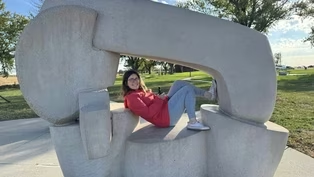
Clip: S17 Ep12 | 9m 12s | Revisiting the story behind I-80’s iconic rest stop art. (9m 12s)
Video has Audio Description
Clip: S17 Ep12 | 9m 12s | Omaha's critical role in shaping Women's Pro Bowling (9m 12s)
Providing Support for PBS.org
Learn Moreabout PBS online sponsorship New Season
- Drama

Hugh Bonneville stars in a crime drama inspired by one of the largest robberies in British history.
 New Episode
- News and Public Affairs

Top journalists deliver compelling original analysis of the hour's headlines.
 New Season
 New Episode



 New Episode
Support for PBS provided by:
Nebraska Stories is a local public television program presented by Nebraska Public Media