
August 25, 2026 - PBS News Hour full episode
8/25/2026 | 57m 46sVideo has Closed Captions
August 25, 2026 - PBS News Hour full episode
August 25, 2026 - PBS News Hour full episode
Problems playing video? | Closed Captioning Feedback
Problems playing video? | Closed Captioning Feedback
Major corporate funding for the PBS News Hour is provided by BDO, BNSF, Consumer Cellular, American Cruise Lines, and Raymond James. Funding for the PBS NewsHour Weekend is provided by...
August 25, 2026 - PBS News Hour full episode
8/25/2026 | 57m 46sVideo has Closed Captions
August 25, 2026 - PBS News Hour full episode
Problems playing video? | Closed Captioning Feedback
Where to Watch PBS News Hour
PBS News Hour is available to stream on pbs.org and the PBS app.
Providing Support for PBS.org
Learn Moreabout PBS online sponsorshipGEOFF BENNETT: Good evening.
I'm Geoff Bennett.
AMNA NAWAZ: And I'm Amna Nawaz.
On the "NewsHour" tonight: Canada announces retaliatory tariffs against the United States, as relations further deteriorate.
We speak with the Canadian trade minister.
DOMINIC LEBLANC, Canadian-U.S.
Trade Minister: We still believe that there's an agreement possible that is in the best interest of both countries.
GEOFF BENNETT: The Supreme Court opens the door to new restrictions on mail-in voting ahead of the midterms.
We get a legal view on what the ruling means and what happens next.
AMNA NAWAZ: On the ground in rural Afghanistan, a rare firsthand look at the devastating impact of cuts to U.S.
aid.
DR.
SIKANDAR GHANI, Nangarhar Government Hospital: When USAID was funding us, the condition of the hospital was good.
Specifically, the conditions of malnutrition were better.
See for yourself.
Now the equipment here, most of it's damaged.
GEOFF BENNETT: And the music world mourns the passing of the Queen of Country, Dolly Parton.
We remember her extraordinary life and lasting impact far beyond Nashville.
(BREAK) AMNA NAWAZ: Welcome to the "News Hour."
Canada imposed retaliatory tariffs against the United States today, as the two neighbors slide toward an all-out trade war.
GEOFF BENNETT: The tariffs will hit a range of U.S.
products, from industrial goods to everyday items.
At the same time, President Trump is threatening Canada with even steeper tariffs.
William Brangham begins our coverage.
WILLIAM BRANGHAM: In Ottawa today, Canada's government had a clear message: It's firing back.
FRANCOIS-PHILIPPE CHAMPAGNE, Canadian Finance Minister: Canada will meet the moment.
Canadians will meet the moment.
We will meet the moment together.
We will support our workers, our businesses and our industry with whatever it takes for as long as it takes.
WILLIAM BRANGHAM: Starting September 8, Canada will impose or raise tariffs ranging between 15 and 50 percent, affecting $27 billion worth of imports, and that will hit over 700 U.S.
products, including some key U.S.
imports.
FRANCOIS-PHILIPPE CHAMPAGNE (through translator): Our response will specifically target products in the sectors of steel, aluminum, household appliances, farming equipment, paper products, and electronics.
WILLIAM BRANGHAM: Canada's retaliation follows the Trump administration placing 50 percent tariffs on roughly $20 billion worth of Canadian imports on Saturday, along with threats of more to come.
President Trump said he will impose 50 percent on steel and autos starting next year.
And this clash between allies has gone beyond goods.
President Trump wrote on social media that the U.S.
doesn't expect to do business with the Canadian border province of Ontario, adding -- quote -- "The United States is giving serious consideration to changing the name of Lake Ontario to Lake America."
To that, one Canadian official simply said today: MELANIE JOLY, Canadian Industry Minister: We will always call it Lake Ontario, period.
(APPLAUSE) WILLIAM BRANGHAM: But for all the rhetoric, Trump last night did acknowledge the U.S.
relies on Canada for some key products like aluminum.
DONALD TRUMP, President of the United States: You know, selfishly, we need aluminum in this country.
We don't have it.
We get it all from Canada for the most part, and we need it badly.
WILLIAM BRANGHAM: President Trump has long lamented the trade deficit between the two countries, which stood at nearly $50 billion last year.
But for a trading relationship as big as the U.S.
and Canada's, these tariffs still hit just a fraction of the roughly $800 billion of commerce between the two neighbors, which U.S.
Trade Representative Jamieson Greer has echoed.
JAMIESON GREER, U.S.
Trade Representative: At the end of the day, this is 5 percent of imports from Canada.
It's 0.06 percent of our overall consumption in this economy.
So there's no possible way it can really affect U.S.
well-being.
WILLIAM BRANGHAM: Still, for states like Michigan, which trades heavily with the nation to its north, this trade war is already having consequences.
Michael Howard says his furniture business has started losing clients.
MICHAEL HOWARD II, Howard Family Designs: With a 50 percent tariff, all those costs have skyrocketed, and our -- just that one project has cost our family thousands of dollars in profit, and which impacts the ability for us to put food on the table for our family.
WILLIAM BRANGHAM: On the U.S.-Canadian border, where $2.5 billion in goods cross every day, the costs to citizens on both sides continue to grow.
For the "PBS News Hour," I'm William Brangham.
GEOFF BENNETT: And we turn now to Canada's trade representative, Dominic LeBlanc, a central figure in Canada's negotiations with the U.S.
Welcome to the "News Hour."
DOMINIC LEBLANC, Canadian-U.S.
Trade Minister: Good evening.
Thanks for having me.
GEOFF BENNETT: Just days ago, you said the U.S.
and Canada were very close to a trade agreement.
Now the talks have fallen apart.
The two countries are moving toward a trade war.
You were at the negotiating table.
What happened?
DOMINIC LEBLANC: So, you're right.
Last week, middle of the week, Wednesday, Thursday, we thought that we were close to an agreement.
We -- President Trump had announced that there was a deal.
We said that we were optimistic, we were positive, we were very close, as you said.
That was our view.
And then, as we got into the final hours on Friday, President Trump had set a deadline of midnight Friday for a series of Section 338 tariffs at 50 percent to apply to almost $28 billion of Canadian exports to the United States.
That was the -- sort of the rush, the intensity to try and get the agreement.
In the end, on that Friday evening, there were sort of three or four significant issues.
What was included in the auto tariff reductions?
How do we treat steel and aluminum derivative products?
Big economic issues for us.
And we weren't able to get to a landing spot that Prime Minister Carney thought was in Canada's economic interest.
So, at that point, we weren't able to conclude the deal.
GEOFF BENNETT: The U.S.
trade representative, Jamieson Greer, said that the U.S.
offered to do the following, reduce a 25 percent tariff on cars that President Trump implemented last year, which you mentioned, reduce the tariff on steel from 50 percent to 25 percent for the majority of steel that Canada sends to the U.S., and reduce all aluminum tariffs from 50 percent to 25 percent.
What about that was insufficient, in your view?
DOMINIC LEBLANC: That's a fundamental question.
First of all, we started the conversation from a premise that the USMCA agreement that President Trump had signed in his first term had zero tariffs in those sectors.
So the U.S.
government unilaterally decided in the 232 tariffs to impose on key sectors of our economy, steel, aluminum automobiles, our case, softwood lumber as well.
These same sort of economic engines that President Trump is promoting in the United States are critical to our economy.
And the challenge for us is, those are the sectors over the last number of decades where we have become the most integrated with the United States.
Automobiles is the best example.
So, 50 percent of the cars made in Canada are made with United -- with American parts.
We're the biggest customer.
We buy more American vehicles than a whole bunch of other countries combined.
We have an integrated economy.
At one point, President Trump decided to apply these tariffs.
So, if there was a different tariff treatment for something as important to Canada as auto parts or medium- and heavy-duty trucks, then you can see that Prime Minister Carney just concluded that the economics of that didn't work for the Canadian industry.
That's just one example, but it's an instructive one.
GEOFF BENNETT: Well, given the enormous amount of integration between the U.S.
and Canadian economies, is it even possible for both countries to engage in a trade war without inflicting major damage on both countries' economies?
DOMINIC LEBLANC: Well, and that has been exactly our concern.
So we certainly didn't seek this particular trade conflict.
We were hopeful that we could find an agreement that would be in the economic interest of both countries, respecting Canadian sovereignty, respecting critical parts of our economy, just as President Trump wants to build and protect those parts of the American economy.
We still believe that there's an agreement possible that is in the best interest of both countries, that -- for example, in steel, we have been working with the United States on stopping non-market economies from dumping steel into the North American economy.
We -- Canada was the first country to put in melt and pour rules around where was the steel melted and poured to qualify as Canadian steel in our case.
So there are many common objectives.
GEOFF BENNETT: You say a deal is still possible, even as Canada is preparing to retaliate dollar for dollar.
What sectors will Canada target?
DOMINIC LEBLANC: So we're obviously looking to protect the same sectors that -- of our economy that are facing this latest round of 338 - - Section 338 tariffs at 50 percent.
So there's steel products.
There's paper products.
There are aluminum derivative products.
I mean, these are key parts of our economy that have exported to the United States and we have imported from the United States in a tariff-free context for decades.
So we're going to make sure that there's not an unfair advantage for American exporters sending goods to Canada.
GEOFF BENNETT: The prime minister said over the weekend that the U.S.
is using economic integration as a weapon, that was the phrase that he used, and that America's signature is now, as he said, written in pencil.
That sounds like something much bigger than a dispute over tariff rates.
Are we witnessing right now a permanent rupture in the U.S.-Canada relationship?
DOMINIC LEBLANC: No, I wouldn't be that stark.
The U.S.-Canada relationship is so broad-based.
There's a critical economic partnership that's existed for decades.
There's a security and defense relationship that has also seen us stand shoulder to shoulder with the United States in global conflicts for decades.
It's also a very personal relationship.
I think, for Americans to understand that, my perspective, there -- almost every Canadian has some personal connection to the United States.
In my case, I went to university there.
I have five first cousins that live in Massachusetts.
Many Canadians own property in the United States, go on holidays in the United States, have business relationships.
So, there's a deep personal connection.
I represent a district on the east coast of Canada, just sort of in a province that borders the state of Maine.
These small border towns in Canada and in Maine, in New Brunswick on our side and in Maine, share fire departments in the case of a major fire.
The fire trucks literally cross the border in these small towns to help each other out.
So this is a deep, deep relationship built on years and years of common interest and goodwill.
So I'm not pessimistic.
We're into some economic turbulence and headwind.
But we will navigate.
We will take our responsibilities as a government of Canada to do what we have to do.
But I remain convinced that it's an enduring relationship that is that is very, very broad-based.
GEOFF BENNETT: An enduring relationship.
Dominic LeBlanc, Canada's minister in charge of U.S.
trade, thank you for joining us this evening, sir.
DOMINIC LEBLANC: Thanks for having me on your program.
Have a great evening.
GEOFF BENNETT: And a note, the "News Hour" has requested an interview with the U.S.
trade representative, and we hope to bring you that interview soon.
AMNA NAWAZ: We start the day's other headlines in Lancaster County, Pennsylvania, where health officials say two people, both unvaccinated, have died from measles.
No further details about the individuals were provided.
They are the first measles-related deaths in the U.S.
this year, which is on track to be the worst year for measles cases since 1991.
Pennsylvania Governor Josh Shapiro today warned about the severity of the outbreak and the rise of misinformation regarding vaccines.
GOV.
JOSH SHAPIRO (D-PA): There's real-life consequences to scaring people and not relying on actual doctors and actual medical professionals to provide unbiased information to parents so that we can make reasonable decisions for our kids.
AMNA NAWAZ: The governor added that he spoke with us Health Secretary Robert F. Kennedy Jr., who has pushed to revise the nation's approach to vaccines.
Shapiro says he was -- quote -- "blunt" with him about the rhetoric coming from government officials.
The Trump administration is threatening to demolish the Kennedy Center in Washington, D.C., if its plans to renovate the arts institution are not allowed to proceed.
Those plans include adding President Trump's name to the building.
In a court filing, Justice Department lawyers called the center -- quote -- "structurally unsound" and said that without renovations, it will -- quote -- "deteriorate further into an unsafe, decrepit structure that will be required to be taken down."
They suggest an outdoor amphitheater could be built on the site.
A hearing is set for Thursday on a bid to stop Trump's name from being added to the center.
The "News Hour" has confirmed that CIA Director John Ratcliffe traveled to Russia today for meetings in Moscow.
Eyewitness videos spotted a Boeing C-17 military aircraft coming into land at an airport in the Russian capital.
The Kremlin had no comment on the plane or the visit.
This would be Ratcliffe's first publicly known trip to Russia as CIA director, and it comes as European officials have accused Russia of a number of recent incidents of sabotage across the continent.
China is criticizing the Trump administration's latest threats of heavy economic sanctions against Iran.
At a news conference today, a Foreign Ministry spokesperson said such economic warfare can only exacerbate tensions and warned that China will -- quote -- "take all necessary measures" to protect its interests.
LIN JIAN, Chinese Foreign Ministry Spokesperson (through translator): We have made clear on many occasions that China firmly opposes illegal unilateral sanctions that lack a basis in international law.
AMNA NAWAZ: Meantime, maritime watchdogs say an oil tanker was struck in the Strait of Hormuz today.
On social media, President Trump claimed that the U.S.
navy had cleared all mines from the international waters of the strait, which could allow more tankers to pass through.
And diplomatic efforts continued.
The foreign minister of Oman was in Tehran for talks, where he signaled hopes for a deal to ensure safe navigation through the waterway.
A federal judge today rejected a bid by Ghislaine Maxwell to throw out her 2021 conviction on sex trafficking charges.
The former girlfriend and associate of Jeffrey Epstein had cited what she called new evidence in seeking to set aside her 20-year prison sentence.
That included documents recently released by the federal government under the Epstein Files Transparency Act.
But in a 67-page decision.
Judge Paul Engelmayer called her claims meritless and frivolous and said the evidence actually -- quote -- "reinforces the correctness' of the legal rulings Maxwell challenges.
New data shows that U.S.
Immigration and Customs Enforcement or ICE arrested more people in July than any other month in the current Trump administration.
According to an Associated Press analysis of data from the U.C.
Berkeley Deportation Data Project, ICE arrested nearly 50,000 people in July.
That's a 15 percent jump from a month earlier.
Many of those were in Texas and Florida, which accounted for nearly 20,000 arrests.
The utility provider for Gary, Indiana, says power is expected to be restored to all remaining customers in the city by tonight after two full weeks of living in the dark.
WOMAN: So, this is where my room is.
I have flashlights all over my house because it gets so dark.
AMNA NAWAZ: Thousands of residents in the predominantly Black city have been without electricity since severe storms hit the region on August 11, knocking out power to nearly 400,000 customers.
Governor Mike Braun has called for an investigation into the utility's response to the outages and says the city's mayor says the pace of restoration has been unacceptable.
Residents have voiced similar frustrations.
SHATIYA HARDIN, Gary, Indiana, Resident: This is the second week now.
So, I mean, it's only -- we can be used to it, but it's not OK for us to be used to it.
It's not OK for us to continually be in survival mode.
AMNA NAWAZ: Gary is also one of the poorest cities in America, and experts have noticed -- noted, rather, that severe weather and natural disasters tend to disproportionately hurt lower-income communities.
In Southwestern France, people picked through what was left of their homes today after a rare and powerful tornado tore through towns and villages, leaving dozens injured.
Authorities say 20 people were hospitalized.
The twister damaged some 300 homes in the small town of Pomas.
No one was killed or reported missing, which the mayor called a true miracle.
On Wall Street today, stocks posted modest gains as oil prices eased.
The Dow Jones industrial average added 160 points on the day.
The Nasdaq climbed two-thirds of 1 percent.
The S&P 500 also ended in positive territory.
Still to come on the "News Hour": remembering the remarkable life and legacy of the great Dolly Parton; a new study reveals just how common brain trauma is among NFL players; and we report from Afghanistan on the devastating impact of cuts to U.S.
aid.
GEOFF BENNETT: The U.S.
Supreme Court issued an emergency order yesterday that allows the Trump administration to move forward for now with plans to restrict mail-in voting ahead of the midterm elections.
It's a ruling opponents say would bring chaos to the election process only days before ballots in some states are mailed out.
Our White House correspondent, Liz Landers, has more.
LIZ LANDERS: The ruling allows the administration to proceed with an executive order President Trump signed in March directing the U.S.
Postal Service to determine which voters should receive mail-in ballots.
It also directs the Department of Homeland Security to build a database of U.S.
citizens who are eligible to vote.
There are a lot of moving parts.
And here to help explain it all is Steve Vladeck.
He's a constitutional law professor at Georgetown University Law Center.
Steve, thank you for joining the program this evening.
STEVE VLADECK, Georgetown University Law Center: Thanks for having me.
LIZ LANDERS: So there are two lawsuits that are challenging the president's executive order about mail-in ballots.
The Supreme Court decision yesterday had to do with a group of states that sued, while the other case that was brought by the League of Women Voters.
What did the Supreme Court's ruling tell the states?
STEVE VLADECK: Yes, so the Supreme Court's ruling only applied, Liz, to the states' lawsuit, and it only said that the states had sued too early because they brought their lawsuit before the U.S.
Postal Service issued their final rule, which, of course, they did last Friday.
So it was, I think, a win for President Trump, but a very time-limited one.
It didn't say anything about whether the underlying executive order is lawful.
It didn't say anything about whether the new Postal Service rule is lawful.
That issue is now going to be litigated probably pretty quickly in both of the cases that are back before Judge Talwani in Boston.
LIZ LANDERS: OK, so let's talk about that executive order.
There's another part of President Trump's E.O.
that bars the Postal Service from delivering ballots to people who are not on federal lists of eligible voters.
And it also will direct the Homeland Security Department to create a list of U.S.
citizens who are eligible to vote.
How are these actions affected by the ruling yesterday?
STEVE VLADECK: So, for now, they're not.
I mean, the most important thing that folks should know is that the status quo, which is the executive order is not in effect and the USPS rule is not in effect, is still the status quo.
All the Supreme Court did yesterday was pause one of the two injunctions against the executive order.
There's still a second injunction blocking the executive order from going into effect.
And, Liz, the rule itself says it can't go into effect until that injunction too is no longer in effect.
So we really are not at the end of the story.
We're really more in the middle of the story, where there's going to be more litigation and where it's possible that these questions are back in the Supreme Court perhaps by this time next week.
LIZ LANDERS: You wrote a Substack post about this.
And you wrote about the Purcell principle, which is this idea that election rules shouldn't be changed too close to an actual election because it confuses both voters and it makes it difficult for election administrators as well.
We're now 70 days from the midterm Election Day and some states like Minnesota are starting their absentee voting, which includes by mail, on September 18.
We spoke earlier today with Minnesota Secretary of State Steve Simon about how plausible it is to carry out the Postal Service rule change.
Here's what he told us.
STEVE SIMON, Minnesota Secretary of State: I think there is serious doubt about whether there's enough time in the 2026 election to stand up this scheme.
That has been imagined by this executive order.
Keep in mind, they're talking about a whole new architecture here.
They're talking about some database that Department of Homeland Security is going to create with the help of states.
But it's really sort of a black box.
We don't know what's inside it.
We don't know what their methodology is going to be.
LIZ LANDERS: What should states do now in the aftermath of this decision?
STEVE VLADECK: So I think, for now, states should keep doing whatever they were doing yesterday.
I mean, again, yesterday's decision by the Supreme Court was about as modest a procedural victory for President Trump as the court could have handed down.
I think the real question, Liz, is what happens next.
Is the rule that the Postal Service issued last Friday actually going to go into effect?
It isn't in effect yet.
Is this going to go back to the Supreme Court to decide whether the president really has the authority to unilaterally interfere in how Americans vote?
The answer ought to be he doesn't.
Or is it all going to be too late and this is really actually just a fight for what happens in the 2028 election cycle?
I think the most important takeaway from yesterday's ruling is that it doesn't actually resolve any of that and that we're going to have to see what happens in the coming days and perhaps weeks, whether this goes back to the Supreme Court, whether something happens to put this rule into effect that could very well upend a lot of mail-in voting, versus the status quo, which is what the rules were last time.
LIZ LANDERS: The Supreme Court ruling said in it -- quote -- "Time will tell if the president's executive order was lawful."
I thought that was very interesting.
From what you have seen, how do you think the Supreme Court will rule and decide on that?
STEVE VLADECK: Yes, I mean, I think it'll be sooner, rather than later.
I mean, I'd be very surprised if we haven't heard something more conclusive from the Supreme Court about whether this executive order and the rule implementing it can go into effect really, Liz, by the end of next week.
It's going to move that quickly.
LIZ LANDERS: And final question for you, should voters feel confident about being able to vote by mail this year?
STEVE VLADECK: So I think they should for now, but I also think voters should be diligent, and voters should check in with their local election officials, with their secretaries of state, and voters should be watching the news, because, unfortunately, the reality of the times we live in is that confidence today could turn into instability tomorrow.
We're not there yet, but that doesn't mean that we're going to be all the way home to Election Day.
LIZ LANDERS: Steve Vladeck, thank you so much for your time this evening.
STEVE VLADECK: Thank you.
AMNA NAWAZ: At least one in four NFL players has CTE when they die, that is the concerning conclusion of a new study out today that examined the brains of former pro-football players.
Chronic traumatic encephalopathy, known as CTE, is a brain disease thought to be caused by years of sustained head trauma.
Symptoms can include depression, anxiety, and aggression, and, later in life, memory trouble and dementia.
Because CTE can only be diagnosed after an autopsy of the brain, the study's researchers say the actual number of NFL players suffering from the disease may be even higher.
For more, we're joined by Dr.
Chris Nowinski.
He's a former college football player, co-founder and CEO of the Concussion and CTE Foundation, and a co-author of this study.
Dr.
Nowinski, welcome to the show.
Thanks for joining us.
CHRIS NOWINSKI, Co-Founder and CEO, Concussion & CTE Foundation: Thanks for having me.
AMNA NAWAZ: So, in the study, you focused on about 235 donated brains from former NFL players who died between 2016 and 2021.
I mean, did you expect the rate of CTE to be so high?
Tell us more about what you found.
CHRIS NOWINSKI: Yes, I mean, ever since we started studying NFL players' brains, it's been more than 90 percent of the sample.
But, over time we got much better at getting a larger sample of NFL players and built a partnership with the retired community so much that we got more than 25 percent of NFL players' brains.
Unfortunately, that rate is still more than 90 percent in that sample.
We have always hoped that this disease might be rare, but I think this is that final nail in the coffin to say, no, this is absolutely not a rare disease in the NFL population.
And now we know it's somewhere between 25 percent and 98 percent.
And we need to figure out what it is between those two numbers.
AMNA NAWAZ: So that one in four number we're seeing is likely a conservative estimate?
Is that what you're saying?
CHRIS NOWINSKI: It's it's almost certainly an extremely conservative estimate.
AMNA NAWAZ: Do you know... CHRIS NOWINSKI: Unfortunately.
AMNA NAWAZ: Do you know from these relationships you have with the families and former players if any of those players or all the players who had CTE also had symptoms they exhibited before their deaths?
CHRIS NOWINSKI: Yes, unfortunately, nearly two-thirds of them had dementia while they were alive.
So most of these were very severe, most of them were very impacted, and that's why their families reached out.
But we are also able to go back and get the national death records of every NFL player we didn't get.
And the unfortunate thing is, we got far fewer than half of NFL players who died with of a neurodegenerative disease.
AMNA NAWAZ: Obviously, this is resonating across a lot of people.
But we did speak to a former NFL player today.
That's Randy Grimes.
He played in the league for nearly a decade.
And we asked him about his reaction to the study earlier today.
Here's what he had to say.
RANDY GRIMES, Former NFL Player: They're tested in the brains of former NFL players, and a lot of them had a lot of years in the league.
But we're not testing the brains of high schoolers, people that played a couple of years in college.
So I think there's a lot more research that needs to be done.
But at least we're talking about it and we're moving in that direction.
AMNA NAWAZ: Dr.
Nowinski, there are millions of people who played as young players in youth leagues, who played in high school, who played in college.
What should we take away from your study about them?
CHRIS NOWINSKI: Well, yes, I know Randy.
He is a great guy, and he's helped us with supporting families.
I guess he -- I do need to let him know, though, we are also studying college football players.
We have studied nearly 400 of them, and we have studied more than 100 former high school players.
What we have shown through the study of people with different career lengths is a clear dose response relationship.
We're -- over 90 percent are NFL players, but I think we're still around two-thirds of our college players we have studied have had it, and about a third of our high school.
We know, again, that sampling bias, so the numbers got to be lower than that, but it's still far too many, considering 20 million men have played high school football in this country.
And so I hope this is the moment where we shift the conversation to this is a minority of players, and we don't have to worry about this, to one where we say, OK, this is a public health crisis that we need to confront, not only in the NFL, but throughout football.
And there are a lot of men who are going to need treatment and a cure.
And we need to really ramp up our investments in making this a curable disease in our lifetime.
AMNA NAWAZ: I just want to put to you part of what the NFL sent to us in a statement in response, because they stress that they are continually striving to make football safer.
They talk about implementing strategies to reduce concussions and head impacts.
That includes new rules, new helmet technology.
They also point out the average age of the players that you studied when they died was about 66, noting they hadn't played for many years.
So is it possible your findings reflect the impacts of a different, earlier era of football?
Is the game safer today?
CHRIS NOWINSKI: Is it possible?
Yes.
Is it probable?
No.
We have made some modest changes to the game, and that's great.
But also players are bigger, stronger, and faster than they have ever been, and they're starting younger, and seasons are longer.
So I wouldn't be surprised if it's worse today or it peaked very recently.
So we have a lot of work ahead of us, and we need to go a lot further if we want to tell ourselves that this game is safe enough, because, as a former player, I will tell you I'm still uncomfortable with this.
And just to give you one example, one of our latest cases was Marshawn Kneeland, who played for the cowboys just over a year ago.
At 24 years old, he died by suicide.
He already had CTE, and he played in the modern era of concussion protocols and practice restrictions.
So nobody should be resting on their laurels thinking that we have this covered and this is now something in the rearview mirror.
AMNA NAWAZ: I mean, you did play at a high level yourself.
The question a lot of folks are going to be asking, in your opinion, is the risk worth it to play today?
CHRIS NOWINSKI: That's something I struggle with.
I will tell you, I just -- I have keep these on my desk.
These are the -- this is me on the cover of the 99 Harvard football program.
My teammate Chris Eitzmann was the last person in the study.
He was our captain.
He died December 29, 2021.
He had stage two disease.
This is our strong safety, Michael Brooks.
He died a couple of years ago.
He had stage two disease.
Both of their deaths seem to be related to their brain disease.
So I -- from my perspective, all I deal with is struggling football players.
So I'm probably not the right person to ask, but this issue is far worse than the conversation we're having at our kitchen table.
AMNA NAWAZ: Dr.
Chris Nowinski, thank you so much for joining us tonight.
We appreciate your time.
CHRIS NOWINSKI: Thanks for having me.
AMNA NAWAZ: Well, it's been 18 months since the Trump administration made across-the-board cuts to foreign aid and began the process of dismantling USAID,or the U.S.
Agency for International Development.
Tonight, we examine one of the country's hardest hit, Afghanistan.
GEOFF BENNETT: Refugees International attributes more than 160 deaths over the past 18 months to cuts in aid, with devastating consequences for mothers and infants.
Now special correspondent Leila Molana-Allen and videographer Eric O'Connor have the latest report in our continuing series from Afghanistan five years after the U.S.
military withdrawal.
Some names have been changed for protection.
And a warning: Some of the images and accounts in this story are disturbing.
LEILA MOLANA-ALLEN: The remote rocky mountains of rural Herat.
We're heading to one of the many villages here, now cut off from medical assistance by international funding cuts.
As we arrive, a man suddenly runs over asking for help.
Someone's collapsed.
He tells us to hurry.
ABDUL SALEM, Village Resident (through translator): He was struggling to breathe, and then he fell.
LEILA MOLANA-ALLEN: When Abdul Salem's brother started having chest pains, they called a doctor in the nearest town 30 minutes away.
Unless they could get him here, the clinic said, the family was on their own.
Then he started having a heart attack.
They still wouldn't send an ambulance.
Our team is trained in emergency first aid.
We jump in to do what we can to save him.
But he's been without oxygen for too long.
MAN: Stop.
LEILA MOLANA-ALLEN: It's too late.
MAN: Sorry.
I'm so sorry.
LEILA MOLANA-ALLEN: His name was Abdul Rahman (ph).
He was the head of this community, a beloved father, husband and brother.
His brother says he was the best man in the village.
He tries to tell us about him, but he's overcome by emotion and can't continue.
All day, the mourners come.
As the sun sets, they bury him high on the hill overlooking his home.
These desperately poor villages were once served by rural and mobile clinics and feeding services funded primarily by the U.S.
Agency for International Development, or USAID.
But after the devastating funding cuts of the past two years, that lifeline for remote areas like these has disappeared.
As we start to speak to other villagers, it's the same story down every alley in every home.
Like most of the women here, Simagul never has enough to eat.
She tried for seven years to have a baby.
Finally, last year, little Fahim arrived.
She was so undernourished she couldn't breast-feed or afford other food for him.
Unable to get to a government hospital or pay their fees, 6-month-old Fahim got worse.
SIMAGUL, Bereaved Mother (through translator): He constantly had fever, vomiting, and diarrhea.
If he got better for two days, then he'd get sick again.
LEILA MOLANA-ALLEN: One day, Fahim fell unconscious, shaking violently.
With the economy here in tatters, Simagul's husband was away in Iran looking for work.
Knowing that Taliban checkpoints wouldn't let her through alone, she had to search both for a male chaperone and a motorcycle to borrow, wasting precious minutes as little Fahim convulsed in her arms.
SIMAGUL (through translator): By the time I found my brother-in-law to take us, my child's condition had already become critical.
LEILA MOLANA-ALLEN: When they finally reached the nearest clinic, miles away in Adraskan, there was nothing they could do for him.
They were sent to the hospital two hours further in Herat City.
SIMAGUL (through translator): He had another seizure.
He died on the way before we even reached Herat.
At that moment, when they told me my son had died, I lost all sense of myself.
I didn't know what to do.
LEILA MOLANA-ALLEN: Now her baby girl, Somaya, not even a-year-old, is starting to show the same signs, constant diarrhea, a distended belly, rashes on her skin.
SIMAGUL (through translator): I just pray my daughter doesn't die like my son.
LEILA MOLANA-ALLEN: Yeganeh is just 21.
Her husband is 70.
She's lost five children in her young life.
YEGANEH, Bereaved Mother (through translator): I was 15 when I got married.
I gave birth to one child every year and they all died.
LEILA MOLANA-ALLEN: She remembers when her first little girl began to waste away, riven by the symptoms of malnutrition and bacterial infection.
YEGANEH (through translator): We didn't have anything to treat her with and she died.
Each one, their stomach suddenly swelled, and they died.
I feel heartbroken.
As a mother, it's very hard to give birth to five children, and they all die.
LEILA MOLANA-ALLEN: Now she has another baby on the way.
The villagers believe she's cursed and want to take her baby away from her.
She knows all she needs is proper care for her and the child.
YEGANEH (through translator): The doctor said you should treat yourself, but we don't have any money to pay for my treatment.
I'm afraid that this child will die like the others.
I wish for this baby to live.
LEILA MOLANA-ALLEN: Her stolen children are buried in the vast rolling plains that lie between Yeganeh and the hospital that might have saved them.
She can't even visit their graves without permission from her husband.
Laleh is a midwife who used to work for a mobile clinic here run by the International Rescue Committee; 80 percent of their work in Herat was funded by USAID.
LALEH, Midwife (through translator): Once, we saw a woman being transported by her husband on a motorcycle.
We delivered her baby in the middle of the road.
If we weren't there, the mother or the child could have died on the way to the hospital.
LEILA MOLANA-ALLEN: They lost that funding last year and tried to limp on to sustain these vital services.
But, earlier this year, the money ran out and they were forced to close.
Now, without support from health workers like her, maternal and child mortality is spiking.
LALEH (through translator): Now I think, who provides services to them when we're not there?
I'm really heartbroken when I hear that women and children of my country have died, and I couldn't do anything for them.
LEILA MOLANA-ALLEN: Worse still, the Taliban has decreed that women must be accompanied by a mahram, a male guardian from their family, at all times outdoors, even in a medical emergency.
Health workers across Afghanistan report women and babies dying at Taliban checkpoints because they aren't allowed to pass to get to hospital.
LALEH (through translator): There was a woman here who was in labor.
Because the midwife who came didn't have a mahram, they sent her back home.
As a result, both the mother and the baby died.
LEILA MOLANA-ALLEN: Laleh now faces unemployment, and with the Taliban crackdown on women working, she can no longer support her family.
She fears female-focused health care will soon disappear entirely.
LALEH (through translator): Because education for women is banned, no new midwives have graduated for five years.
I see the future for Afghanistan and Afghan women in a very dark situation.
LEILA MOLANA-ALLEN: This crisis isn't a slow decline, but a sudden and crippling shock.
After last year's USAID cuts, nearly 500 clinics closed; 300 more shut earlier this year, leaving six million people without any local health services.
As always, it's the poorest of the poor with no other options who are the hardest hit.
Child hunger in Afghanistan has now hit a record high, with over a third of the country's provinces facing critical levels of acute child malnutrition.
And, this year, nearly half Afghanistan's children aren't getting enough to eat.
Even for the lucky ones who do make it to a hospital, their condition is often so severe they can't be saved.
Dr.
Sikander Ghani heads the child malnutrition ward at Nangarhar's government hospital on the other side of the country from Herat.
And Yasmin is three months old?
DR.
SIKANDER GHANI, Nangarhar Government Hospital: Yes, she is three months old.
LEILA MOLANA-ALLEN: And the seizures and sepsis are caused by the severe malnutrition.
DR.
SIKANDER GHANI: Yes.
LEILA MOLANA-ALLEN: With local maternity clinics and child feeding services across the country now closed by funding cuts, parents travel huge distances from four surrounding provinces to get here.
Many wait too long out of fear they can't pay.
Nearly 20 percent of the babies who come here now die.
Last month, they hospitalized more than 250 kids, their highest ever intake.
DR.
SIKANDER GHANI (through translator): Most of the children come in very bad condition, often unconscious or in a coma.
When they come late, the symptoms are much worse.
So curing it becomes much more difficult.
LEILA MOLANA-ALLEN: The hospital used to receive USAID funding, but now that's gone too.
DR.
SIKANDER GHANI (through translator): They shouldn't tie these health services, these humanitarian services to politics.
When USAID was funding us, the condition of the hospital was good.
Specifically, the conditions of malnutrition were better.
See for yourself.
Now the equipment here, most of it's damaged.
LEILA MOLANA-ALLEN: With such limited resources, it's an endless battle.
Sometimes, they have enough medicine, oxygen, beds.
Sometimes, they don't.
DR.
SIKANDER GHANI (through translator): It's truly distressing when a child dies in front of our eyes.
With a well-equipped unit, their lives could have definitely been saved.
It hurts.
But what can we do?
We're trying our best.
LEILA MOLANA-ALLEN: Farmi sits quietly in the corner, her shoulders sagging with despair as she clutches her emaciated baby to her chest.
FARMI, Mother of Patient (through translator): His bones are sticking out.
LEILA MOLANA-ALLEN: Mortaza is 6 months old.
He weighs just 4.5 pounds.
He should weigh closer to 20.
FARMI (through translator): He needed formula milk, but we could not even afford that.
We also couldn't even afford to bring him here.
Poverty is a terrible thing.
When you have no one and no money, you can't do anything.
No one cares about you.
LEILA MOLANA-ALLEN: Cradling her baby on the floor of the hospital, she tries desperately to feed him formula over and over again.
But he's too sick and can't keep it down.
FARMI (through translator): He can't even tell us where he's in pain.
Whenever you touch him, he cries.
LEILA MOLANA-ALLEN: They have been here six days.
The doctors have done what they can, but Mortaza's condition is too advanced.
He's not getting better.
FARMI (through translator): When they said he would not get better, my heart dropped.
I lost hope and thought he's going to die.
LEILA MOLANA-ALLEN: Mortaza is Farmi's only child.
His twin brother died in childbirth.
She doesn't know what she will do if she loses him.
FARMI (through translator): My message to Americans is this.
Help this place.
I cry constantly for him.
He has suffered so much.
When I look at him, my heart breaks.
LEILA MOLANA-ALLEN: A generation of mothers and children abandoned to suffer and die in the dark.
For the "PBS News Hour," I'm Leila Molana-Allen in Jalalabad, Afghanistan.
GEOFF BENNETT: The "News Hour" asked the U.S.
State Department for a response to questions surrounding the aid cuts detailed in this story.
They did not directly address the deaths that have occurred, but did write in part - - quote -- "Since the Biden administration's chaotic withdrawal from Afghanistan, the Taliban have consistently failed to take action to improve the country's stability and uphold their counterterrorism commitments."
They continued: "At the direction of President Trump, the U.S.
Department of State has suspended any foreign assistance that could possibly reach the hands of the Taliban."
AMNA NAWAZ: The State Department also cited a March 2025 inspector general's report on Afghanistan that said aid groups -- quote -- "needed to strengthen agreements with public international organizations to ensure that U.S.
funds are not diverted to terror groups."
GEOFF BENNETT: They are the one-name legends of American music, artists we all know and generations have loved, Aretha, Sinatra, Elvis, Prince.
And, tonight, sadly, we add another name to that legendary pantheon, Dolly.
Dolly Parton's nephew Bryan Seaver announced her passing today on social media.
BRYAN SEAVER, Nephew of Dolly Parton: Dolly opened doors, not just for me, but for her entire family to reach the potential we didn't even know was possible.
Dolly also opened doors for generations of singers, songwriters, musicians, and dreamers from every walk of life and across every continent.
By her example, we believed that anything was possible.
She never saw a door she couldn't open, and the doors she opened made and changed history.
GEOFF BENNETT: Tributes are pouring in tonight from fans, admirers, and fellow artists.
AMNA NAWAZ: Reba McEntire remembered her friend, saying -- quote -- "There will, never ever be another you."
Dionne Warwick posted that she will -- quote -- "certainly miss her laughter, jokes, and her being."
Mick Jagger said -- quote -- "She brought so many people together.
We will all miss her so much."
Country singer Kacey Musgraves wrote -- quote -- "The world feels a lot less sparkly all of a sudden."
Today, President Trump ordered flags to half-staff for one week.
Parton's enormous legacy spans not only music, but the world of movies and entertainment, health care, philanthropy, and education.
Here's a look at her extraordinary life.
From country music star... JOHNNY CARSON, Former Host, "The Tonight Show": Welcome, Ms.
Dolly Parton.
(CHEERING) AMNA NAWAZ: ... to national treasure.
DOLLY PARTON, Musician: Thank you so much.
AMNA NAWAZ: Dolly Parton's seven-decade career brought her international acclaim and unadulterated adoration from fans drawn to her music, her unparalleled charisma, and her trademark wit.
TEEN: If you could tell teenagers of America today one thing, whether it be advice or something of support, what would it be?
DOLLY PARTON: I would say, act like it's raining every day and wear your rubbers.
(LAUGHTER) (CHEERING) AMNA NAWAZ: Born in 1946, the fourth of 12th children, Parton grew up in a one-room cabin in the Smoky Mountains of East Tennessee.
Her father paid the doctor who delivered her the only way he could afford, with a sack of cornmeal.
DOLLY PARTON: We had a roof over our head, I always say, even if it did leak.
We had something to eat on our table, even if it wasn't exactly what we wanted.
AMNA NAWAZ: Parton began composing songs before she could read or write, in 1959, at just 13 years old, making her first appearance at the Grand Ole Opry, a stage she would return to time and again.
From the early days of her career, Parton championed the rights of women and their ambitions in her music.
On her second solo album, 1968's "Just Because I'm a Woman," she brought the women's liberation movement to her lyrics.
(MUSIC) AMNA NAWAZ: Through the more than 1,000 songs Parton wrote, her message and her music resonated.
She sold more than 100 million records, with 49 top 10 country albums and released more studio albums than any other female country artist.
She won her first Grammy in 1979.
Nine more followed, with a total of 55 nominations throughout her career.
And, in 2011, Parton received the Recording Academy's lifetime achievement award.
Two of Parton's songs, "I Will Always Love You" and "Jolene," have been inducted into the Grammy Hall of Fame.
(MUSIC) AMNA NAWAZ: In 1980, she made her big screen debut alongside Jane Fonda and Lily Tomlin in the hit comedy "9 to 5."
DOLLY PARTON: A restaurant?
How can you think of food at a time like this?
AMNA NAWAZ: In a male-dominated industry, Parton was larger than life and unapologetic, speaking openly about her cosmetic surgery and navigating the industry as a woman, including with Judy Woodruff in 2020.
DOLLY PARTON: Of course, I have been hit on all my life, and especially in those early days.
But I knew how to manage that myself.
I never sold out, never did anything that was going to take away from who I was as a human being.
AMNA NAWAZ: Rivaling her cultural impact through music, her social impact through philanthropy.
In the early days of the COVID pandemic, Parton's million-dollar contribution to Vanderbilt University's coronavirus research helped to develop the promising Moderna vaccine.
Parton publicly got a taste of her own medicine in 2021.
DOLLY PARTON: That didn't hurt, just stung a little bit, but that was from the alcohol pad, I think.
AMNA NAWAZ: Bucking the expectations of her time, Parton chose career over kids, but famously said -- quote -- "God didn't let me have children so that all kids could be mine."
She helped millions through her Imagination Library, donating 200 million books to children around the world.
CHILD: Dolly Parton.
CHILD: Dolly Parton.
CHILD: Dolly Parton sent me the books.
AMNA NAWAZ: The idea, she told "News Hour" in 2013, came to her from her own father, who couldn't read or write.
DOLLY PARTON: It really, really started out as a very personal thing for me, and it was originally just meant for the folks in my home county because of my dad.
AMNA NAWAZ: Parton never endorsed a political party, but did speak passionately on a few issues, including the Black Lives Matter movement and LGBTQ rights.
DOLLY PARTON: When someone blatantly asks you, do you think Black lives matter, well, of course, Black lives matter.
We're all God's children.
We all have a place in this world.
We all need to be loved and respected.
I don't care if you're, like I say, Black or white or whatever.
I don't care if you're gay or lesbian or transgender.
Everybody should have an equal chance.
AMNA NAWAZ: Over her lifetime, Parton's many businesses comprised a massive empire worth an estimated $650 million.
An early entrepreneur, 20-year-old Parton first established a publishing company in 1966, helping her retain her own publishing rights over the years.
In 1985, she co-founded Sandollar Productions for film and TV projects.
One year later, her amusement park, Dollywood, held its grand opening just minutes from her hometown.
DOLLY PARTON: But the best thing about this memory is, you can relive it.
AMNA NAWAZ: Now welcoming more than three million visitors a year.
DOLLY PARTON: The accountants and lawyers I had at the time thought it was a big mistake, and I said I'm doing it anyway.
So, needless to say, I did not keep those lawyers and those accountants.
AMNA NAWAZ: Despite her very public persona, the Queen of Country was notoriously private about her husband of 60 years, Carl Dean.
DAN RATHER, News Anchor: You know there are people to this day who do not believe your husband, Carl Dean, actually exists.
DOLLY PARTON: I know that.
They do.
They think that I just made him up.
Some say I'm having a relationship with my girlfriend Judy.
We have just had a great friendship.
But we have been married.
My husband just does not want to be in the spotlight.
AMNA NAWAZ: After Dean's death in 2025, Parton wrote -- quote -- "Like all great love stories, they never end," dedicating a new song, "If You Hadn't Been There," to the man she called the star of her life story.
(MUSIC) AMNA NAWAZ: From small-town girl to global icon, Parton earned single-name status and a legion of devoted Dolly fans, leaving behind a catalog of incomparable hits, a legacy of generosity, and a shining example of a life well lived.
DOLLY PARTON: I want to live young.
I want to think young.
I want to do young.
I want to always be important.
I want to be useful.
And, as I have often said, I would much rather wear out than the rust out.
AMNA NAWAZ: Dolly Parton was 80 years old.
Well, for more on her remarkable life, the PBS documentary "Dolly Parton: Here I Am" is streaming now at PBS.org and on the PBS app.
It's airing again this Thursday on your local PBS station.
Check your local listings.
GEOFF BENNETT: And that is the "News Hour" for tonight.
I'm Geoff Bennett.
AMNA NAWAZ: And I'm Amna Nawaz.
On behalf of the entire "News Hour" team, thank you for joining us.

Canada retaliates with tariffs against U.S.
Video has Closed Captions
Canada retaliates with tariffs against U.S. as relations deteriorate (3m 34s)

Canadian trade minister on importance of deal with U.S.
Video has Closed Captions
Canadian trade minister says reaching deal with U.S. in best interest for both countries (7m 54s)
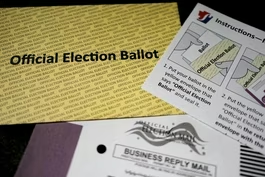
Constitutional law professor on mail-in voting ruling
Video has Closed Captions
Constitutional law professor explains Supreme Court's ruling on mail-in voting (6m 6s)
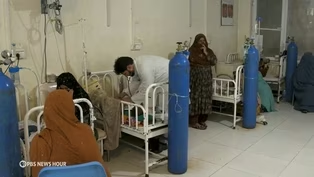
The devastating impact of USAID cuts in rural Afghanistan
Video has Closed Captions
A look at the devastating impact of USAID cuts in rural Afghanistan (12m 10s)

News Wrap: 2 unvaccinated people die from measles in Penn.
Video has Closed Captions
News Wrap: 2 unvaccinated people die from measles in Pennsylvania (6m 15s)

Remembering Dolly Parton's artistry and generosity
Video has Closed Captions
Remembering Dolly Parton, whose artistry and generosity touched generations (8m 53s)

Study finds widespread signs of CTE among former NFL players
Video has Closed Captions
New study reveals widespread signs of brain trauma among former NFL players (6m 57s)
Providing Support for PBS.org
Learn Moreabout PBS online sponsorship
- News and Public Affairs

FRONTLINE is investigative journalism that questions, explains and changes our world.
 New Episode
- News and Public Affairs

Today's top journalists discuss Washington's current political events and public affairs.
 New Episode
 New Episode
 New Episode
 New Episode
 New Episode
 New Episode
 New Episode

 New Episode
 New Episode
Support for PBS provided by:
Major corporate funding for the PBS News Hour is provided by BDO, BNSF, Consumer Cellular, American Cruise Lines, and Raymond James. Funding for the PBS NewsHour Weekend is provided by...